
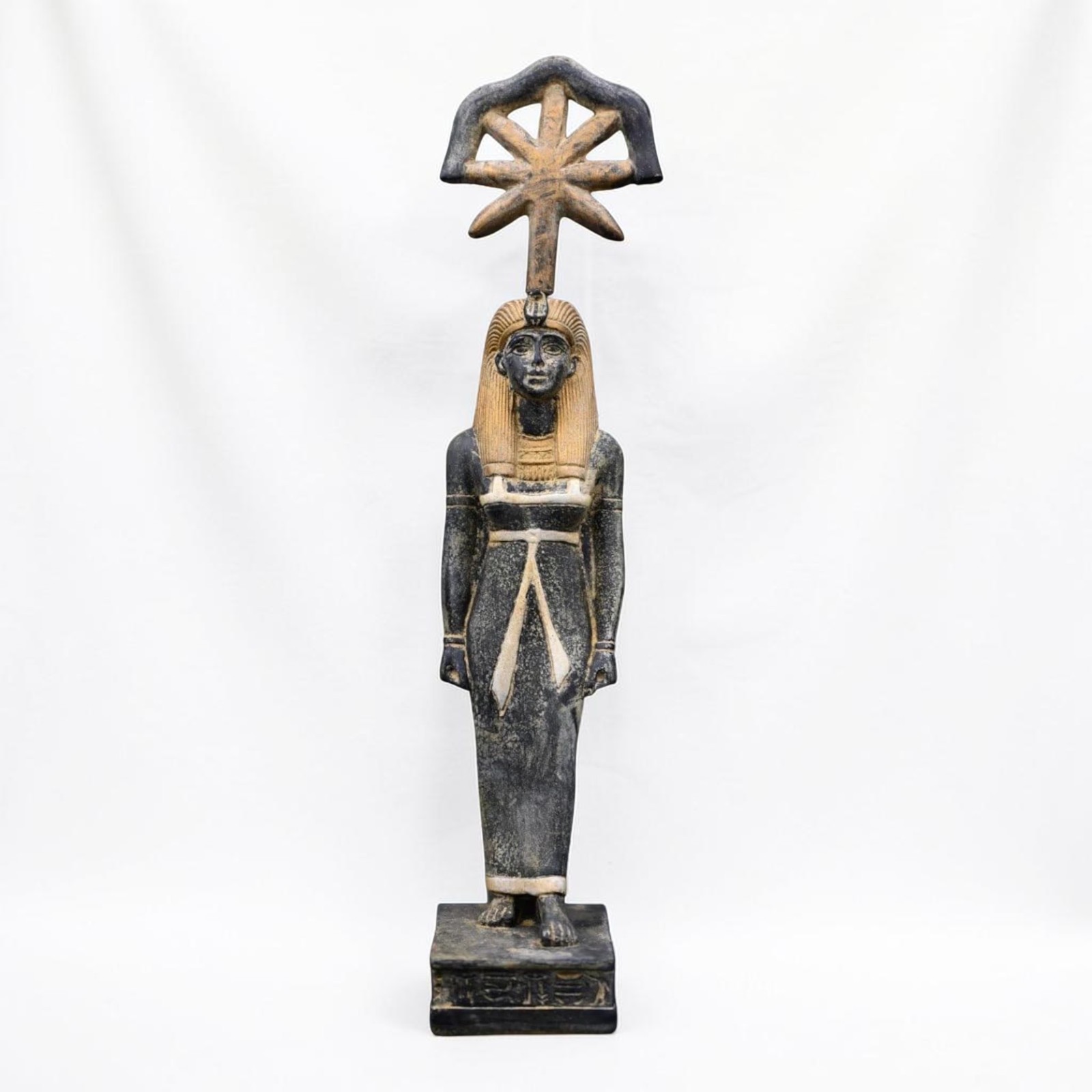
Ancient Egyptian Statue Seshat Goddess Antiques Rare Antique Pharaonic Unique BC For Sale
When you click on links to various merchants on this site and make a purchase, this can result in this site earning a commission. Affiliate programs and affiliations include, but are not limited to, the eBay Partner Network.

Ancient Egyptian Statue Seshat Goddess Antiques Rare Antique Pharaonic Unique BC:
$490.00
Ancient Egyptian Statue Seshat Goddess Antiques Rare Antique Pharaonic Unique BCDescription**Seshat** (also spelled *Seshet*) is an ancient Egyptian goddess associated primarily with **measurement, writing, record-keeping, and the counting of time**—especially the work of priests and scribes. She is often treated as a counterpart or companion to other goddesses and divine figures connected with order, knowledge, and ritual correctness.
In many traditions, Egyptian religion links divine functions to the **cosmic maintenance of maat** (“order, truth, proper balance”). Seshat’s role fits neatly into that worldview: accurate measurement and correct documentation are not just “bureaucracy,” but part of keeping the world functioning properly.
Core domains and responsibilities**Measurement and surveying**Seshat is strongly tied to **measuring instruments and techniques**—the kind of work needed for tasks such as:- laying out architectural/ritual spaces,- determining land boundaries,- ensuring correct alignment and dimensions for temple or ceremonial activity.
That association is part of why she appears in texts and images alongside themes of **precision** and **ritual exactness**: if worship, construction, or calendrical duties are miscalculated, the society (and by extension the cosmos) risks disorder.
**Writing, records, and scribal authority**Seshat is also connected to **writing and documentation**. In Egyptian culture, scribes held tremendous status, because written records were essential for:- taxation and property,- temple administration,- historical memory,- administrative continuity between reigns and generations.
Seshat’s “divine scribal” character elevates these activities: the goddess symbolizes that knowledge and record-keeping can be **inherently sacred**.
**Counting time and regulating the calendar**A major aspect of Seshat is her connection to the **measurement and counting of time**, including how calendars, festivals, and reigns are tracked. This is especially relevant in Egyptian royal ideology, where correct timing strengthens the legitimacy and stability of rule.
In short: Seshat represents the *divine guarantee* that time can be known, counted, and used properly.
Relationship to royal ideology and the “duration” of reignsEgyptian kingship depended on the idea that the pharaoh’s rule was not only powerful but **structured**—anchored in cycles of time and ritual observances.
Seshat is sometimes described in ways that imply she helps determine or record:- the **length of a reign**,- the **chronological order** of years,- and the measured unfolding of a king’s authority.
This connects her to a wider theme in Egyptian religion: the king maintains maat, and maintaining maat includes keeping time correctly.
Iconography: how Seshat is depictedWhile depictions vary by period and context, Seshat is often shown with symbols that communicate her functions, such as:
- **writing implements** (or behaviors associated with scribal activity),- **inscribed or measured elements** (connected to record-keeping and counting),- and visual cues related to **ritual measurement**.
Her overall presentation communicates: *she is the goddess who makes knowledge measurable and records reliable*.
Seshat and other Egyptian goddesses of order/knowledgeEgyptian theology was not a simple “single goddess = single job.” Rather, religious roles overlap. Seshat’s functions can intersect with other figures involved in:- knowledge and learning,- sacred texts and ritual,- the stability of cosmic and social order.
So while Seshat is distinctive for measurement/counting/recording, she belongs to a broader network of divinities whose combined purposes support maat.
Why Seshat matters (religious meaning)To understand Seshat, it helps to remember that in ancient Egypt:- measurement and written records were essential for survival and governance,- ritual correctness depended on accurate timing and exact procedure,- and maintaining cosmic order required humans to “match” divine structure.
Seshat therefore symbolizes more than practical skills. She represents the idea that **accurate knowledge is a sacred force**.
Seshat is an ancient Egyptian goddess chiefly associated with:- **measurement** (including surveying and ritual precision),- **writing and documentation** (scribal authority and record-keeping),- **counting time** (calendar reckoning and chronological order),- and, by extension, the **maintenance of order (maat)** through accurate reckoning and correct ritual administration.Size :Height : 35 cm.Our Guarantee 👌That the Item Will Delivered to You As Shown in Pictures Therefore we recommend that you see the picture well and then take your decision and take your responsibility.
Shipment ✈️
DHL Fast Shipping 4-12 Days with track number - We Offer Combine Shipping 📦
Returns : 🔁I check myself each product and sell only the best quality products. In any case, if you are not satisfied with the product, first, please contact me and I will do everything to your 💯 satisfaction. Related Items:
Ancient Egyptian Antiques Afterlife God Anubis Statue Egyptian Artifact BC
$169.00
COLLECTION of 15 RARE ANCIENT EGYPTIAN PHARAONIC ANTIQUE Amulets (Egypt History)
$152.00
RARE ANCIENT EGYPTIAN ANTIQUE Key Life Scarab Horus Eye Protection Egypt History
$164.81
