
Vintage 1927 Big Four Bond 🚂 Cleveland Cincinnati Chicago St Louis $1000 For Sale
When you click on links to various merchants on this site and make a purchase, this can result in this site earning a commission. Affiliate programs and affiliations include, but are not limited to, the eBay Partner Network.

Vintage 1927 Big Four Bond 🚂 Cleveland Cincinnati Chicago St Louis $1000:
$8.95
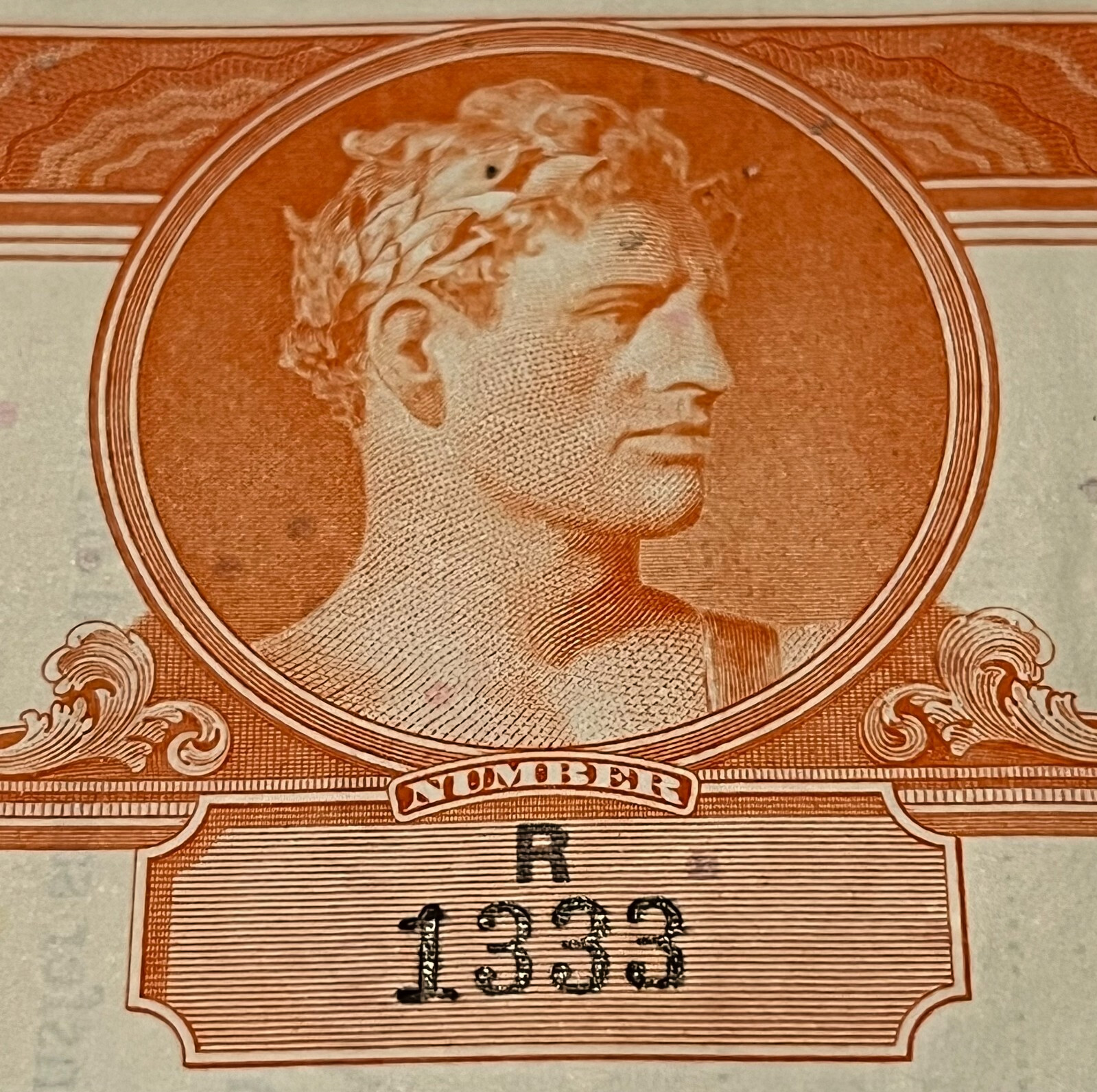
🚂 What did it feel like to hold a piece of the Big Four in your hands?There's a particular kind of paper history that doesn't survive well — the working documents of American business, printed by the thousands and then quietly retired, redeemed, or shredded once their job was done. A railroad bond is exactly that kind of survivor. This one carries the name of the Cleveland, Cincinnati, Chicago and St. Louis Railway Company — the "Big Four" — and it still shows the orange engraved border, the classical laurel-crowned vignette, and the dense legal small print that made these documents feel like serious business the moment they landed on an investor's desk.
🏛️ What This Piece IsThis is a $1,000 Series E Four and One-Half Per Cent Refunding and Improvement Mortgage Bond issued by The Cleveland, Cincinnati, Chicago and St. Louis Railway Company, engraved and printed by the American Bank Note Company. The certificate measures 14 x 9.5 inches (about 35.5 x 24 cm) — a substantial, wall-worthy size that was built to be handled, filed, and kept, not glanced at once and tossed. The design is classic American Bank Note house style: a heavy orange intaglio border worked in fine engine-turned lines and scrollwork, twin "$1000" denomination medallions flanking a central oval vignette of a laurel-wreathed classical head, and beneath it a banner reading "NUMBER" over the certificate's registration panel. The body of the document is dense black letterpress text laying out the terms of the bond — payment in gold coin, semi-annual interest, mortgage security, redemption terms — finished with the engraved signatures of the company's officers. This is a genuine issued bond from the original railway issue, registered and endorsed the way an actively-traded bond is, and cancelled at the end of its run. The item's own printed date reads "Dated the first day of July, 1927," placing this issue squarely in the late 1920s heyday of American railroading — a period when steam still ruled the rails but the industry was already reorganizing under bigger corporate umbrellas.
🛤️ The Big Four Railroad — Four Cities, One RailroadOld-timers in railroad circles will tell you the "Big Four" nickname trips people up constantly — it sounds like it should mean four different railroads banding together, but it was always just one company's nickname, drawn from the four cities baked into its name: Cleveland, Cincinnati, Chicago, and St. Louis. The railroad was formed in 1889 by merging several smaller Midwestern lines — the Cleveland, Columbus, Cincinnati and Indianapolis Railway among them — into one larger system. There's a favorite bit of irony collectors of Big Four paper love to point out: the one city that was part of every single company that merged to create the Big Four in 1889 was Indianapolis — and yet Indianapolis never made it into the railroad's name at all. The company was in fact headquartered in Indianapolis, in the Chesapeake Building on South Meridian Street, even though "Cleveland" led the corporate title.
By the mid-1920s, right around when this bond series was issued, the Big Four was hauling enormous tonnage — grain, coal, manufactured goods, and mail — across a network reaching into Illinois, Indiana, Michigan, and Ohio. For towns along its right-of-way, the Big Four name on a depot sign or a timetable was a lifeline: it meant a connection to Chicago's Loop, to the factories of Cincinnati, to the riverfront wharves of St. Louis. In 1895 the railroad extended its reach further still by acquiring the Big Four Bridge spanning the Ohio River at Louisville, Kentucky — an engineering landmark that, lore among rail historians holds, stood for decades as one of the most photographed river crossings in the region before its railroad use ended and it found new life as a pedestrian span.
🏢 The New York Central ConnectionBy 1906, the Big Four had been acquired by the mighty New York Central Railroad — the Vanderbilt system — which folded it in as a western division while quietly letting the Big Four keep its own corporate identity on paper, tickets, and securities like this one. That's precisely why a bond dated 1927 still carries the full Cleveland, Cincinnati, Chicago and St. Louis Railway Company name and its own set of corporate officers: the railroad was, by then, a Vanderbilt property in every practical sense, but it remained its own legal entity capable of issuing its own mortgage bonds right up until 1930, when the New York Central formally leased the line for 99 years. Collectors of railroad scripophily often point to this exact window — the 1920s — as a sweet spot: bonds from a still-independent-on-paper Big Four, printed with all the ceremony of a standalone railroad, even though everyone in the business understood the New York Central was calling the shots behind the scenes.
🖋️ The American Bank Note Company — Artistry Behind the InkThe engraving on this certificate wasn't incidental — it came from one of the most storied security printers in American history. The American Bank Note Company traced its roots back to 1795 as Murray, Draper, Fairman & Company, and formally took its familiar name in 1858 when seven of the era's leading bank note engraving firms merged in the wake of the financial Panic of 1857. From its New York City headquarters, the firm went on to engrave everything from postage stamps to paper currency for the country's state-chartered banks to, of course, the ornate stock and bond certificates that industrial America ran on. Company lore among collectors credits early ABN engravers with popularizing the use of classical Greek gods and goddesses in the small engraved "vignettes" that decorate documents like this one — a decorative convention meant to project permanence and trustworthiness at a glance, long before anyone worried about photocopiers or scanners. The laurel-crowned head at the top of this bond sits squarely in that classical vignette tradition — a tiny piece of Old World imagery pressed into service to guarantee New World credit.
🌆 The Slow Fade — and What's Left TodayThe Big Four's corporate story didn't end quietly. Its lines were absorbed into Penn Central in 1968 when the New York Central merged with the Pennsylvania Railroad — a merger that famously collapsed into bankruptcy by 1970, one of the largest corporate failures in the country at the time. Many of the old Big Four routes were folded into the government-created Conrail system in 1976, and Conrail itself was eventually split between CSX and Norfolk Southern in the late 1990s. Rail historians note that stretches of the old Big Four right-of-way are still in active freight use today under those successor carriers — meaning that somewhere out there, freight still rolls over rail bed the Big Four laid down generations ago, even though the company's name has long since vanished from the timetables. Old rail yards along the route, still known informally among railfans by their Big Four-era names, are a favorite pilgrimage stop for those tracing the system's footprint today.
🖼️ Display Ideas- 🚂 Frame it solo as the centerpiece of a railroad or transportation-themed wall
- 🗺️ Pair it with a vintage Midwest rail map to show the Big Four's Cleveland-Cincinnati-Chicago-St. Louis reach
- 📷 Group it alongside old depot or steam locomotive photography for an instant "history corner"
- 💼 Display it in a home office or library as a conversation-starting piece of American business history
- 🏛️ Set it in a shadow box with a magnifier nearby so guests can appreciate the fine engraving up close
- 🛋️ Hang it in a den or hallway where the bold orange border reads well from across the room
Scripophily — the collecting of antique stock and bond certificates — draws railroad historians, engraving and printing enthusiasts, Midwest local-history buffs, and anyone drawn to the graphic artistry of pre-digital finance. Big Four and New York Central material in particular appeals to collectors tracing the consolidation of American railroads, while American Bank Note Company engraving is its own specialty niche for those who appreciate the vignette artistry and anti-counterfeiting craftsmanship of the era. It's also a favorite gift for the railfan in the family, or for anyone furnishing a den, office, or train room with genuine period paper rather than a reproduction print.
❓ FAQIs this an original bond certificate, or a reproduction?This is an original, issued bond from the Cleveland, Cincinnati, Chicago and St. Louis Railway Company's own bond printing, engraved by the American Bank Note Company.
What company issued this bond, and is it related to the New York Central?It was issued by the Cleveland, Cincinnati, Chicago and St. Louis Railway Company, nicknamed the "Big Four." The New York Central acquired control of the Big Four in 1906 and operated it as an affiliated line while the Big Four retained its own corporate identity — which is why the railway could still issue bonds under its own name into the late 1920s.
What does "Refunding and Improvement Mortgage Bond" mean?It's a bond secured by a mortgage on the railway's own property, issued to replace ("refund") earlier debt and to help fund ongoing improvements to the line — a standard financing tool for major railroads of the era.
What size is the certificate?It measures 14 x 9.5 inches (about 35.5 x 24 cm), a full-size format that suits standard mat and frame dimensions.
Who engraved and printed it?The American Bank Note Company, one of the premier security printing firms in American history, formed in 1858 from a merger of leading bank note engravers and known for its ornate vignette artistry.
Does the bond still hold financial value?No — this is a collectible historical document reflecting a railroad and financing era long since folded into successor railroads; it's collected for its history, artistry, and provenance rather than any monetary redemption value.
Is every certificate exactly the same?Each carries the same Series E issue design, company name, denomination, and American Bank Note Company engraving common to this issue; individual printed details such as certificate numbers will vary copy to copy.
These are issued instruments rather than blanks. Bonds and debentures of this type were registered to a holder, authenticated by the trustee, and punch- or cut-cancelled when they were finally redeemed. Expect financial writings, markings, stamps, hole punches and staple holes as part of the life of the instrument: endorsements and signatures, trustee and registrar stamps, revenue or documentary tax stamps, cancellation punches, staple holes from being bound into a transfer book, pencil ledger notations. That is the paper trail of a security that actually did its job, and it is what separates a document that lived from a blank that never did. No two are alike: holder details, serial numbers, dates, signatures, stamps and punch patterns vary from example to example, so the photographs show the type rather than the exact sheet that ships.
Related Items:
Vintage Golden West Coffee Tin 1927 Closset & Devers 1 Lb Can Cowboy
$125.00
Vintage 1927 Pacific Steamship Co. Admiral Line Ship Postcard/Menu - SCARCE
$49.95
Vintage 1927 Coca-Cola Delivery Truck made by Danbury Mint Co. in 1995
$75.00
