
Antique Swedish Copper Blancmange Mold HASSELBACKEN Restaurant Wilhelm Davidson For Sale
When you click on links to various merchants on this site and make a purchase, this can result in this site earning a commission. Affiliate programs and affiliations include, but are not limited to, the eBay Partner Network.

Antique Swedish Copper Blancmange Mold HASSELBACKEN Restaurant Wilhelm Davidson:
$495.00
Antique Swedish Tinned Copper Culinary Mold — Hasselbacken Restaurant, Wilhelm Davidson Era, Stockholm, circa 1860–1883
Attributed to the Wilhelm Davidson period; stamped “W. D.” and “HASSELBACKEN.”
A remarkable survivor of Stockholm’s grand dining tradition
Imagine the kitchens behind one of nineteenth-century Stockholm’s celebrated dining destinations: copper utensils catching the light, cooks preparing carefully composed dishes, and a restaurant whose reputation depended as much on presentation as on flavor. This striking copper culinary mold brings that world into tangible view.
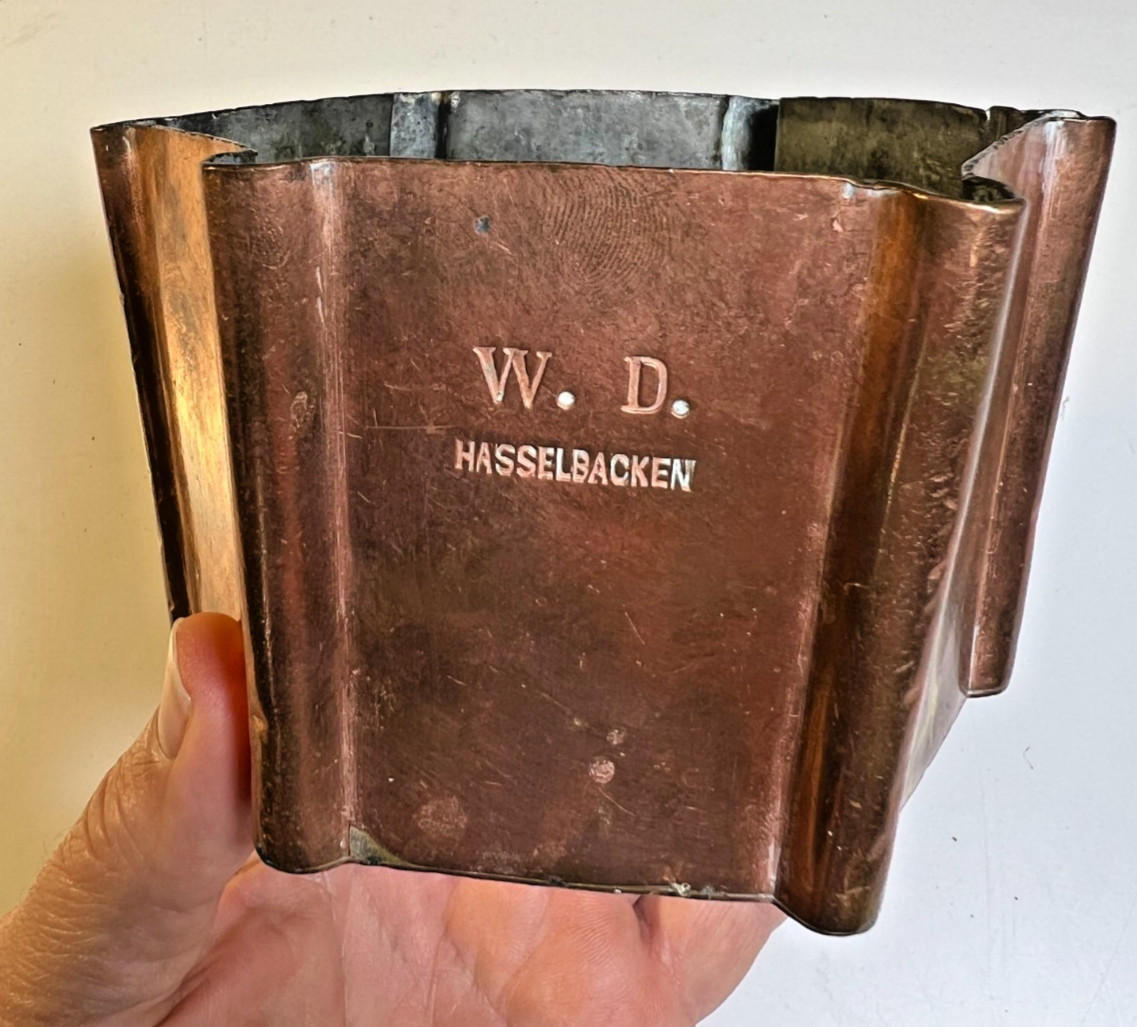
Broad, nearly square panels are interrupted by deeply projecting rounded ribs, creating a sculptural silhouette that looks handsome from every angle. Warm copper, an aged tin-lined interior, and emphatic ownership stamps give the piece a presence far beyond its modest size.
Most compelling are the two markings on its side: large “W. D.” initials above the clearly stamped name “HASSELBACKEN.” The restaurant name provides a direct identifying connection, while the accompanying initials strongly support an attribution to Wilhelm Davidson, the confectioner and restaurateur responsible for Hasselbacken’s nineteenth-century rise.
Here is an object with material beauty, an unusual form, and a named association with an important chapter in Swedish hospitality.
Hasselbacken — Stockholm, Sweden
Situated on Djurgården, Hasselbacken became a distinguished setting for dining and celebration during the nineteenth century. Wilhelm Davidson purchased the property then known as Ludvigsro in 1852 and opened his establishment in 1853.
Swedish archival accounts credit Davidson with introducing luxury into Stockholm’s restaurant culture. His Hasselbacken achieved a reputation extending beyond Sweden, making it an especially evocative name to find stamped into an antique kitchen utensil.
The atmosphere is captured in Claës Lundin’s 1890 account of Stockholm: guests arriving by boat or tram, broad stairs leading into the grounds, dining on the veranda, and views from an upstairs balcony across the surrounding city and water. This was a destination where the setting itself formed part of the occasion.
Against that background, this mold offers a glimpse behind the dining-room doors, into the equipment used to give food its finished appearance.
Wilhelm Davidson and the “W. D.” marking
Jacob Wilhelm Davidson, born in 1812, trained in the confectioner’s trade in Vienna and Stockholm before becoming an influential restaurateur. His background makes a shaped culinary mold a particularly fitting object to associate with his establishment.
Under his direction, Hasselbacken developed a reputation for fine food, carefully selected wines, music, and prestigious gatherings. It hosted celebrations connected with exhibitions, student meetings, and visits by distinguished guests. Davidson died in February 1883, and his sons continued the business.
The paired “W. D.” / “HASSELBACKEN” stamps are the central evidence for the attribution offered here. They are interpreted as restaurant ownership markings associated with Wilhelm Davidson. The proposed date of circa 1860–1883 places the mold within his mature period at Hasselbacken.
The attribution rests on the markings, construction, and historical context. No original purchase invoice or inventory entry accompanies the mold, so its precise manufacturing date remains unverified.
An unusually sculptural culinary form
The mold combines broad, relatively straight walls with pronounced rounded ribs extending outward from the main body. Its flat bottom and absence of a central chimney give it a distinctive profile, while the ribs would impart strong contours to food released from the interior.
Its appeal is immediate even before the markings are examined. The copper alternates between broad reflective panels and curved projections, producing changing highlights and shadows as the piece turns. The form has an almost miniature architectural quality: restrained across the walls, dramatic at the ribs.
The exterior carries visible surface texture, fine scratches, scattered small marks, and mellow copper coloration. Inside, the aged lining contrasts with the warmer exterior. Together, these surfaces convey the character of an old working utensil.
At approximately 12.8 ounces, the piece has substantial weight for its size. The measured metal thickness of approximately **0.039 inch—almost 1 mm—**underscores its solid construction. That measurement describes the substance of the copper; it does not independently establish its age.
What might it have shaped?
A molded jelly, blancmange, or other set dessert is an especially plausible use for this form. Nineteenth-century cookbooks document jellies and blancmanges poured into molds, allowed to set, and turned out onto serving dishes.
The rounded ribs would lend themselves to a decorative presentation, translating the vessel’s unusual outline into a finished dish. Imagine a translucent jelly catching the light or an ivory-colored blancmange taking on the mold’s bold contours, then arranged on a plate for service.
These possibilities fit the broader culinary practices of the period and Davidson’s confectionery background. A savory preparation set in aspic is another possible application. Its specific original recipe is unknown; no kitchen record has been located identifying a dish made in this particular vessel.
“Culinary mold” therefore captures its purpose well, with jelly and set-dessert preparation as plausible uses.
Measurements and materials
- Weight: approximately 12.8 oz / 363 g
- Width across the main walls: approximately 4.25 inches / 10.8 cm
- Maximum width, projecting rib to rib: approximately 5.25 inches / 13.3 cm
- Metal thickness: approximately 0.039 inch / 0.99 mm
- Material: copper body with an aged tin-lined interior
- Form: flat-bottomed vessel with broad panels and projecting rounded ribs
- Marks: “W. D.” above antique piece with visible evidence of age and handling. The photographs show exterior scratches, small dents and irregularities, variation along the rim, and scattered discoloration. The interior lining is darkened, mottled, and visibly worn, with localized greenish discoloration.
Both identifying stamps remain clearly legible and make a strong visual feature of the piece.
Why this piece stands out
Its appeal brings several collecting interests together: antique copper, historic kitchen equipment, Swedish decorative objects, and restaurant memorabilia with a specific named connection.
The unusual silhouette makes it display beautifully, while the stamps reward closer inspection. “HASSELBACKEN” anchors the object to a recognizable establishment; “W. D.” supplies the personal historical clue that makes the Davidson attribution so compelling.
For a collector who values objects that connect craftsmanship with the places where they were used, this is an especially engaging survivor: a substantial little copper vessel carrying the name of a celebrated Stockholm restaurant and the initials attributed to the man who shaped its golden era.
Related Items:
ANTIQUE Dala Horse ORANGE Swedish Folk Art Hand PAINTED Carved Patina 1900s 6"T
$250.00
Antique Johan Engstrom Eskilstuna Swedish Burl Barrel Knife 1882 Working
$85.00
Antique dala horse authentic Dalecarlian Swedish Hemslojd wooden
$42.56
