Château d'If Harbor Scene WWII Era Photograph 1940s Marseille France Sepia For Sale
When you click on links to various merchants on this site and make a purchase, this can result in this site earning a commission. Affiliate programs and affiliations include, but are not limited to, the eBay Partner Network.

Château d'If Harbor Scene WWII Era Photograph 1940s Marseille France Sepia:
$19.99
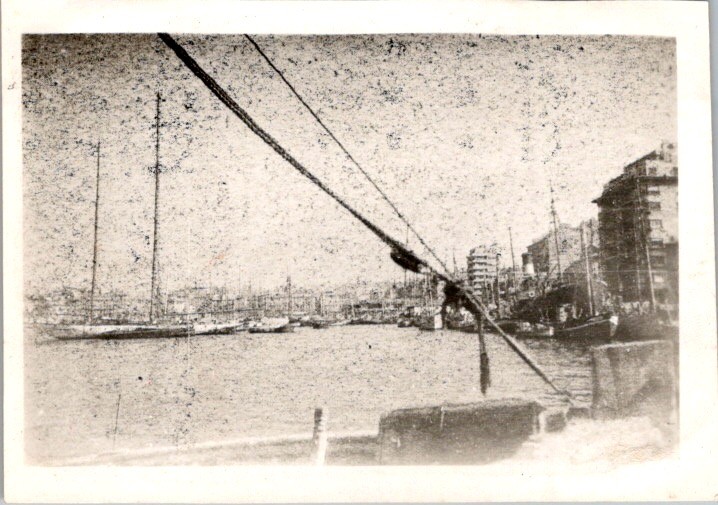
A harbor scene unfolds from the vantage point of a vessel’s deck, its heavy mooring ropes cutting diagonally across the immediate foreground and anchoring the composition in the physicality of the maritime environment. Across the water, a dense assembly of sailing craft rises against a European waterfront, their tall masts forming a delicate lattice against a soft, hazy sky. The built environment beyond is composed of multi-story urban structures, their rooflines and facades rendered with a certain period architectural gravity. The image carries a faded, sepia-toned quality, the result of age and the inherent characteristics of the printing process, with speckling and a loss of contrast that imparts a dreamlike, retrospective atmosphere to the busy port. The dark hull of a substantial vessel is moored close to the quay on the right, its presence adding a note of mass to the otherwise spindly verticals of the other ships' rigging.The reverse of the print bears a handwritten inscription in French, providing a crucial key to the scene's identity: “Mon père m’a trouvé un Château D’If.” This personal annotation, likely written by the American soldier who collected the photograph, identifies the location as the famous island fortress of Château d’If, situated in the Bay of Marseille. The reference to his father finding the image suggests a familial connection or a shared interest in the landmark, perhaps made famous by Alexandre Dumas’s *The Count of Monte Cristo*. The photograph was printed on Agfa Lupex paper, a common stock during the mid-20th century, which, alongside the context of the soldier’s service in Europe during and immediately after World War II, dates the item to the 1940s. The scene offers a glimpse into the post-war travels of a serviceman, capturing a moment of leisure and historical tourism against the backdrop of a continent rebuilding itself. The faint handwritten numeral “25” in the upper corner of the image likely served as an organizational mark within the soldier’s album, a silent index to a personal archive of memory.
Related Items:

