
Jaeger-LeCoultre 8 Days Travel Clock Triple Calendar Art Deco Leather Case 1940s For Sale
When you click on links to various merchants on this site and make a purchase, this can result in this site earning a commission. Affiliate programs and affiliations include, but are not limited to, the eBay Partner Network.

Jaeger-LeCoultre 8 Days Travel Clock Triple Calendar Art Deco Leather Case 1940s:
$1500.00
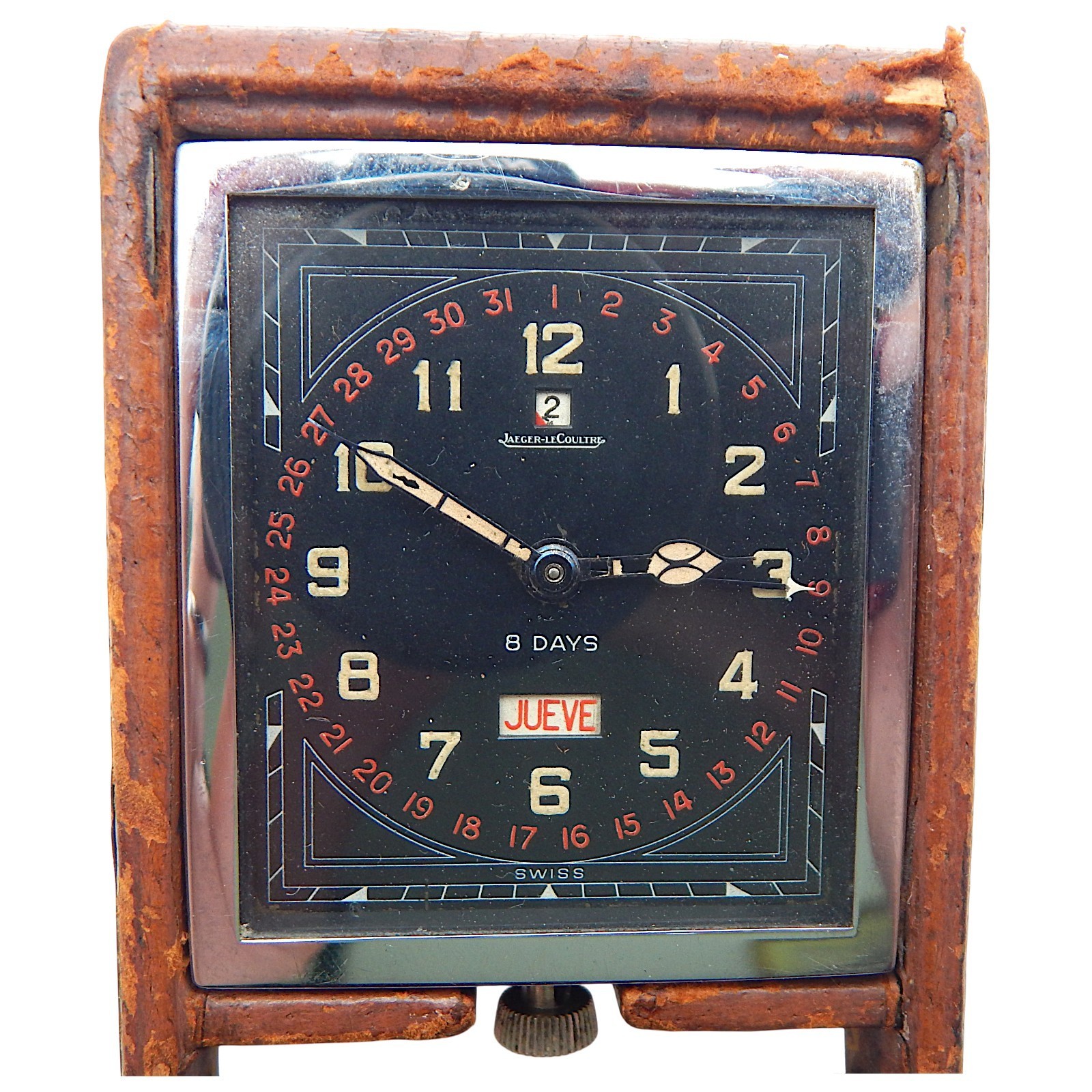
There is a kind of object that tells you everything about the era it came from the moment you open it, and this Jaeger-LeCoultre 8 Days travel clock is exactly that. Closed, it is a slim brown leather folding wallet measuring 55 mm x 85 mm and only 14 mm thick, small enough to disappear into a jacket pocket or the corner of a suitcase. Fold the leather back on itself and the object transforms: the rear flap drops down and becomes an easel, the body tilts up, and in three seconds you have a proper bedside clock standing on a hotel nightstand. That single gesture is the entire idea behind these pieces. Long before quartz alarms and phones, a traveller crossing Europe or South America carried one of these, wound it once a week, and never had to ask anyone the date again.
Using it is genuinely simple, which is part of the charm. The knurled crown sits on the side of the chrome inner case, and it does everything. Wind it clockwise until it stops and the eight-day mainspring is full, so a single winding on Sunday morning carries you through the following Sunday. Pull or push the crown into its setting position and the hands move to the correct hour. The calendar is read on three separate indications: the small square aperture below 12 o'clock shows the month by number, the long slender hand sweeping to the outer red track points to the day of the month from 1 to 31, and the rectangular window above 6 o'clock shows the day of the week. That is what watchmakers call a triple calendar, and on a travel clock of this size it is a genuinely uncommon complication.
The detail that makes this particular example impossible to replace is the day-of-week disc: it is printed in Spanish, currently displaying JUEVE (Jueves, Thursday), truncated by the width of the aperture exactly as it left the factory. Jaeger-LeCoultre supplied these clocks with language-specific discs for their export markets, and Spanish-language examples are dramatically scarcer than the English and French ones that dominate the collector market. If you are building a collection, this is precisely the kind of factory variant that separates a nice example from a piece people remember.
A note on colour, because photographs never fully convey it. The leather is a warm cognac brown that has oxidised over eighty-odd years into something far more interesting than it started: bright rust and burnt-orange across every raised edge and high point, deepening to near-black chocolate in the folds and recesses, with the fine pinpoint grain of the original hide still perfectly visible across the panels. It reads almost like weathered saddle leather or old library binding. Against that, the inner case is bright nickel-chrome with a cool silver-white sheen, and the dial is deep matte black with numerals in a soft aged ivory that has warmed to a light butter tone, punctuated by the vermilion red of the calendar track and the day window. Warm brown, cold silver, black, red and cream — the contrast is the whole visual argument of the piece.
Some context on the maker. Jaeger-LeCoultre traces back to 1833, when Antoine LeCoultre founded his workshop in Le Sentier, deep in the Vallée de Joux, and the house went on to become the movement supplier the rest of Swiss haute horlogerie quietly depended on. The alliance with the Parisian instrument maker Edmond Jaeger gave the firm its double name, and the same period produced its most enduring designs: the Reverso in 1931, the Atmos clock that runs on temperature variation, and this family of eight-day travel clocks that became standard equipment for anyone who travelled well. The Art Deco geometry on this dial, with its stepped corner brackets and fine engine-turned framing, places it firmly in that pre- and immediate post-war window.
Condition and disclosure, stated plainly. The clock has been serviced by our watchmaker and is running and keeping time, with all calendar indications advancing correctly. The chrome case is bright with light surface scratches consistent with use, and the hinged rear panel carries the factory serial 028169 alongside the patent stamp, plus decades of watchmaker service marks scratched inside by hand, which we have deliberately left untouched as part of its history. The dial is original and unrestored, with light ageing to the luminous material. The leather case shows honest wear throughout: surface loss, cracking along the fold, and small tears at the upper corner, all visible in the photographs. This is the original leather case; there is no outer box or papers. Not water resistant and not tested for water resistance. Shipped fully insured with tracking.
Related Items:
Jaeger LeCoultre Model 526-8 ATMOS Mantel Clock TESTED Runs Great (READ)
$695.00
Vintage Jaeger LeCoultre 8-Day Desk Clock Brass Date Window - Running, Swiss
$215.00
Jaeger-LeCoultre No. 354 8-Day Skeleton Table Clock 16 Jewel Baguette w/ Box
$1095.00
