
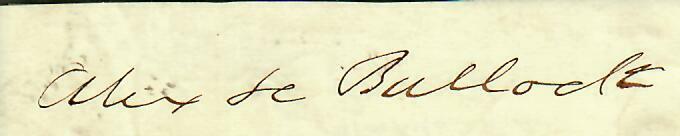
RARE “19th Century Massachusetts Governor" Alexander Bullock Clipped Signature For Sale
When you click on links to various merchants on this site and make a purchase, this can result in this site earning a commission. Affiliate programs and affiliations include, but are not limited to, the eBay Partner Network.

RARE “19th Century Massachusetts Governor" Alexander Bullock Clipped Signature:
$129.99
Up for sale the "26th Massachusetts Gov" Alexander Bullock Clipped Signature.
ES-1751
Alexander Hamilton Bullock (March 2, 1816 –
January 17, 1882) was an American lawyer, politician, and businessman
from Massachusetts. First
a Whig and then a Republican, he
served three terms (1866–69) as the 26th Governor of
Massachusetts. He was actively opposed to the expansion of slavery
before the American Civil War,
playing a major role in the New England Emigrant Aid
Society, founded in 1855 to settle the Kansas Territory with abolitionists. He was for many
years involved in the insurance industry in Worcester, where he also
served one term as mayor. Bullock was educated as a lawyer, and married into
the wealthy Hazard family of arms manufacturers, becoming one the state's
wealthiest men. He served in the state legislature during the war, and was
active in recruiting for the war effort. He was an advocate of temperance,
and of the expansion of railroads in the state. Alexander Hamilton Bullock was
born on March 2, 1816, in Royalston, Massachusetts,
the son of Sarah (Davis) and Rufus Bullock. His father was a merchant and
farmer who also owned a small mill and was active in local politics. He
attended the local schools before going to Leicester Academy. Bullock graduated from Amherst College in 1836 and from Harvard
Law School in 1840. He was then admitted to the Massachusetts
Bar and joined the law practice of Emory Washburn in Worcester. However, he drifted away
from the law, becoming involved in the insurance business as an agent. He
eventually joined the State Mutual Life Assurance Company, which had John Davis as
its first president. In 1842 Bullock became
active in political and public service. He served as a military assistant to
John Davis, who was Governor of Massachusetts that
year, after which he was frequently referred to as "Colonel Bullock".[3] In that year he also became editor of the National
Aegis, a Whig newspaper with which he would remain associated for many
years.
In
1844 Bullock married Elvira Hazard, daughter of Augustus George Hazard of Enfield, Connecticut; they
had three children,[6] including explorer Fanny Bullock Workman.[7] Elvira's father was owner of a major munitions
factory, and upon his death in 1868 the Bullocks inherited a significant
fortune, becoming one of the wealthiest families in the state. Bullock was first
elected to the Massachusetts
House of Representatives as a Whig in 1844, serving until 1848;
for two years he was chairman of the Judiciary Committee. In 1849 he served in
the Massachusetts Senate. In
1854, Bullock became a principal in the New England Emigrant Aid
Company, established by Eli Thayer to send anti-slavery settlers to the Kansas
Territory after the Kansas-Nebraska Act specified
that slavery in the territory was to be determined by popular sovereignty. Bullock received the
Republican Party nomination for governor in 1865 after John A. Andrew decided
not to stand for reelection. Bullock defeated Civil War General Darius Couch in the general election, and served three
consecutive one-year terms. Bullock was a member of an informal group of
Republicans known as the "Bird Club" (for its organizer, paper
magnate Francis W. Bird), which effectively controlled the state Republican
Party organization and dominated the state's elected offices into the 1870s. During
his tenure he improved the state's finances, reducing war-related debts. Bullock
was an outspoken advocate of women's suffrage, although the more conservative
legislature never enacted enabling legislation. He also favored state support
for railroads, signing bills providing loans totalling $6 million to
the Troy and Greenfield
Railroad for the construction of the Hoosac Tunnel in each of his terms. He was also
responsible for hiring Benjamin Latrobe, Jr. to
oversee the work on that troubled project.
One
of the more contentious issues during Bullock's tenure was the state's alcohol
prohibition law, which had been enacted in the 1850s, and which politically
divided the otherwise dominant Republicans. Easing of either the law's strict
rules or their enforcement was regularly debated in the legislature. Bullock,
in contrast to the laissez-faire approach of Andrew before
him, enforced the prohibition law more strictly than any other governor of the
period. This policy was probably responsible for the declining margins of
victory in his three elections.[26] In 1868, legislative proponents of relaxed
rules secured passage of a law abolishing the state police, who were tasked
with the law's enforcement. Bullock vetoed this bill, pointing out that the
state police performed other vital functions. At the same time, a law replacing
abolition with a licensing scheme was passed; Bullock allowed this bill to
become law without his signature. In 1869, a more conservative legislature
restored the previous prohibition statute. Bullock declined to run
for reelection in 1868, promoting Henry L. Dawes as his successor. Opposing Dawes for the
Republican nomination was George F. Loring, a protégé of Benjamin Franklin Butler.
Bullock's mentor Francis Bird worked behind the scenes to secure the nomination
instead for William Claflin, who went
on to win the election.
Related Items:
Rare 19th Century German Luther Family Bible Salesman’s Sample
$200.00
Rare 19th C Antique Civil War Era Black Powder Flask Natural Horn. Great Cond.
$149.99
Rare handcarved Chinese Tortoise shell case & cover, 19th century, Qing Dynastie
$1400.00
