
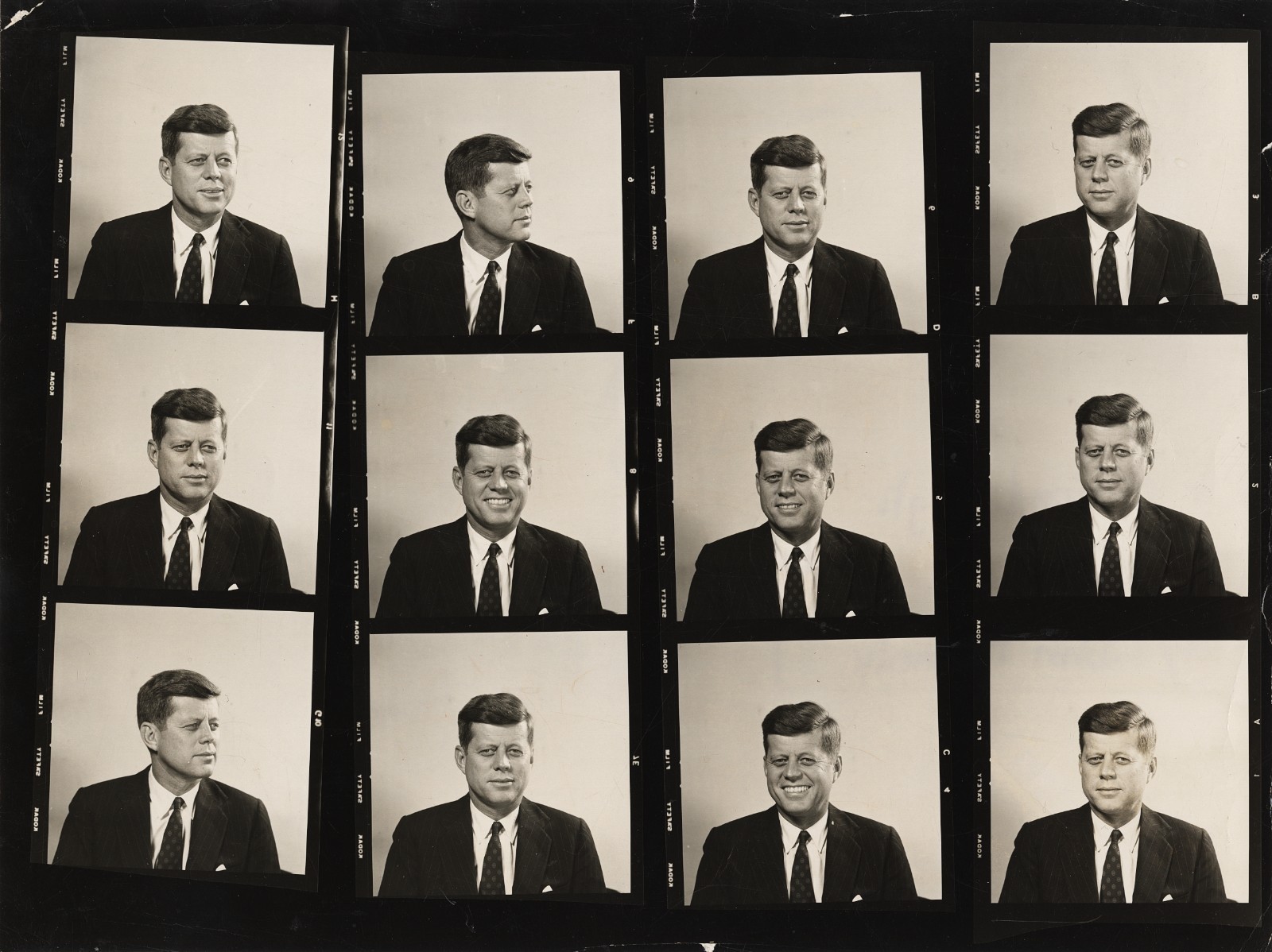
1960 John Fitzgerald Kennedy Contact Sheet Photograph by Ormond Gigli TYPE I For Sale
When you click on links to various merchants on this site and make a purchase, this can result in this site earning a commission. Affiliate programs and affiliations include, but are not limited to, the eBay Partner Network.

1960 John Fitzgerald Kennedy Contact Sheet Photograph by Ormond Gigli TYPE I:
$5000.00
DATE: 1960PHOTOGRAPHER: Ormond Gigli (see bio below)SUBJECT: John Fitzgerald Kennedy (see bio below) taken during his campaign for the United States of America's presidency.PROCESS: Silver GelatinSIZE:10.625" x 8"CONDITION: Creasing. Surface Damage. Edgewear. See photosSHIPPING: Shipping cost is non-negotiable, please consider it when offerding/buying.COMBINED SHIPPING: Yes, I do combine shipping. Additional shipping per item is 20% of the lower shipping cost [For example, if 2 items are purchased that have a $30 and $10 shipping cost each, the combined shipping cost becomes $32 for the 2 items]. If offerding/buying more than 1 item, please wait for an invoice with combined shipping before Gigli (1925–2019) was an American photographer whose versatile career captured the glamour and grit of mid‑20th‑century culture. Born in New York City in 1925, he received his first camera as a teenager and graduated from the School of Modern Photography in 1942. During World War II he served in the U.S. Navy as a photographer, gaining invaluable experience processing and shooting images under pressure.After the war, Gigli apprenticed briefly at the Rapho photo agency. In 1952, a Life editor tapped him to replace Robert Capa for a series of celebrity portraits, and that same year Life sent him to cover the Paris fashion shows—his center‑spread debut cemented his reputation as a fashion photographer. In 1954 he opened a studio on Manhattan’s East 65th Street, where he shot theatre luminaries, dancers, and screen stars. His groundbreaking portraits include early images of Sophia Loren, Anita Ekberg, Marlene Dietrich, Judy Garland, John F. Kennedy, and Marilyn Monroe, many of which appeared on the covers and inside pages of Life, Time, Paris Match, Collier’s, and the Saturday Evening Post.Gigli’s directorial approach to photography—staking out complex, sometimes risky setups and putting subjects at ease—yielded candid yet meticulously composed shots that reveal both persona and process. His 1960 self‑assigned photograph Girls in the Windows (models arranged across the façade of a brownstone opposite his studio) became one of the most collected and highest‑grossing images of all time, illustrating his blend of imaginative staging and technical mastery.In the 1970s and ’80s Gigli expanded into advertising while continuing editorial assignments that took him around the globe. His work has been exhibited at the International Center of Photography and featured in anthologies of fashion and portrait art. Until his passing in 2019, he remained celebrated for a body of work that spans celebrity portraiture, street fashion, and inventive self‑initiated projects—each marked by a rare combination of elegance, empathy, and theatrical November 22, 1963, when he was hardly past his first thousand days in office, John Fitzgerald Kennedy was shot to death as his motorcade wound through Dallas, Texas. Kennedy was the youngest man elected president; he was the youngest to die.Of Irish descent, he was born in Brookline, Massachusetts, son of financier Joseph Kennedy and his wife Rose, on May 29, 1917. Graduating from Harvard in 1940, he entered the Navy. In 1943, when his PT-109 boat was rammed and sunk by a Japanese destroyer, Kennedy, despite injuries, led the survivors through perilous waters to safety.Back from the war, he became a Democratic congressman from Boston, advancing in 1953 to the Senate. He married Jacqueline Bouvier on September 12, 1953. They had a daughter, Caroline, a son, John Jr., and another son, Patrick, who died soon after birth. In 1955, while recuperating from a back operation, he wrote Profiles in Courage, which won the Pulitzer Prize for history.In 1956 Kennedy almost gained the Democratic nomination for vice president, and four years later was a first-ballot nominee for president. Millions watched his television debates with the Republican candidate, Richard Nixon. Winning by a narrow margin in the popular vote, Kennedy became the first Roman Catholic president.His Inaugural Address offered the memorable injunction: “Ask not what your country can do for you—ask what you can do for your country.” As president, he set out to redeem his campaign pledge to get America moving again. After two years of temporizing, Kennedy in 1963 called on Congress to pass a civil rights bill that would desegregate hotels, restaurants, and other public accommodations.His vision also extended to the quality of the national culture and the role of the arts in American society. Jacqueline Kennedy sought to make the White House a world-class museum, saved architectural treasures from the wrecker’s ball, and improved the appearance of Pennsylvania Avenue.President Kennedy wanted America to resume its enduring mission as the first nation dedicated to the preservation of human rights. With the Alliance for Progress and the Peace Corps, he brought American idealism to the aid of developing nations. But the Cold War was still on with a vengeance.Shortly after his inauguration, Kennedy permitted a band of Cuban exiles, already armed and trained, to invade their homeland. The attempt to overthrow the regime of Fidel Castro was a failure. Soon thereafter, the Soviet Union renewed its campaign against West Berlin. Kennedy replied by increasing the nation’s military strength, including new efforts in outer space. Confronted by this reaction, Moscow, after the creation of the Berlin Wall, relaxed its pressure in central Europe.But in the summer of 1962, the Soviets secretly installed nuclear missiles in Cuba. When this was discovered by air reconnaissance in October, Kennedy imposed a quarantine on all offensive weapons bound for Cuba. While the world trembled on the brink of nuclear war, Kennedy initiated secret negotiations and persuaded the Kremlin to take the missiles out in exchange for certain American concessions.Kennedy declared that both sides had a vital interest in stopping the spread of nuclear weapons and slowing the arms race. This led to a partial nuclear test ban treaty in 1963.That November, Kennedy was assassinated, and the world mourned. Americans still remember his charm, wit, bravery, glamour, intelligence, and above all, the potential for future leadership of which the nation was denied.
Related Items:
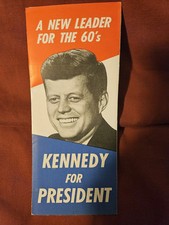
Vintage 1960 John F. Kennedy "NEW LEADER FOR THE 60's" Campaign Brochure
$30.80
1960 John Fitzgerald Kennedy Contact Sheet Photograph by Ormond Gigli TYPE I
$5000.00
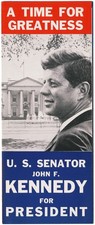
1960 John F. Kennedy TIME FOR GREATNESS Official Campaign Brochure
$19.95
