
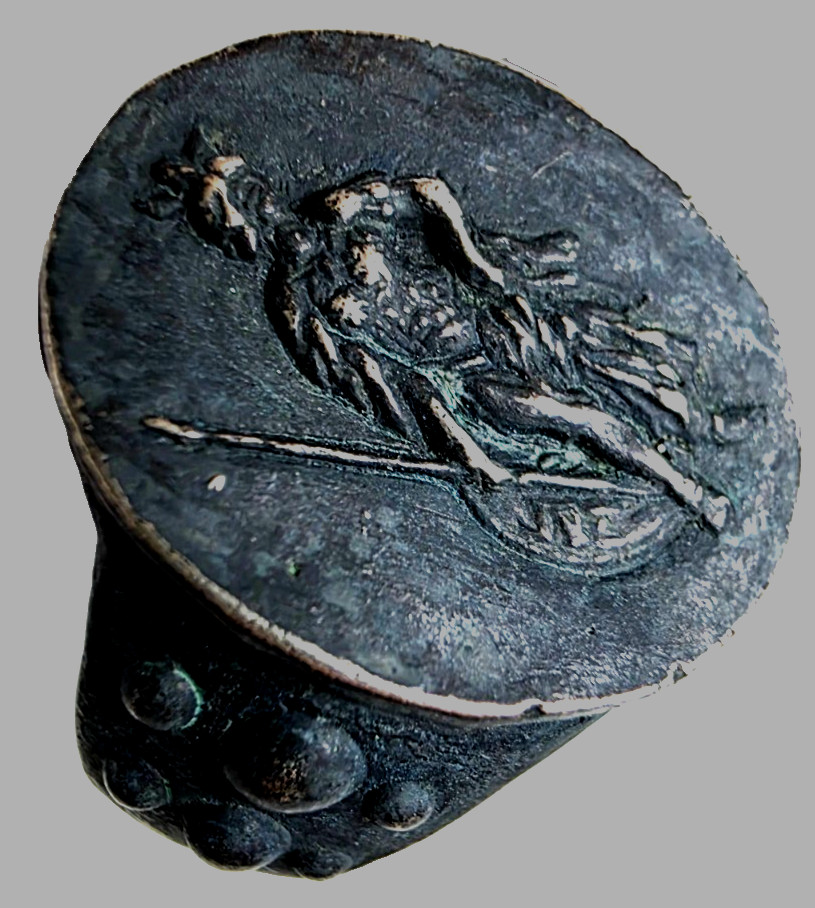
300 BC Ancient Roman Silver Ring Bellona goddess of destructive brutal warfare For Sale
When you click on links to various merchants on this site and make a purchase, this can result in this site earning a commission. Affiliate programs and affiliations include, but are not limited to, the eBay Partner Network.

300 BC Ancient Roman Silver Ring Bellona goddess of destructive brutal warfare:
$560.00
300 BC Ancient Roman Silver Ring Bellona goddess of destructive brutal warfare
Bellona (IPA: [bɛlˈloːna]) is an ancient Roman goddess of war. She is generally characterized as embodying the destructive and brutal side of warfare. Her main attribute is the military helmet worn on her head; she often holds a sword, spear, or shield, and brandishes a torch or whip as she rides into battle in a four-horse chariot. Bellona had many temples throughout the Roman Empire, one of which served as a site for Senate meetings prior to the reign of Augustus. Her iconography was extended by painters and sculptors following the Renaissance. Archaeological evidence confirms that the Bellona dates back to at least the 4th-century BCE, as the earliest mention of this goddess derives from a Campanian patera dating to this period upon which is painted the phrase "Belolai pocolom" ("cup of Bellona"). Given the ritual function of paterae, which were associated with libation, it is likely that this artifact was involved in some religious activity. However, according to Poplacean, due to the near omnipresence of libation throughout Roman religious life, it is difficult to draw any deeper conclusions regarding the function of this cup. Whereas the exact findspot of the artifact is unknown, the classicist Mary Beard argues that the location of its provenance indicates that it was not a dedication, as it was not uncovered within the temple itself. Beard instead suggests that it may have functioned as a temple souvenir, perhaps removed from the site of the temple. The earliest known artistic portrayal of the deity appears upon this cup: It depicts the deity—according to the archaeologist Meghan Poplacean—with a long neck, a "calm" and "demure" expression, hair tied atop her head, and several curls of hair. This portrayal is slightly unusual; in later art, Bellona is almost exclusively depicted with armor, and she largely lacks the unkempt appearance found on this cup. The lines in her hair have been interpreted as representations of snakes, which could indicate early associations between Bellona and the Furies, with whom the goddess was frequently associated in later Imperial art. It is perhaps possible that this design was influenced by the Greek divinity Enyo, with whom Bellona was equated. Poplacean, however, argues that—on this cup—the design of Bellona is unremarkable, and her traits are typical of other 4th-century BCE artistic portrayals of Italian goddesses. According to Poplacean, since such lines appear on numerous other contemporary Italian artworks, it is more likely that they serve as a generic symbol for hair curls rather than any unique characteristic particular to Bellona.Bellona is largely characterized as an embodiment of the carnage and brutality of war. She was identified with Nerio, the consort of the war god Mars, and later with the Greek war goddess Enyo. In the Punica of Silius Italicus, a 1st-century CE Roman author, Bellona is depicted as holding the reins of the chariot of Mars, an image possibly influenced by the role of Enyo as the charioteer of Ares. The 1st-century BCE poet Virgil, in his Aeneid, mentions Bellona as part of an ekphrasis describing the shield of Aeneas: She is—within this passage—mentioned alongside the goddess Discordia. This section of the Aeneid may parallel another verse from Iliad, in which the shield of Achilles is also—in an ekphrasis—associated with chaotic goddesses such as Ker and Eris. However, according to the classicist John Serrati, it is possible that Bellona was not viewed as a wholly negative entity, as—in the prologue to his play Amphitryon—the 3rd-century BCE playwright Plautus lists Bellona alongside Neptune, Virtus, Victoria, and Mars, all of whom were deities with positive connotations. Moreover, Serrati suggests that the Romans did not necessarily view war—and therefore Bellona—as exclusively odious: The word bellum ("war") itself is possibly related to the description of warfare as "bella acta" ("valorous deeds"). Literary depictions of Bellona often emphasize the booming noise and excessive gore accompanying her entry into battle: The 1st-century BCE poet Horace, in his Satires, mentions the "thunder of Bellona, who delights in bloodshed" and Valerius Flaccus, a 1st-century Roman poet, writes "above the open portals appeared Bellona with bare flank, her brazen weapons clanging as she moved." Generally, Bellona and her weapons are covered in blood: Lucan describes the goddess wielding a "bloody whip" ("sanguinem flagellum") and Ovid, a 1st-century BCE Roman author, writes "But their cries are drowned in the clash of arms and the groans of dying men; while Bellona drenches and pollutes with blood the sacred home, and ever renews the strife." According to Serrati, the motif of her blood-soaked weapons may indicate a perception of the goddess as permanently locked in combat, and therefore without the ability to wash away the blood and thus symbolically remove herself from battle. Beside the Temple of Bellona in Rome was the war column (columna bellica), which represented non-Roman territory. To declare war on a distant state, a javelin was thrown over the column by one of the priests concerned with diplomacy (fetiales) in a modification of the archaic practice, from Roman territory toward the direction of the enemy land and this symbolical attack was considered the opening of war. The Temple of Bellona also served as a common location for Senate meetings: Both the 1st-century BCE Roman statesman Cicero and the 1st-century BCE Roman historian Livy utilized the same term—frequens ("filled, frequent")—to describe the gathering of Senators within this location. Poplacean suggests that, in particular, the Temple of Bellona served as the standard site for the discussion of wartime matters by the Roman senate. Moreover, since the site was located outside of the pomerium—a line of demarcation surrounding Rome—it allowed Senators to meet with and award triumphs to generals holding imperium, who were prohibited from entering the crossing the boundaries of the city. Given the various political functions associated with the temple, Poplacean proposes that the Bellona may have overseen the act of initiating and conducting war in Rome. It was under her supervision where war was officially declared, the Senate discussions concerning wartime decisions were held, and the bequeathment or denial of a triumph was granted—an act that, according to Poplacean, was linked to the conclusion of a war in Rome. The involvement of Bellona within Senate activities may imply that the goddess was not exclusively considered a personification of chaos and savagery but instead possessed a more administrative side.Emperor Augustus (r. 27 BCE – 14 CE) constructed the Theatre of Marcellus near the site of the Temple of Bellona, leaving only a narrow opening between the walls of the two structures. Therefore, it is possible that any future triumphal processions were unable to pass through the temple and were instead redirected through the theatre. Moreover, Augustus also decreed that Senate discussions regarding wartime matters or triumphs ought to occur—not in the Temple of Bellona—but in the temple to Mars Ultor, which Augustus himself had constructed. Poplacean suggests that Augustus may have intentionally sought to mitigate the prominence of the temple and its goddess, as Bellona naturally symbolized the prior period of pervasive civil wars during the final decades of the Roman Republic. In contemporary literature, she was frequently associated with failed marriage, itself a common metaphorical symbol denoting war in Roman culture. Two 1st-century BCE poets, Virgil and Ovid, portray Bellona appearing at ill-fated weddings: Virgil depicts Bellona as the bridesmaid ("pronuba") of Lavinia and Ovid describes Bellona appearing at the wedding of Perseus and Andromeda.[33][34] Another Roman author, the 1st-century CE poet Statius, depicts Bellona as a torchbearer at the wedding of Helen. The 1st-century Greek historian Plutarch suggests that the Roman military leader and dictator Sulla—who was himself involved in a civil war—may have propitiated the goddess Bellona. Though, Plutarch also states this goddess may have been Luna or Minerva and was "borrowed from the Cappadocians
This ancient Roman silver ring featuring Bellona, goddess of destructive and brutal warfare, is a unique and authentic piece from the Roman era. Made of solid silver with a metal composition of 890/920, this original Roman style ring is a one-of-a-kind collectible item. With a certificate of authenticity available and a lifetime warranty, this intaglio ring is a rare and valuable addition to any collection. The provenance of this piece from Italy adds to its historical significance and makes it a special decorative item for collectors of ancient Roman artifacts.
Expertise of the materials:SOLID SILVER 890 / 920 :Silver haveauthenticGENUINE OLD PATINA.
MUSEUM GRADE RESTORED
GUARANTEES: We give for buyer a 100%lifetime warrantyfor theuniquenessof this artifactONE OF A KINDEXTREMELYUNIQUE.
CERTIFICATE OF AUTHENTICITY(COA):Below in the listing description,foryour convenience and security, is aCERTIFICATE OF AUTHENTICITY(COA)AVAILABLE.
How to obtain aCOA- Please print the description and photos (Photos of your choice ), from the listing if desired (laminate) and apply theprinted documents and Photos to the item.
The Authenticity of ouritems is guaranteed and protected by our 100% buyer satisfaction guarantee aswell as a guaranteed one hundred percent opportunity to return the item andreceive a full refund of the amount you purchased it for, according to policies.
GUARANTEES: We give for buyer a 100%lifetime warrantyfor theuniquenessof this artifactONE OF A KINDEXTREMELYUNIQUE.
1.Expertise of the materials:SOLID SILVER890 / 920:Silver haveauthenticGENUINE OLD PATINA.
5. GUARANTEES : We give for buyer a 100% lifetime warranty for the uniqueness of this artifact ONE OF A KIND EXTREMELY UNIQUE.
The UNIQUEring is presented in its unaltered condition,with detailing of the features clearly visible, a relatively smooth surface,and a naturally aged patina, deep covered in molted variations of hues andcolours as maintained. If you examine the enlarged photos of this ring, you'll see that it has been meticulouslycrafted with stunning details. I'm confident that you'll be 100% satisfied withthis ring,which is not only a beautiful work of art but also great antiquities. Thank youfor considering our offerings, and we look forward to serving you !!! At ourshop, we take pride in offering a unique collection of Ancient Artifacts ofdiverse cultures from different eras that are truly one-of-a-kind. Many of these items are quite old andrare, and once they are sold, we may not be able to find another one to replaceit. That's why we believe that whoever possesses one of these special rings can be considered to have true pride. Weunderstand that our customers are discerning collectors who appreciate thevalue and significance of these rare artifacts. That's why we make every effortto ensure that our collection is authentic and of the highest quality. Webelieve that owning one of these ringsis not just a matter of acquiring abeautiful object, but also of connecting with a rich cultural tradition thatspans centuries. So if you're looking for a truly unique ring to add to your collection - you are in theright place ! Our inventory represents time-tested investment quality itemswith everlasting decorative beauty. We look forward to your business andappreciate any reasonable offers. All of our curated items are vetted andguaranteed authentic and as described. We only deals in original antiques andnever reproductions. 100% Customer Satisfaction Guaranteed - We are extremelyconfident that all items presented from our collection are genuine antiques.
The photos are part of the descriptionin this Listing!!!Dear Customers, you will receive exactly the same item which you see on thepictures, not similar or other. Please read the description carefully andreview the photos. All items, which I sell, are captured with high -photographic equipment and the photos, which I insert in my sales, are withhigh resolution. The photos are absolutely clear and the potential buyer cantruly identify the item, which purchased. Photos are not further processed byspecialized software! Upon purchase my item, you will receive exactly the sameitem which you saw on the photo !!! The pictures in listing are CLEAR that you can perfectly identify all the details of item !
RETURNS: IF YOU HAVE ANY REASON TO DOUBT A ITEM THAT YOU HAVE PURCHASED, YOU MAYRETURN IT WITHIN14DAYS !!!
Related Items:
300 BC Ancient Roman Silver Ring Bellona goddess of destructive brutal warfare
$560.00
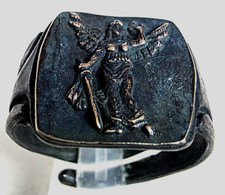
300 BC Ancient Greek Silver Ring Nike goddess victory in battle and contests
$480.00
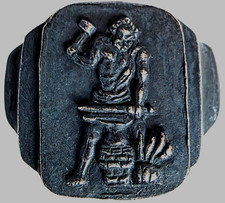
300 BC Ancient Greek Silver Ring Hephaestus god of artisans fire metallurgy
$430.00
