
ABBOTT LAWRENCE,PHILANTROPIST, 1844 LETTER PRAISING BOSTON ENGLISH HIGH SCHOOL For Sale
When you click on links to various merchants on this site and make a purchase, this can result in this site earning a commission. Affiliate programs and affiliations include, but are not limited to, the eBay Partner Network.

ABBOTT LAWRENCE,PHILANTROPIST, 1844 LETTER PRAISING BOSTON ENGLISH HIGH SCHOOL:
$175.00
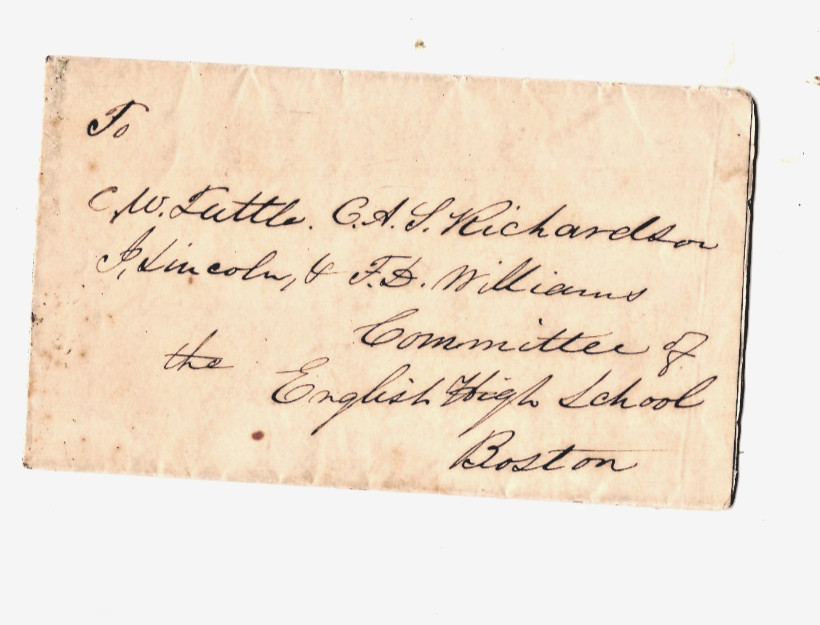
HAD GIVEN A $1000 GIFT TO THE SCHOOL)1844 BOSTON, ABBOTT LAWRENCE ALS TO C.W. TUTTLE C.A.S. RICHARDSONI. LINCOLN + F. D. WILLIAMS COMMITTEE OF THE ENGLISH HIGH SCHOOL BOSTON.ADDRESSING THE SENIOR CLASS, LAWRENCE PRAISES ENGLISH HIGH SCHOOL"....ONE OF THE BEST IN THE WORLD TO PREPARE YOUNG MEN FOR MERCANTILE,MECHANICAL, OR OTHER PRACTICAL PURSUITS OF LIFE.I PRAY YOU OFFER YOUR CLASS-MATES.... AND ACCEPT FOR YOURSELVES THE WARMESTREGARDS WITH WHICH I REMAIN YOUR FRIEND + OBT SERVT ABBOTT LAWRENCE"
ON THE OUTSIDE FLAP OF THE FOLDED LETTER...(SCAN 3)"THIS LETTER IS THE ANSWER TO ONEWAS --- AND PRESENTED BY ----'S CLASS TO A LAWRENCE ESQR (A WEALTHY MERCHANT HERE) WHO GAVE ONE THOUSAND DOLLARS FOR A LIBRARY FOR THE HIGH SCHOOL"
VERY FINE FOLDED LETTER. FIRM, WHITE PAPER.
Abbott Lawrence(December 16, 1792 – August 18, 1855) was an American businessman, politician, and philanthropist. He was among the group of industrialists who founded a settlement on theMerrimack Riverthat would later be named for him,Lawrence, Massachusetts.Portrait by Chester Harding, c. 1842
United States Minister to the United KingdomIn office
October 20, 1849– October 12, 1852President
- Zachary Taylor
- Millard Fillmore
from Massachusetts's 1st districtIn office
March 4, 1839– September 18, 1840Preceded byRichard FletcherSucceeded byRobert Charles WinthropIn office
March 4, 1835– March 3, 1837Preceded byBenjamin GorhamSucceeded byRichard FletcherPersonal detailsBornDecember 16, 1792
Groton, Massachusetts, U.S.DiedAugust 18, 1855 (aged62)
Boston, Massachusetts, U.S.Resting placeMount Auburn CemeteryParty
- National Bigelow (m.1819)RelationsSamuel Lawrence (father)
Amos Lawrence (brother)
Amos Adams Lawrence (nephew)Children1Alma materGroton Lawrence (December 16, 1792 – August 18, 1855) was an American businessman, politician, and philanthropist. He was among the group of industrialists who founded a settlement on the Merrimack River that would later be named for him, Lawrence, Massachusetts.Early life and educationLawrence was born on December 16, 1792, in Groton, Massachusetts, the son of American Revolutionary War officer Samuel Lawrence. He attended Groton Academy, now known as the Lawrence Academy, in Groton.
CareerUpon his graduation in 1808, Lawrence became an apprentice to his brother, Amos, as chief clerk in his brother's firm. On the conclusion of his apprenticeship, in 1814, the Lawrences formed a partnership, specializing in imports from Britain and China, and later expanded their interests to textile manufacturing. Initially called A. & A. Lawrence, the firm later was named A. & A. Lawrence and Co. It continued until Amos's death, and became the greatest wholesale mercantile house in the United States.[citation needed] It was successful even in the hard times of 1812–1815. In 1818, A. &. A Lawrence purchased 50 shares of the Suffolk Bank, a clearinghouse bank on State Street in Boston.[1]
The firm did much for the establishment of the cotton textile industry in New England.[citation needed] In 1830, it came to the aid of financially distressed mills of Lowell, Massachusetts. In that year, the Suffolk, Tremont and Lawrence companies were established in Lowell, and Luther Lawrence, the eldest brother, represented the firm's interests there.[2] When Amos retired from the business in 1831 due to ill health, Abbott became head of the firm. In 1845–1847, the firm established and built up Lawrence, Massachusetts, named in honour of Abbott, who was a director of the Essex Company, which controlled the water power of Lawrence, and later was president of the Atlantic Cotton Mills and Pacific Mill] there. The Lawrence brothers were among the founders of New England's influential textile industry.
In 1819, Abbott Lawrence married Katherine Bigelow, the daughter of Timothy Bigelow and sister of John P. Bigelow.[3] Their daughter, Katherine Bigelow Lawrence, married Augustus Lowell on June 1, 1854.[4]
In the 1820s, Lawrence became a prominent public figure, including as a vocal supporter of railroad construction for economic benefit.[5] He was an ardent protectionist, and represented Massachusetts at the Harrisburg protectionist convention in 1827. Lawrence was highly influential among Massachusetts Whigs.[6] In 1834, he was elected US Representative as a Whig, serving in the 24th Congress. He did not seek re-election in 1836, but was elected again in 1838, serving in the 26th Congress. In 1840, he took an active part in the successful presidential campaign of William Henry Harrison. In 1842, he was appointed commissioner to settle the Northeastern Boundary Dispute between Canada and the United States. In 1844, he supported the campaign of Henry Clay and was a presidential elector. Lawrence was elected a member of the American Antiquarian Society in 1846,[7] and subsequently was also elected a Fellow of the American Academy of Arts and Sciences in 1847.[8]
Portrait of Ambassador Abbott Lawrence by G.P.A. Healy.In 1848, Lawrence was an unsuccessful candidate for party nomination as vice president on the Whig ticket, headed by Zachary Taylor. After Taylor's presidential victory, he offered Lawrence a choice of positions in the administration. Lawrence rejected a cabinet appointment, and chose the post of minister to Great Britain. He was involved in the negotiations of the Clayton–Bulwer Treaty, and resigned in October 1852. He returned to the United States to join the 1852 presidential campaign of Gen. Winfield Scott. However, he grew dissatisfied with the Whig stand on slavery, and abandoned the party.
Lawrence was active in Boston's Unitarian Church and donated money to various causes.[9] He supported Lawrence Academy, affordable housing in Boston, and the Boston Public Library. He also provided $50,000 to establish the Lawrence Scientific School at Harvard College,[9] and provided a similar sum in his will for the School. He died in Boston on August 18, 1855, aged 62, and was interred in Mount Auburn Cemetery, Cambridge, IN 1821, ENGLISH SCHOOL, BOSTON, WAS ONE OF THE FIRST PUBLIC HIGH SCHOOLSIN THE UNITED STATES.From 1844 to 1922, Boston English's building was adjacent and matching on the other side to the structure for the Boston Latin School, first near downtown Boston and then, starting in 1881, in a building (now demolished) on Warren Street in the South End. From 1954 to 1961, Boston English was then at 77 Avenue
The motto of the school has been: "The aim of every English High School boy is to become a man of honor and achievement." The current motto of the school is "Honor, Achievement, Service to Mankind".
Related Items:
ABBOTT LAWRENCE,PHILANTROPIST, 1844 LETTER PRAISING BOSTON ENGLISH HIGH SCHOOL
$175.00
