
Antique 1910s-20s Victory Army & Navy Cigar Label 🦅 Red Lion PA, WWI Patriotic For Sale
When you click on links to various merchants on this site and make a purchase, this can result in this site earning a commission. Affiliate programs and affiliations include, but are not limited to, the eBay Partner Network.

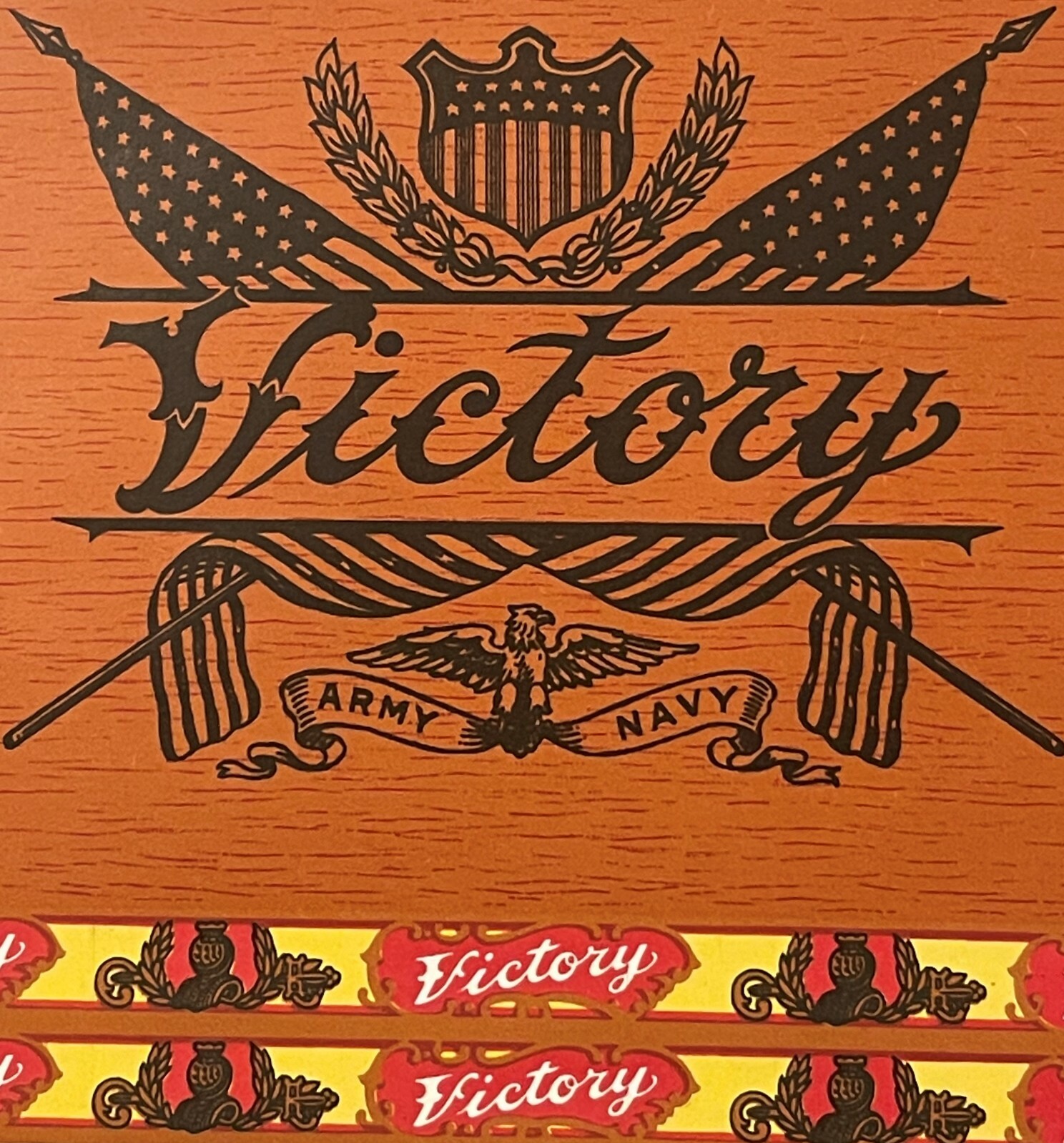
Antique 1910s-20s Victory Army & Navy Cigar Label 🦅 Red Lion PA, WWI Patriotic:
$6.95
🦅 What did it feel like when a small Pennsylvania town rolled ten percent of America's cigars?Size: 10 1/4" x 6 1/4"
There's a particular kind of nostalgia that comes from holding a piece of paper that once meant something to working people — not a museum piece behind glass, but a label that sat in a cigar shop display case or rode the inside of a box lid while somebody's grandfather picked out a smoke to celebrate news from the front. This Victory Army & Navy cigar box label is exactly that kind of survivor: bright, patriotic, unapologetically proud, and tied to a town that most Americans have never heard of but that once perfumed the whole country with cedar and tobacco leaf.
This is an original Victory brand cigar box label, produced by chromolithograph — the layered, hand-engraved color printing process that gave early 20th-century advertising its jewel-box richness. The design centers on a faux-woodgrain field in warm orange and brown, over which two crossed American flags rise behind a stars-and-stripes shield wrapped in a laurel wreath. Below, the word "Victory" sweeps across in bold flowing script, flanked by a second pair of crossed flags, with a spread-winged eagle beneath carrying a ribbon reading "ARMY — NAVY." A decorative border of red-and-yellow "Victory" cartouches frames the whole piece, and a small stock number, B.S.5670, is printed in the upper corner — very likely a lithographer's own catalog or reference number from the era's stock-label system, though its full meaning has faded from record. The piece measures 10 1/4 by 6 1/4 inches and comes to you as New Old Stock (NOS) — meaning this example was never applied to a box, never sold with cigars inside, and has simply waited out the decades as printed. Style and printing convention place it in the 1910s–1920s, the window when Army & Navy patriotic imagery was at its height in American commercial art.
🏭 Red Lion, Pennsylvania: The Cigar Capital Nobody Talks About AnymoreTo understand why a label like this exists at all, you have to understand Red Lion, a small borough in York County, Pennsylvania, that at its peak was arguably the cigar-making capital of the entire world. This wasn't a boutique operation — it was an economy. By 1907, York County was home to some 1,200 cigar factories, rolling an estimated 300 million cigars a year and generating roughly a million dollars in federal tax revenue, an enormous sum for the time. One longtime tobacco merchant, Arthur Meads, recalled that as late as 1927 there were still 109 cigar factories operating in Red Lion alone — and old-timers describe many of them as barely more than a man, his wife, and a child rolling cigars in a basement and selling what they made out the front door.
The town didn't just make cigars — it was built by them. Schools, streets, churches, firehouses, parks, and even the public library were funded and maintained by cigar-industry revenue. Local history sums up the town's brand roster almost like a civic ledger: the nickel cigars paid the wages, certain brands generated the taxes that built the roads, and — as it happens — "Victorys" were named right alongside "Gold Ribbons" as the brands that paid people's mortgages. That's not incidental color; it's a direct historical record that the Victory brand your label comes from was a genuine working product of Red Lion's cigar economy, not a generic novelty name dreamed up elsewhere.
Local legend still holds Red Lion up as a point of civic pride: the town is remembered as having once rolled close to ten percent of all cigars made in the United States, and to this day Red Lion keeps the memory alive with a New Year's Eve tradition — raising a giant cigar instead of a ball to ring in the year, a nod nobody in town has ever let fade.
🦅 W.C. Frutiger & the Birth of a Wartime BrandThe Victory brand traces to the W.C. Frutiger Cigar Company, founded by William Christian Frutiger, who entered the Red Lion cigar trade in the early 1900s. Frutiger's operation ran under federal Factory No. 417, documented as active from roughly 1920 into 1967, and the company manufactured some fifteen different cigar brands over its decades in business — Victory among the best remembered of them. A circa-1927 photograph survives showing workers inside the Frutiger factory, which local histories place on South Charles Street, right where the old Kaltreider Memorial Library parking lot later stood.
What makes the Victory name especially fitting for a piece like this is why it existed at all. Cigar-label researchers note that Frutiger created the Victory brand specifically during the First World War, riding the wave of patriotic sentiment that swept American advertising in that era. Production slowed after the war ended, but — and this is the part collectors find most compelling — when the Second World War erupted, the company revived Victory and began producing it again using the very same wartime-era labels it had used the first time around. Only after WWII finally ended did the brand's popularity fade for good. That means a genuine Victory Army & Navy label like this one belongs to a brand with a life story that spans not one war, but two — created for the doughboys, brought back for the boys overseas a generation later.
The Frutiger name didn't stay confined to the factory floor, either. Family history in Red Lion carried forward for generations — a later Frutiger descendant went on to serve the borough as mayor and sat on its Water Authority, Zoning Board, and Historical Society, having started his own working life at the very cigar factory that put the Victory name on the map.
🎨 Reading the Label: Craft Behind the ColorLabels like this one were the product of a serious commercial art trade. Stone chromolithography allowed printers to lay down flat spot colors and fine engraved linework with a precision that modern buyers still admire — every star on those crossed flags, every feather on the eagle's wing, every curl of the laurel wreath was carved into a separate printing stone and registered by hand. Smaller cigar makers, unable to commission fully custom artwork, often ordered patriotic designs like this straight from a lithographer's catalog of stock images, which is very likely what that small B.S.5670 reference number in the corner represents — a printer's own tracking mark rather than anything tied to a specific cigar box or customer.
The imagery itself is worth lingering over. The crossed, star-spangled flags and laurel-wrapped shield are classic Gilded Age-into-Progressive Era patriotic motifs, drawn from the same visual language as recruiting posters and Grand Army of the Republic ephemera. The eagle bearing an "Army — Navy" ribbon beneath the word "Victory" wasn't subtle — it was designed to be read at a glance from across a cigar counter, a small burst of civic pride sold five cents at a time.
🗺️ The Legacy Red Lion Left BehindRed Lion's cigar boom didn't last forever. Cigarette smoking rose sharply through the 1930s, and increasingly efficient cigar-rolling machinery gradually replaced the small hand operations that had defined the town for decades. The industry that once employed much of Red Lion's population wound down over the following decades, and today no active cigar factories remain in the borough. What's left are the labels — the small, colorful paper survivors of an industry that quite literally built a town, church by church and street by street.
That's part of what makes a piece like this worth holding onto. Every Victory label that survives is a direct physical link to an industry, a family business, and a Pennsylvania town that shaped an era of American working life — a story that's largely faded from public memory outside of York County itself.
🖼️ Display Ideas- Framed alone as a standout piece of early American patriotic advertising art, matted to let the woodgrain background and border breathe
- 🎖️ Grouped with WWI-era medals, service photographs, or discharge papers for a small home military history corner
- 🍸 Hung in a home bar, den, or game room where cigar and tobacco advertising art has always felt right at home
- 📚 Paired with other Red Lion, Pennsylvania cigar-industry ephemera to tell a focused regional history story
- 🎁 Given as a meaningful gift to a veteran, history buff, or anyone building a collection around Army & Navy Americana
- 🏛️ Set alongside other early 20th-century lithographed advertising art for a broader gallery wall of American commercial design
Cigar box label collecting is its own quietly devoted hobby, and pieces like this one tend to draw a few overlapping crowds: collectors of early American advertising art and chromolithography, who prize the engraving and color work as a lost commercial craft; military and patriotic Americana collectors, drawn to the Army & Navy eagle and flag imagery; and regional history collectors with a specific interest in Pennsylvania's cigar-manufacturing heritage, for whom a documented Red Lion brand is a genuine find. It's also a natural pickup for anyone assembling a themed WWI or WWII-era wall display, since the design speaks to both conflicts at once.
❓ FAQIs this label from a box that actually held cigars?No — this is New Old Stock. It was printed for use but never applied to a box or sold with cigars, which is why the artwork and color have kept their strength all these years.
What does "Victory" refer to, exactly?It's the actual brand name of a cigar manufactured by the W.C. Frutiger Cigar Company of Red Lion, Pennsylvania — one of roughly fifteen brands the company produced. It was not a generic name; it was documented as a real, working Red Lion cigar line.
How old is this label?Based on its printing style and the era of Army & Navy patriotic cigar advertising, it dates to the 1910s–1920s. Its design was also documented as reused later for wartime production, so pinning it to an exact year isn't possible — but the range above reflects its true production window.
What does "B.S.5670" mean?It's a stock or reference number printed in the corner, most consistent with a lithographer's own internal catalog numbering rather than a government tax or factory mark. Its exact system has not survived in the historical record.
What size is the label?It measures 10 1/4 by 6 1/4 inches, a substantial size well suited to framing on its own.
Was Red Lion really a major cigar-making town?Yes — at its height, York County housed over a thousand cigar factories, and Red Lion itself is remembered as having produced close to ten percent of all cigars made in the United States, a legacy the town still marks every New Year's Eve.
Why does the design feel tied to two different wars?Because it was. The Victory brand was created during World War I and, according to cigar-industry researchers, was revived using its original wartime labels when World War II began — giving this single design a documented life across both conflicts.
Related Items:
Antique 1910s-20s Buick Automobile Advertising Pinback Pin
$95.00
Antique 1910s-20s Carved Alabaster Lamp Nouveau Grapevine
$300.00
Antique 1910s-20s Victory Army & Navy Cigar Label 🦅 Red Lion PA, WWI Patriotic
$6.95
