
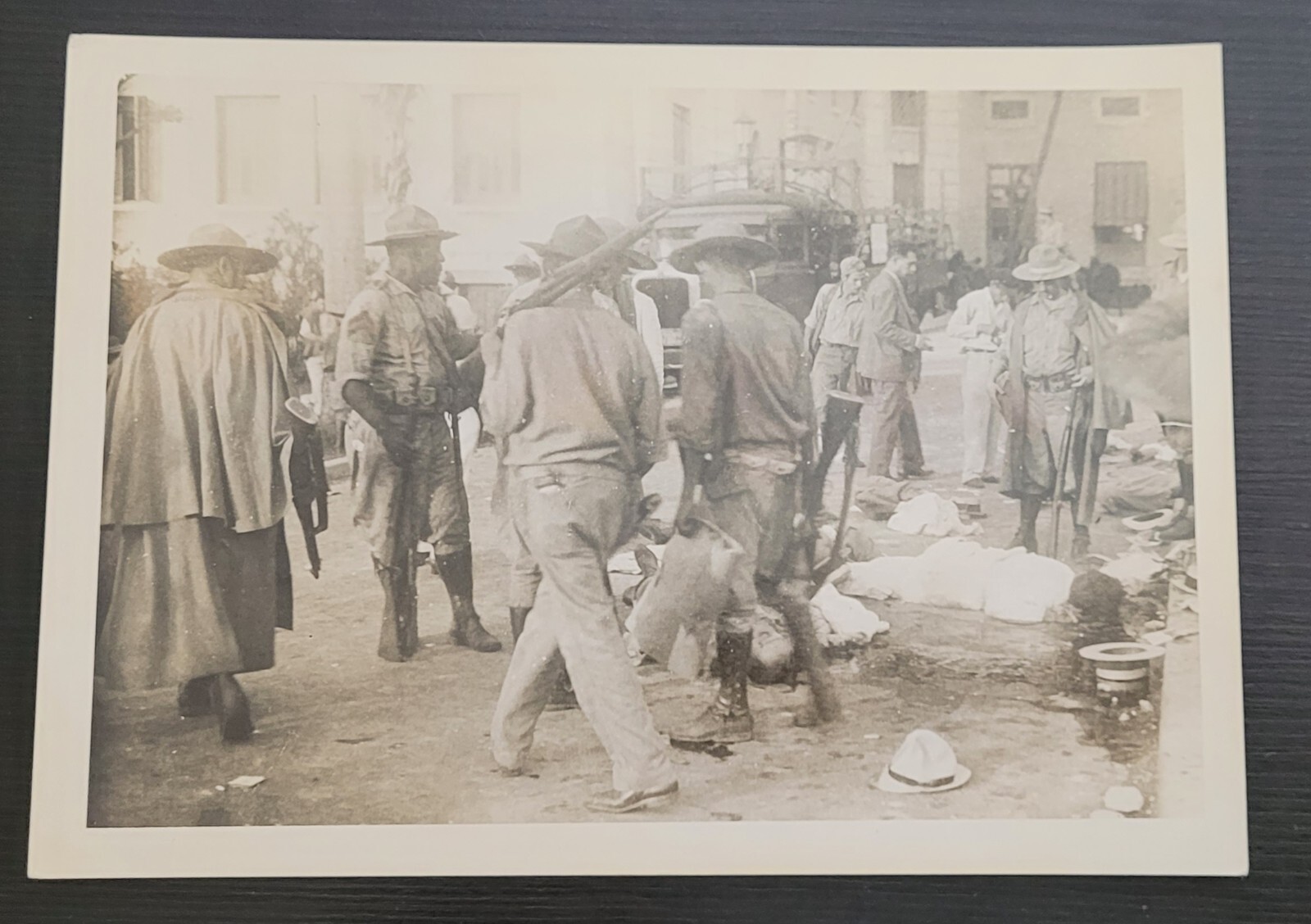
CUBA REVOLUTION 1933 PROTEST ORIGINAL PHOTO Hotel Nacional RARE VINTAGE SHOOTING For Sale
When you click on links to various merchants on this site and make a purchase, this can result in this site earning a commission. Affiliate programs and affiliations include, but are not limited to, the eBay Partner Network.

CUBA REVOLUTION 1933 PROTEST ORIGINAL PHOTO Hotel Nacional RARE VINTAGE SHOOTING:
$312.29
AN EXCEENDLY RARE CUBAN REVOLUTION OF 1933 5X7 INCH PHOTO SHOWS DEAD OFFICERS ON LAWN OF NATIONAL HOTEL AFTER ONSLUAGHT OF SHOOTING FOLLOWING THEIR SURREDERThe Cuban Revolution of 1933 (Spanish: Revolución cubana de 1933), also called the Sergeants' Revolt, was a coup d'etat that occurred in Cuba in September 1933. It began as a revolt of sergeants and enlisted men in the military, who soon allied with student activists in the Directorio Estudiantil Universitario.The coup deposed Carlos Manuel de Céspedes y Quesada as president, installing a new government led by a five-man coalition, known as the Pentarchy of 1933. After only five days, the Pentarchy gave way to the presidency of Ramón Grau, whose term is known as the One Hundred Days Government. The leader of the revolt, Sergeant Fulgencio Batista, became the head of the armed forces and began a long period of influence on Cuban politics.
The Cuban Revolution of 1933 (Spanish: Revolución cubana de 1933), also called the Sergeants' Revolt, was a coup d'etat that occurred in Cuba in September 1933. It began as a revolt of sergeants and enlisted men in the military, who soon allied with student activists in the Directorio Estudiantil Universitario.
The coup deposed Carlos Manuel de Céspedes y Quesada as president, installing a new government led by a five-man coalition, known as the Pentarchy of 1933. After only five days, the Pentarchy gave way to the presidency of Ramón Grau, whose term is known as the One Hundred Days Government. The leader of the revolt, Sergeant Fulgencio Batista, became the head of the armed forces and began a long period of influence on Cuban politics.
BackgroundThe authoritarian policies of Gerardo Machado and the Great Depression beginning in 1929 plunged Cuba into an economic and social crisis, amidst which opposition groups proliferated. Pressure and demonstrations by the Directorio Estudiantil Universitario (Student Directory) and workers, as well by US Ambassador Sumner Welles, forced Machado to resign.[1]
Carlos Manuel de Céspedes y Quesada led a provisional government that included members of the opposition group ABC in its cabinet. Other groups from the Machado opposition were unsatisfied with the provisional government, which to them represented an unacceptable compromise with US interventionism. On August 24, the Student Directory issued a Manifesto-Program that denounced the ABC and made various demands, including the formation of a new government.[2]
MilitaryAfter the fall of Machado, the military perceived its situation as precarious. Opposition forces controlled Havana, and took their revenge on supporters of the Machado regime, including police and some soldiers. The military was reluctant to intervene in this situation lest the public perceive it as an agent of the old regime. Arrest of 50 soldiers and 21 officers did not satisfy demands for reform.[3]
Critics of the Céspedes government, including within the military, charged that it was not taking sufficient action against Machado's backers within the military, and that it had failed to reinstate officers who had opposed Machado.[4] This situation exacerbated longstanding tension (related to age, class, and race) between the ranks of officers.[5]
Conspiracy
Flag used by the revolutionariesA group of sergeants began meeting at the Columbia barracks, forming the Columbia Military Union. Their ambition to improve conditions in the army quickly expanded to a plan for regime change.[6] This group, later called the Junta of the Eight (despite uncertainty about numbers) included Batista and other members of his ABC cell, as well as Pablo Rodríguez, whom some perceived to be the group's leader.[7]
A funeral for Sergeant Miguel Ángel Hernández y Rodríguez, captured and killed by the Machado government in May 1933, took place on 19 August 1933. This gave Batista the opportunity to do a passionate oration which brought him attention as a future leader. At the funeral he met with journalist Sergio Carbó, who acted as an important contact for him in the civilian world.[8]
In August the group of sergeants created a manifesto calling for dignity, respect, and benefits for soldiers, and declaring the duty of soldiers to rebel. Batista asked the ABC, to which he belonged, to publicize the manifesto. The ABC, which had established itself as part of the status quo government, refused, and Batista and others left the group.[9]
Other factions within the military were also plotting against the Céspedes government, and some spoke openly against it.[10]
As the movement grew, the plotters met in larger venues, including the masonic Gran Logia de Cuba and a military hospital.[11] These preparations became somewhat obvious, but meetings continued to occur on the pretext of planning projects to improve quality of life for enlisted men.[12] The action mostly took place in Havana, with some outreach to Matanzas Province soon before the coup.[13]
CoupWe had gained a great deal of confidence; we were on the point of overthrowing Céspedes; and this movement at Camp Columbia might be the vehicle for that overthrow. These circumstances prompted us to get moving. We set out for Columbia to see what was going on, to figure out what we should do, and to see what we could accomplish.When we left for Columbia, we did not even remotely consider — in spite of the psychological determinism that will soon become evident — that the sergeants would constitute the ultimate solution to the military conflict Machado had left behind. Perhaps — we felt more or less subconsciously — this might be an opportunity to bring down the Plattist regime Ambassador Welles had imposed and, after a very brief intermediate step, we might achieve an easy formula of happy adjustment to the apparatus of the state.
Student activist Justo Carrillo[14]On September 3 and 4 some of the lower-ranking officers at Columbia barracks directly raised issues of back pay and promotions with the senior officers.[15] On September 4, Captain Mario Torres Menier appeared at a meeting of the enlisted men at Camp Columbia. Batista allowed him to enter. The soldiers made their complaints with mounting enthusiasm; Torres Menier withdrew to consult with other superior officers. Another meeting was scheduled for 8PM. In the interim, leaders of the coup rallied their supporters. Batista contacted Carbó and secured the support of Juan Blas Hernández, a rebel who opposed Machado for two years.[16]
The meeting that evening took place in a theater. The senior officers had been excluded. Batista spoke from onstage, declaring:
From this moment forward, do not obey anyone's orders but mine. First sergeants must immediately take control of their respective military units. If there is no first sergeant, or if he refuses to take command, the senior sergeant must do so. If there is no sergeant, a corporal. If there is no willing corporal, then a soldier, and if not, then a recruit. The units must have someone in command and he must be an enlisted man.[17]
Thus the sergeants took uncontested control of Columbia barracks and soon established communications with sympathetic officers in other cities. Members of the Student Directory—beginning with José Leyva, Ramiro Valdés Daussá, Juan António Rubio Padilla, Carlos Prío Socarrás, Rubén de León, and Justo Carrillo—came to the barracks and joined forces with the army. While President Céspedes was away from Havana to survey hurricane damage,[18] the rebels forced the remaining government officers in Havana to leave their posts. They then issued a proclamation announcing that they were in control of the country, and set up a Pentarchy modeled on the then-current government of Uruguay.[19]
After President Céspedes returned on September 5, members of the junta arrived at his office and informed him that they were to receive the government from him. Swayed by their claim to command the allegiance of the military rank and file, Céspedes vacated the Presidential Palace.[19][20]
JuntaThe junta of officers and students proclaimed that it had taken power in order to fulfill the aims of the revolution; it briefly described a program which included economic restructuring, punishment of wrongdoers, recognition of public debts, creation of courts, political reorganization, and any other actions necessary to construct a new Cuba based on justice and democracy.[21]
Both Grau and Batista visited Welles on September 5 to seek support from the US and ascertain its position.[22]
Only five days after the coup, Batista and the Student Directory promoted Ramón Grau, one of the members of the Pentarchy, to the role of President, replacing the Pentarchy.[23]
The coup displaced 900 officers from command. Of these, 200 rejoined the armed forces under Batista; 300 went into retirement, exile, or prison; and 400 gathered at the Hotel Nacional, to await a return to power.[24] The sergeants consolidated their power over the military at the Battle of the Hotel Nacional, in which the higher-ranking officers were eliminated. Batista, having pushed Rodríguez out of power, emerged as the foremost leader.[25]
The ensuing One Hundred Days Government issued a number of reformist declarations but never gained diplomatic recognition from the US; it was overthrown in January 1934 under pressure from Batista and the US.[citation needed]
The island of Cuba was inhabited by various Amerindian cultures prior to the arrival of the explorer Christopher Columbus in 1492. After his arrival, Spain conquered Cuba and appointed Spanish governors to rule in Havana. The administrators in Cuba were subject to the Viceroy of New Spain and the local authorities in Hispaniola. In 1762–63, Havana was briefly occupied by Britain, before being returned to Spain in exchange for Florida. A series of rebellions between 1868 and 1898, led by General Máximo Gómez, failed to end Spanish rule and claimed the lives of 49,000 Cuban guerrillas and 126,000 Spanish soldiers.[1] However, the Spanish–American War resulted in a Spanish withdrawal from the island in 1898, and following three-and-a-half years of subsequent US military rule,[2] Cuba gained formal independence in 1902.[3]
In the years following its independence, the Cuban republic saw significant economic development, but also political corruption and a succession of despotic leaders, culminating in the overthrow of the dictator Fulgencio Batista by the 26th of July Movement, led by Fidel Castro, during the 1953–1959 Cuban Revolution.[4] The new government aligned with the Soviet Union and embraced communism.[a] In the early 1960s, Castro's regime withstood invasion, faced nuclear Armageddon,[b] and experienced a civil war that included Dominican support for regime opponents.[c] Following the Warsaw Pact invasion of Czechoslovakia (1968), Castro publicly declared Cuba's support. His speech marked the start of Cuba's complete absorption into the Eastern Bloc.[9] During the Cold War, Cuba also supported Soviet policy in Afghanistan, Poland, Angola, Ethiopia, Nicaragua, and El Salvador.[10] The Cuban economy was mostly supported by Soviet subsidies.
With the dissolution of the USSR in 1991 Cuba was plunged into a severe economic crisis known as the Special Period that ended in 2000 when Venezuela began providing Cuba with subsidized oil. The country has been politically and economically isolated by the United States since the Revolution, but has gradually gained access to foreign commerce and travel as efforts to normalise diplomatic relations have progressed.[11][12][13][14][15] Domestic economic reforms are also beginning to tackle existing economic problems which arose in the aftermath of the special period (i.e. the introduction of the dual currency system).
Pre-Columbian (to 1500)
Taíno women preparing cassava breadCuba's earliest known human inhabitants inhabited the island in the 4th millennium BC.[16] The oldest known Cuban archeological site, Levisa, dates from approximately 3100 BC.[17] A wider distribution of sites date from after 2000 BC, most notably represented by the Cayo Redondo and Guayabo Blanco cultures of western Cuba. These neolithic cultures used ground stone and shell tools and ornaments, including the dagger-like gladiolitos.[18] The Cayo Redondo and Guayabo Blanco cultures lived a subsistence lifestyle based on fishing, hunting and collecting wild plants.[18]
The indigenous Guanajatabey, who had inhabited Cuba for centuries, were driven to the far west of the island by the arrival of subsequent waves of migrants, including the Taíno and Ciboney. These people had migrated north along the Caribbean island chain. The Taíno and Siboney were part of a cultural group commonly called the Arawak, who inhabited parts of northeastern South America prior to the arrival of Europeans. Initially, they settled at the eastern end of Cuba, before expanding westward across the island. The Spanish Dominican clergyman and writer Bartolomé de las Casas estimated that the Taíno population of Cuba had reached 350,000 by the end of the 15th century. The Taíno cultivated the yuca root, harvested it and baked it to produce cassava bread. They also grew cotton and tobacco, and ate maize and sweet potatoes.[19]
Spanish conquest
A watercolor painting of Havana Bay, c. 1639Christopher Columbus, on his first Spanish-sponsored voyage to the Americas in 1492, sailed south from what is now the Bahamas to explore the northeast coast of Cuba and the northern coast of Hispaniola. Columbus, who was searching for a route to India, believed the island to be a peninsula of the Asian mainland.[20][21] Columbus arrived at Cuba on October 27, 1492, and he landed on October 28, 1492, at Puerto de Nipe.[22][23]
During a second voyage in 1494, Columbus passed along the south coast, landing at various inlets including what was to become Guantánamo Bay. With the Papal Bull of 1493, Pope Alexander VI commanded Spain to conquer and convert the pagans of the New World to Catholicism.[24] The Spanish began to create permanent settlements on the island of Hispaniola, east of Cuba, soon after Columbus' arrival in the Caribbean, but the coast of Cuba was not fully mapped by Europeans until 1508, by Sebastián de Ocampo.[25] In 1511, Diego Velázquez de Cuéllar set out from Hispaniola to form the first Spanish settlement in Cuba, with orders from Spain to conquer the island. The settlement was at Baracoa, but the new settlers were greeted with stiff resistance from the local Taíno population. The Taínos were initially organized by cacique (chieftain) Hatuey, who had himself relocated from Hispaniola to escape Spanish rule. After a prolonged guerrilla campaign, Hatuey and successive chieftains were captured and burnt alive, and within three years the Spanish had gained control of the island. In 1514, a south coast settlement was founded in what was to become Havana. The current city was founded in 1519.
Clergyman Bartolomé de las Casas observed a number of massacres initiated by the invaders, notably the massacre near Camagüey of the inhabitants of Caonao. According to his account, some three thousand villagers had traveled to Manzanillo to greet the Spanish with food, and were "without provocation, butchered".[26] The surviving indigenous groups fled to the mountains or the small surrounding islands before being captured and forced into reservations. One such reservation was Guanabacoa, today a suburb of Havana.[27]A monument to the Taíno chieftain Hatuey in Baracoa, CubaIn 1513, Ferdinand II of Aragon issued a decree establishing the encomienda land settlement system that was to be incorporated throughout the Spanish Americas. Velázquez, who had become Governor of Cuba, was given the task of apportioning the land and the indigenous peoples to groups throughout the new colony. The scheme was not a success, however, as the natives either succumbed to diseases brought from Spain such as measles and smallpox, or simply refused to work, preferring to move into the mountains.[22] Desperate for labor for the new agricultural settlements, the Conquistadors sought slaves from surrounding islands and the continental mainland. Velazquez's lieutenant Hernán Cortés launched the Spanish conquest of the Aztec Empire in Cuba, sailing from Santiago to the Yucatán Peninsula.[28] However, these new arrivals also dispersed into the wilderness or died of disease.[22]
Despite the difficult relations between the natives and the new Europeans, some cooperation was in evidence. The Spanish were shown by the natives how to nurture tobacco and consume it as cigars. There were also many unions between the largely male Spanish colonists and indigenous women. Modern studies have revealed traces of DNA that renders physical traits similar to Amazonian tribes in individuals throughout Cuba,[29] although the native population was largely destroyed as a culture and civilization after 1550. Under the Spanish New Laws of 1552, indigenous Cuban were freed from encomienda, and seven towns for indigenous peoples were set up. There are indigenous descendant Cuban (Taíno) families in several places, mostly in eastern Cuba. The local indigenous population also left their mark on the language, with some 400 Taíno terms and place-names surviving to the present day. For example, Cuba and Havana were derived from Classic Taíno, and indigenous words such as tobacco, hurricane and canoe were transferred to English.[27]
Colonial periodFurther information: Slavery in Cuba
A 1736 colonial map by Herman Moll of the West Indies and Mexico, together comprising "New Spain", with Cuba visible in the center.
The fortress of El Morro in Havana, built in 1589
The British Fleet Entering Havana, 21 August 1762, a 1775 painting by Dominic SerresThe Spanish established sugar and tobacco as Cuba's primary products, and the island soon supplanted Hispaniola as the prime Spanish base in the Caribbean.[30] African slaves were imported to work the plantations as field labor. However, restrictive Spanish trade laws made it difficult for Cubans to keep up with the 17th and 18th century advances in processing sugar cane until the Haitian Revolution saw French planters flee to Cuba.[31] Spain also restricted Cuba's access to the slave trade, instead issuing foreign merchants asientos to conduct it on Spain's behalf, and ordered regulations on trade with Cuba. The resultant stagnation of economic growth was particularly pronounced in Cuba because of its great strategic importance in the Caribbean, and the stranglehold that Spain kept on it as a result. Colonial Cuba was a frequent target of buccaneers, pirates and French corsairs. In response to repeated raids, defenses were bolstered throughout the island during the 16th century. In Havana, the fortress of Castillo de los Tres Reyes Magos del Morro was built to deter potential invaders.[32] Havana's inability to resist invaders was dramatically exposed in 1628, when a Dutch fleet led by Piet Heyn plundered the Spanish ships in the city's harbor.[33] In 1662, English pirate Christopher Myngs captured and briefly occupied Santiago de Cuba on the eastern part of the island.[33]
Nearly a century later, the British Royal Navy launched another invasion, capturing Guantánamo Bay in 1741 during the War of Jenkins' Ear. Admiral Edward Vernon saw his 4,000 occupying troops capitulate to raids by Spanish troops, and more critically, an epidemic, forcing him to withdraw his fleet to British Jamaica.[34] In the War of the Austrian Succession, the British carried out unsuccessful attacks against Santiago de Cuba in 1741 and again in 1748. Additionally, a skirmish between British and Spanish naval squadrons occurred near Havana in 1748.[34]
The Seven Years' War, which erupted in 1754 across three continents, eventually arrived in the Spanish Caribbean. In 1762 a British expedition of five warships and 4,000 troops set out from Portsmouth to capture Cuba. The British arrived on 6 June, and by August had Havana under siege.[35] When Havana surrendered, the admiral of the British fleet, George Keppel, entered the city as a new colonial governor and took control of the whole western part of the island. The arrival of the British immediately opened up trade with their North American and Caribbean colonies, causing a rapid transformation of Cuban society.[35] Though Havana, which had become the third-largest city in the Americas, was to enter an era of sustained development and closening ties with North America during this period, the British occupation proved short-lived. Pressure from London sugar merchants fearing a decline in sugar prices forced negotiations with the Spanish over colonial territories. Less than a year after Havana was seized, the Peace of Paris was signed by the three warring powers, ending the Seven Years' War. The treaty gave Britain Florida in exchange for Cuba.[35] In 1781, General Bernardo de Gálvez, the Spanish governor of Louisiana, reconquered Florida for Spain with Mexican, Puerto Rican, Dominican, and Cuban troops.[36] In the 19th century, Cuba became the most important world producer of sugar, thanks to the expansion of slavery and a relentless focus on improving sugar technology. Use of modern refining techniques was especially important because the British Slave Trade Act 1807 abolished the slave trade in the British Empire. The British government set about trying to eliminate the transatlantic slave trade. Under British diplomatic pressure, in 1817 Spain agreed to abolish the slave trade from 1820 in exchange for a payment from London. Cubans rushed to import further slaves in the time legally left to them. Over 100,000 new slaves were imported from Africa between 1816 and 1820.[31] In spite of the new restrictions a large-scale illegal slave trade continued to flourish in the following years.[37] Many Cubans were torn between desire for the profits generated by sugar and a repugnance for slavery. By the end of the 19th century, slavery was abolished.States proposed in the Spanish Draft Federal Constitution of 1873, among which Cuba was included.When Spain opened the Cuban trade ports, it quickly became a popular place. Cubans began to use water mills, enclosed furnaces, and steam engines to produce higher-quality sugar at a much more efficient pace. The boom in Cuba's sugar industry in the 19th century made it necessary for the country to improve its transportation infrastructure. Many new roads were built, and old roads were quickly repaired. Railroads were built relatively early, easing the collection and transportation of perishable sugar cane. By 1860, Cuba was devoted to growing sugar, having to import all other necessary goods. Cuba was particularly dependent on the United States, which bought 82 percent of its sugar. In 1820, Spain abolished the slave trade, hurting the Cuban economy even more and forcing planters to buy more expensive, illegal, and "troublesome" slaves (as demonstrated by the slave rebellion on the Spanish ship Amistad in 1839).[38]
Reformism, annexation, and independence (1800–1898)See also: History of Cuban nationalityIn the early 19th century, three major political currents took shape in Cuba: reformism, annexation and independence. Spontaneous and isolated actions added a current of abolitionism. The 1776 Declaration of Independence by the Thirteen Colonies and the successes of the French Revolution of 1789 influenced early Cuban liberation movements, as did the successful revolt of black slaves in Haiti in 1791. One of the first of such movements in Cuba, headed by the free black Nicolás Morales, aimed at gaining equality between "mulatto and whites" and at the abolition of sales taxes and other fiscal burdens. Morales' plot was discovered in 1795 in Bayamo, and the conspirators were jailed.
Reform, autonomy and separatist movementsAs a result of the political upheavals caused by the Iberian Peninsular War of 1807–1814 and of Napoleon's removal of Ferdinand VII from the Spanish throne in 1808, a western separatist rebellion emerged among the Cuban Creole aristocracy in 1809 and 1810. One of its leaders, Joaquín Infante, drafted Cuba's first constitution, declaring the island a sovereign state, presuming the rule of the country's wealthy, maintaining slavery as long as it was necessary for agriculture, establishing a social classification based on skin color and declaring Catholicism the official religion. This conspiracy also failed, and the main leaders were deported.[39] In 1812 a mixed-race abolitionist conspiracy arose, organized by José Antonio Aponte, a free-black carpenter. He and others were executed.
The Spanish Constitution of 1812, and the legislation passed by the Cortes of Cádiz after it was set up in 1808, instituted a number of liberal political and commercial policies, which were welcomed in Cuba but also curtailed a number of older liberties. Between 1810 and 1814 the island elected six representatives to the Cortes, in addition to forming a locally elected Provincial Deputation.[40] Nevertheless, the liberal regime and the Constitution proved ephemeral: Ferdinand VII suppressed them when he returned to the throne in 1814. By the end of the 1810s, some Cubans were inspired by the successes of Simón Bolívar in South America. Numerous secret-societies emerged, most notably the "Soles y Rayos de Bolívar", founded in 1821 and led by José Francisco Lemus. It aimed to establish the free Republic of Cubanacán, and it had branches in five districts of the island.
In 1823 the society's leaders were arrested and condemned to exile. In the same year, King Ferdinand VII abolished constitutional rule in Spain yet again. As a result, the national militia of Cuba, established by the Constitution and a potential instrument for liberal agitation, was dissolved, a permanent executive military commission under the orders of the governor was created, newspapers were closed, elected provincial representatives were removed and other liberties suppressed.
This suppression, and the success of independence movements in the former Spanish colonies on the North American mainland, led to a notable rise of Cuban nationalism. A number of independence conspiracies developed during the 1820s and 1830s, but all failed. Among these were the "Expedición de los Trece" (Expedition of the 13) in 1826, the "Gran Legión del Aguila Negra" (Great Legion of the Black Eagle) in 1829, the "Cadena Triangular" (Triangular Chain) and the "Soles de la Libertad" (Suns of Liberty) in 1837. Leading national figures in these years included Félix Varela and Cuba's first revolutionary poet, José María Heredia.[41]
Between 1810 and 1826, 20,000 royalist refugees from the Latin American Revolutions arrived in Cuba. They were joined by others who left Florida when Spain ceded it to the United States in 1819. These influxes strengthened loyalist pro-Spanish sentiments.[42]
Antislavery and independence movementsIn 1826 the first armed uprising for independence took place in Puerto Príncipe, led by Francisco de Agüero and Andrés Manuel Sánchez. Both were executed, becoming the first popular martyrs of the Cuban independence movement.[43]
The 1830s saw a surge of activity from the reformist movement, whose main leader, José Antonio Saco, stood out for his criticism of Spanish despotism and of the slave trade. Nevertheless, Cubans remained deprived of the right to send representatives to the Spanish parliament, and Madrid stepped up repression.
Under British diplomatic pressure, the Spanish government had pledged to abolish slavery.[citation needed] In this context, Black revolts in Cuba increased, and were put down with mass executions. One of the most significant was the Conspiración de la Escalera (Ladder Conspiracy) in 1843–1844. The Ladder Conspiracy involved free Black persons and enslaved, as well as white intellectuals and professionals. It is estimated that 300 Black and mixed-race persons died from torture, 78 were executed, over 600 were imprisoned and over 400 expelled from the island.[44][45] José Antonio Saco, one of Cuba's most prominent thinkers, was expelled.[46]Spanish General Arsenio Martínez Campos in Havana, Colonial Cuba, 1878Following the 1868–1878 rebellion of the Ten Years' War, all slavery was abolished by 1886. Slave traders looked for others sources of cheap labour, such as Chinese colonists and Indians from Yucatán. Another feature of the population was the number of Spanish-born colonists, known as peninsulares, who were mostly adult males; they constituted between ten and twenty per cent of the population between the middle of the 19th century and the great depression of the 1930s.
Possibility of annexation by the United StatesSee also: Ostend manifestoBlack unrest and attempts by the Spanish metropolis to abolish slavery motivated many Creoles to advocate Cuba's annexation by the United States, where slavery was still legal. Other Cubans supported the idea due to their desire for American-style economic development and democratic freedom. In 1805, President Thomas Jefferson considered annexing Cuba for strategic reasons, sending agents to the island to negotiate with Captain General Someruelos.
In April 1823, U.S. Secretary of State John Quincy Adams discussed the rules of political gravitation: "if an apple severed by its native tree cannot choose but fall to the ground, Cuba, forcibly disjoined from its own unnatural connection with Spain, and incapable of self-support, can gravitate only towards the North American Union which by the same law of nature, cannot cast her off its bosom".[47] He furthermore warned that "the transfer of Cuba to Great Britain would be an event unpropitious to the interest of this Union".[48] Adams voiced concern that a country outside of North America would attempt to occupy Cuba.[49]
On 2 December 1823, U.S. President James Monroe specifically addressed Cuba and other European colonies in his proclamation of the Monroe Doctrine. Cuba, located just 94 miles (151 km) from Key West, Florida, was of interest to the doctrine's founders, as they warned European forces to leave "America for the Americans".[50]
The most outstanding attempts in support of annexation were made by the Venezuelan filibuster General Narciso López, who prepared four expeditions to Cuba in the US. The first two, in 1848 and 1849, failed before departure due to U.S. opposition. The third, made up of some 600 men, managed to land in Cuba and take the central city of Cárdenas, but failed eventually due to a lack of popular support. López's fourth expedition landed in Pinar del Río province with around 400 men in August 1851; the invaders were defeated by Spanish troops and López was executed.
Struggle for independence
Depiction of an engagement between Cuban rebels and Spanish Royalists during the Ten Years' War (1868–78)In the 1860s, Cuba had two more liberal-minded governors, Serrano and Dulce, who encouraged the creation of a Reformist Party, despite the fact that political parties were forofferden. But they were followed by a reactionary governor, Francisco Lersundi, who suppressed all liberties granted by the previous governors and maintained a pro-slavery regime.[51] On 10 October 1868, the landowner Carlos Manuel de Céspedes declared Cuban independence and freedom for his slaves. This began the Ten Years' War from 1868 to 1878. The Dominican Restoration War (1863–65) brought to Cuba an unemployed mass of former Dominicans who had served with the Spanish Army in the Dominican Republic before being evacuated to Cuba.[52] Some of these former soldiers joined the new Revolutionary Army and provided its initial training and leadership.[52][53]Defense of a train attacked by Cuban insurgentsWith reinforcements and guidance from the Dominicans, the Cuban rebels defeated Spanish detachments, cut railway lines, and gained dominance over vast sections of the eastern portion of the island.[54] The Spanish government used the Voluntary Corps to commit harsh acts against the Cuban rebels, and the Spanish atrocities fuelled the growth of insurgent forces; however, they failed to export the revolution to the west. On 11 May 1873, Ignacio Agramonte was killed by a stray bullet; Céspedes was killed on 27 February 1874. In 1875, Máximo Gómez began an invasion of Las Villas west of a fortified military line, or trocha, bisecting the island.[citation needed] The trocha was built between 1869 and 1872; the Spanish erected it to prevent Gómez to move westward from Oriente province.[55] It was the largest fortification built by the Spanish in the Americas.[56]
Gómez was controversial in his calls to burn sugar plantations to harass the Spanish occupiers. After the American admiral Henry Reeve was killed in 1876, Gómez ended his campaign. By that year, the Spanish government had deployed more than 250,000 troops to Cuba, as the end of the Third Carlist War had freed up Spanish soldiers. On 10 February 1878, General Arsenio Martínez Campos negotiated the Pact of Zanjón with the Cuban rebels, and the rebel general Antonio Maceo's surrender on 28 May ended the war. Spain sustained 200,000 casualties, mostly from disease; the rebels sustained 100,000–150,000 dead and the island sustained over $300 million in property damage.[52] The Pact of Zanjón promised the manumission of all slaves who had fought for Spain during the war, and slavery was legally abolished in 1880. However, dissatisfaction with the peace treaty led to the Little War of 1879–80.
Conflicts in the late 19th century (1886–1900)Main article: Cuban War of IndependenceBackgroundDuring the time of the so-called "Rewarding Truce", which encompassed the 17 years from the end of the Ten Years' War in 1878, fundamental changes took place in Cuban society. With the abolition of slavery in October 1886, former slaves joined the ranks of farmers and urban working class. Most wealthy Cubans lost their rural properties, and many of them joined the urban middle class. The number of sugar mills dropped and efficiency increased, with only companies and the most powerful plantation owners owning them. The numbers of campesinos and tenant farmers rose considerably. Furthermore, American capital began flowing into Cuba, mostly into the sugar and tobacco businesses and mining. By 1895, these investments totalled $50 million. Although Cuba remained Spanish politically, economically it became increasingly dependent on the United States.[57]
These changes also entailed the rise of labour movements. The first Cuban labour organization, the Cigar Makers Guild, was created in 1878, followed by the Central Board of Artisans in 1879, and many more across the island.[58] Abroad, a new trend of aggressive American influence emerged. Secretary of State James G. Blaine placed particular importance on the control of Cuba: "If ever ceasing to be Spanish, Cuba must necessarily become American and not fall under any other European domination".[59]
Martí's Insurrection and the start of the warAfter his second deportation to Spain in 1878, the pro-independence Cuban activist José Martí moved to the United States in 1881, where he began mobilizing the support of the Cuban exile community in Florida.[60] He sought a revolution and Cuban independence from Spain, but also lobbied to oppose U.S. annexation of Cuba. Propaganda efforts by the Cuban Junta continued for years and intensified starting in 1895.[61][62]
After deliberations with patriotic clubs across the United States, the Antilles and Latin America, the Partido Revolucionario Cubano (Cuban Revolutionary Party) was officially proclaimed on 10 April 1892, with the purpose of gaining independence for both Cuba and Puerto Rico. Martí was elected delegate, the highest party position. In Foner's words, "Martí's impatience to start the revolution for independence was affected by his growing fear that the United States would succeed in annexing Cuba before the revolution could liberate the island from Spain".[63]
On 25 December 1894, three ships set sail for Cuba from Fernandina Beach, Florida, loaded with armed men and supplies. Two of the ships were seized by U.S. authorities in early January, but the proceedings went ahead. The insurrection began on 24 February 1895, with uprisings across the island. The uprisings in the central part of the island, such as Ibarra, Jagüey Grande and Aguada, suffered from poor co-ordination and failed; the leaders were captured, some of them deported and some executed. In the province of Havana the insurrection was discovered before it got off and the leaders detained. Thus, the insurgents further west in Pinar del Río were ordered to wait.
Martí, on his way to Cuba, gave the Proclamation of Montecristi in Santo Domingo, outlining the policy for Cuba's war of independence: the war was to be waged by blacks and whites alike; participation of all blacks was crucial for victory; Spaniards who did not object to the war effort should be spared, private rural properties should not be damaged; and the revolution should bring new economic life to Cuba.[59][64]
On 1 and 11 April 1895, the main rebel leaders landed on two expeditions in Oriente: Major Antonio Maceo and 22 members near Baracoa and Martí, Máximo Gómez and four other members in Playitas. Around that time, Spanish forces in Cuba numbered about 80,000, including 60,000 Spanish and Cuban volunteers. The latter were a locally enlisted force that took care of most of the guard and police duties on the island. By December, 98,412 regular troops had been sent to the island and the number of volunteers had increased to 63,000 men. By the end of 1897, there were 240,000 regulars and 60,000 irregulars on the island. The revolutionaries were far outnumbered.[59]
The rebels came to be nicknamed "Mambis" after a black Spanish officer, Juan Ethninius Mamby, who joined the Dominicans in the fight for independence in 1846.[65][66] When the Ten Years' War broke out in 1868, some of the same soldiers were assigned to Cuba, importing what had by then become a derogatory Spanish slur. The Cubans adopted the name with pride.[67]
After the Ten Years' War, possession of weapons by private individuals was prohibited in Cuba. Thus, one of the most serious and persistent problems for the rebels was a shortage of suitable weapons. This lack of arms forced them to utilise guerrilla tactics, using the environment, the element of surprise, fast horses and simple weapons such as machetes. Most of their firearms were acquired in raids on the Spaniards. Between 11 June 1895 and 30 November 1897, 60 attempts were made to bring weapons and supplies to the rebels from outside Cuba, but only one succeeded, largely due to British naval protection.[59]
Escalation of the war
Rebel leaders engaged in extensive propaganda to get the U.S. to intervene, as shown in this cartoon in an American magazine. Columbia (the American people) reaches out to help oppressed Cuba in 1897 while Uncle Sam (the U.S. government) is blind to the crisis and will not use its powerful guns to help. Judge magazine, 6 February 1897.Martí was killed on 19 May 1895, but Máximo Gómez (a Dominican) and Antonio Maceo (a mulatto)[68] fought on. Gómez used scorched-earth tactics, which entailed dynamiting passenger trains and burning the Spanish loyalists' property and sugar plantations—including many owned by Americans.[69] By the end of June all of Camagüey was at war. Continuing west, Gómez and Maceo joined up with veterans of the 1868 war, Polish internationalists, General Carlos Roloff and Serafín Sánchez in Las Villas. In mid-September, representatives of the five Liberation Army Corps assembled in Jimaguayú to approve the Jimaguayú Constitution. This constitution established a central government, which grouped the executive and legislative powers into one entity, the Government Council, which was headed by Salvador Cisneros and Bartolomé Masó.
After a period of consolidation in the three eastern provinces, the liberation armies headed for Camagüey and then for Matanzas, outmanoeuvring and deceiving the Spanish Army. The revolutionaries defeated the Spanish general Arsenio Martínez Campos and killed his most trusted general at Peralejo. Campos tried the same strategy he had employed in the Ten Years' War, constructing a broad defensive belt across the island, about 80 kilometres (50 mi) long and 200 metres (660 ft) wide. This line, called the trocha, was intended to limit rebel activities to the eastern provinces, and consisted of a railroad, from Jucaro in the south to Moron in the north, on which armored railcars could travel. At various points along this railroad there were fortifications, posts and barbed wire; booby traps were placed at the locations most likely to be attacked.
For the rebels, it was essential to bring the war to the western provinces of Matanzas, Havana and Pinar del Río, where the island's government and wealth was located.[59] In a successful cavalry campaign, overcoming the trochas, the rebels invaded every province. Surrounding all the larger cities and well-fortified towns, they arrived at the westernmost tip of the island on 22 January 1896.[70][71]Cuban victims of Spanish reconcentration policies
Human skulls and bones in Havana Harbor, 1898. An estimated 225,000 Cubans died in Spanish concentration camps.[72][discuss]Unable to defeat the rebels with conventional military tactics,[73] the Spanish government sent Gen. Valeriano Weyler y Nicolau (nicknamed The Butcher), who reacted to these rebel successes by introducing terror methods: periodic executions, mass exiles, and the destruction of farms and crops. These methods reached their height on 21 October 1896, when he ordered all countryside residents and their livestock to gather in various fortified areas and towns occupied by his troops. Hundreds of thousands of people had to leave their homes, creating appalling conditions of overcrowding. This was the first recorded and recognized use of concentration camps where non-combatants were removed from their land to deprive the enemy of succor and then the internees were subjected to appalling conditions.[74] It is estimated that this measure caused the death of at least one-third of Cuba's rural population.[75] The forced relocation policy was maintained until March 1898.[59]
Since the early 1880s, Spain had also been suppressing an independence movement in the Philippines, which was intensifying; Spain was thus now fighting two wars, which placed a heavy burden on its economy. In secret negotiations in 1896, Spain turned down the United States' offers to buy Cuba.
Maceo was killed on 7 December 1896.[76] As the war continued, the major obstacle to Cuban success was weapons supply. Although weapons and funding came from within the United States, the supply operation violated American laws, which were enforced by the U.S. Coast Guard; of 71 resupply missions, only 27 got through.[77]
In 1897, the liberation army maintained a privileged position in Camagüey and Oriente, where the Spanish only controlled a few cities. Spanish liberal leader Praxedes Sagasta admitted in May 1897: "After having sent 200,000 men and shed so much blood, we don't own more land on the island than what our soldiers are stepping on".[78] The rebel force of 3,000 defeated the Spanish in various encounters, such as the battle of La Reforma and the surrender of Las Tunas on 30 August, and the Spaniards were kept on the defensive.
As stipulated at the Jimaguayú Assembly two years earlier, a second Constituent Assembly met in La Yaya, Camagüey, on 10 October 1897. The newly adopted constitution decreed that a military command be subordinated to civilian rule. The government was confirmed, naming Bartolomé Masó as president and Domingo Méndez Capote as vice president. Thereafter, Madrid decided to change its policy toward Cuba, replacing Weyler, drawing up a colonial constitution for Cuba and Puerto Rico, and installing a new government in Havana. But with half the country out of its control, and the other half in arms, the new government was powerless and rejected by the rebels.
USS Maine incident
The wreckage of the USS Maine, photographed in 1898The Cuban struggle for independence had captured the North American imagination for years and newspapers had been agitating for intervention with sensational stories of Spanish atrocities. Americans came to believe that Cuba's battle with Spain resembled the United States's Revolutionary War. North American public opinion was very much in favor of intervening for the Cubans.[79]
In January 1898, a riot by Cuban-Spanish loyalists against the new autonomous government broke out in Havana, leading to the destruction of the printing presses of four local newspapers which published articles critical of the Spanish Army. The U.S. Consul-General cabled Washington, fearing for the lives of Americans living in Havana. In response, the battleship USS Maine was sent to Havana. On 15 February 1898, the Maine was destroyed by an explosion, killing 268 crewmembers. The cause of the explosion has not been clearly established, but the incident focused American attention on Cuba, and President William McKinley and his supporters could not stop Congress from declaring war to "liberate" Cuba. In an attempt to appease the United States, the colonial government ended the forced relocation policy and offered negotiations with the independence fighters. However, the truce was rejected by the rebels and the concessions proved too late. Madrid asked other European powers for help; they refused.
On 11 April 1898, McKinley asked Congress for authority to send U.S. Armed Forces troops to Cuba for the purpose of ending the civil war. On 19 April, Congress passed joint resolutions supporting Cuban independence and disclaiming any intention to annex Cuba, demanding Spanish withdrawal, and authorizing military force to help Cuban patriots gain independence. This included from Senator Henry Teller the Teller Amendment, which passed unanimously, stipulating that "the island of Cuba is, and by right should be, free and independent".[80] The amendment disclaimed any intention on the part of the United States to exercise jurisdiction or control over Cuba for other than pacification reasons. War was declared on 20/21 April 1898.
Cuban Theatre of the Spanish–American WarMain article: Spanish–American War
Destruction of Admiral Cervera's Spanish Fleet off Santiago de Cuba. 1898.Hostilities started hours after the declaration of war when a U.S. contingent under Admiral William T. Sampson blockaded several Cuban ports. The Americans decided to invade Cuba in Oriente where the Cubans were able to co-operate. The first U.S. objective was to capture the city of Santiago de Cuba to destroy Linares' army and Cervera's fleet. To reach Santiago they had to pass through concentrated Spanish defences in the San Juan Hills. Between 22 and 24 June 1898 the Americans landed under General William R. Shafter at Daiquirí and Siboney and established a base. The port of Santiago became the main target of U.S. naval operations, and the American fleet attacking Santiago needed shelter from the summer hurricane season. Nearby Guantánamo Bay was chosen for this purpose and attacked on 6 June. The Battle of Santiago de Cuba, on 3 July 1898, was the largest naval engagement during the Spanish–American War, and resulted in the destruction of the Spanish Caribbean Squadron.
Resistance in Santiago consolidated around Fort Canosa,[81] while major battles between Spaniards and Americans took place at Las Guasimas on 24 June, and at El Caney and San Juan Hill on 1 July,[82] after which the American advance ground to a halt. Spanish troops successfully defended Fort Canosa, allowing them to stabilize their line and bar the entry to Santiago. The Americans and Cubans began a siege of the city,[83] which surrendered on 16 July after the defeat of the Spanish Caribbean Squadron. Thus, Oriente fell under the control of Americans and the Cubans, but U.S. General Nelson A. Miles would not allow Cuban troops to enter Santiago, claiming that he wanted to prevent clashes between Cubans and Spaniards. Cuban General Calixto García, head of the mambi forces in the Eastern department, ordered his troops to hold their areas and resigned, writing a letter of protest to General Shafter.[80]
After losing the Philippines and Puerto Rico, which had also been invaded by the United States, Spain sued for peace on 17 July 1898.[84] On 12 August, the U.S. and Spain signed a protocol of peace, in which Spain agreed to relinquish Cuba.[85] On 10 December 1898, the U.S. and Spain signed the formal Treaty of Paris, recognizing continuing U. S. military occupation.[86] Although the Cubans had participated in the liberation efforts, the United States prevented Cuba from sending representatives to the Paris peace talks or signing the treaty, which set no time limit for U.S. occupation and excluded the Isle of Pines from Cuba.[87] Although the U.S. president had no objection to Cuba's eventual independence, U.S. General William R. Shafter refused to allow Cuban General Calixto García and his rebel forces to participate in the surrender ceremonies in Santiago de Cuba.
U.S. occupation (1898–1902)Main article: United States Military Government in CubaAfter the last Spanish troops left the island in December 1898, the government of Cuba was temporarily handed over to the United States on 1 January 1899. The first governor was General John R. Brooke. Unlike Guam, Puerto Rico, and the Philippines, the United States did not annex Cuba because of the restrictions imposed in the Teller Amendment.[88]
Political changesThe U.S. administration was undecided on Cuba's future status. Once it had been pried away from the Spaniards it was to be assured that it moved and remained in the U.S. sphere. How this was to be achieved was a matter of intense discussion and annexation was an option. Brooke set up a civilian government, placed U.S. governors in seven newly created departments, and named civilian governors for the provinces as well as mayors and representatives for the municipalities. Many Spanish colonial government officials were kept in their posts. The population were ordered to disarm and, ignoring the Mambi Army, Brooke created the Rural Guard and municipal police corps at the service of the occupation forces. Cuba's judicial powers and courts remained legally based on the codes of the Spanish government. Tomás Estrada Palma, Martí's successor as delegate of the Cuban Revolutionary Party, dissolved the party a few days after the signing of the Paris Treaty. The revolutionary Assembly of Representatives was also dissolved.[89]
Economic changesBefore the United States officially took over the government, it had already begun cutting tariffs on American goods entering Cuba, without granting the same rights to Cuban goods going to the United States.[90] Government payments had to be made in U.S. dollars.[87] The Foraker Amendment prohibited the U.S. occupation government from granting privileges and concessions to American investors, to appease anti-imperialists during the occupational period. Despite this, the Cuban economy was soon dominated by American capital.[90] By 1905 nearly 10% of Cuba's land area belonged to Americans. By 1902, American companies controlled 80% of Cuba's ore exports and owned most of the sugar and cigarette factories.[91]
Immediately after the war, there were several serious barriers for foreign businesses attempting to operate in Cuba. The Joint Resolution of 1898, the Teller Amendment, and the Foraker Amendment threatened foreign investment. Eventually, Cornelius Van Horne of the Cuba Company, an early railroad company in Cuba, found a loophole in "revocable permits" justified by preexisting Spanish legislation that effectively allowed railroads to be built in Cuba. General Leonard Wood, the governor of Cuba and a noted annexationist, used this loophole to grant hundreds of franchises, permits, and other concessions to American businesses.[92]
Once the legal barriers were overcome, American investments transformed the Cuban economy. Within two years of entering Cuba, the Cuba Company built a 350-mile railroad connecting the eastern port of Santiago to the existing railways in central Cuba. The company was the largest single foreign investment in Cuba for the first two decades of the twentieth century. By the 1910s it was the largest company in the country.[93] The improved infrastructure allowed the sugar cane industry to spread to the previously underdeveloped eastern part of the country. As many small Cuban sugar cane producers were crippled with debt and damages from the war, American companies were able to quickly and cheaply take over the industry. At the same time, new productive units called centrales could grind up to 2,000 tons of cane a day making large-scale operations most profitable.[94] The large fixed cost of these centrales made them almost exclusively accessible to American companies with large capital stocks. Furthermore, the centrales required a large, steady flow of cane to remain profitable, which led to further consolidation. Cuban cane farmers who had formerly been landowners became tenants on company land. By 1902, 40% of the country's sugar production was controlled by Americans.[95]
With American corporate interests firmly rooted in Cuba, the U.S. tariff system was adjusted accordingly to strengthen trade between the nations. The Reciprocity Treaty of 1903 lowered the U.S. tariff on Cuban sugar by 20%. This gave Cuban sugar a competitive edge in the American marketplace. At the same time, it granted equal or greater concessions on most items imported from the United States. Cuban imports of American goods went from $17 million in the five years before the war, to $38 million in 1905, and eventually to over $200 million in 1918. Likewise, Cuban exports to the United States reached $86 million in 1905 and rose to nearly $300 million in 1918.[96]
Elections and independencePopular demands for a Constituent Assembly soon emerged.[87] In December 1899, the U.S. War Secretary assured the Cuban populace that the occupation was temporary, that municipal and general elections would be held, that a Constituent Assembly would be set up, and that sovereignty would be handed to Cubans. Brooke was replaced by General Leonard Wood to oversee the transition. Parties were created, including the Cuban National Party, the Federal Republican Party of Las Villas, the Republican Party of Havana and the Democratic Union Party.
The first elections for mayors, treasurers and attorneys of the country's 110 municipalities took place on 16 June 1900, but balloting was limited to literate Cubans older than 21 and with properties worth more than $250. Only members of the dissolved Liberation Army were exempt from these conditions. Thus, the number of about 418,000 male citizens over 21 was reduced to about 151,000. The same elections were held one year later, again for a one-year-term.
Elections for 31 delegates to a Constituent Assembly were held on 15 September 1900 with the same balloting restrictions. In all three elections, pro-independence candidates won overwhelming majorities.[97] The Constitution was drawn up from November 1900 to February 1901 and then passed by the Assembly. It established a republican form of government, proclaimed internationally recognized individual rights and liberties, freedom of religion, separation between church and state, and described the composition, structure and functions of state powers.
On 2 March 1901, the U.S. Congress passed the Army Appropriations Act, stipulating the conditions for the withdrawal of United States troops remaining in Cuba. As a rider, this act included the Platt Amendment, which defined the terms of Cuban-U.S. relations until 1934. The amendment provided for a number of rules heavily infringing on Cuba's sovereignty:
That the government of Cuba shall never enter into any treaty with any foreign power which will impair the independence of Cuba, nor in any manner permit any foreign power to obtain control over any portion of the island.That Cuba would contract no foreign debt without guarantees that the interest could be served from ordinary revenues.That Cuba consent that the United States may intervene for the preservation of Cuban independence, to protect life, property, and individual liberty, and to discharging the obligations imposed by the treaty of Paris.That the Cuban claim to the Isle of Pines (now called Isla de la Juventud) was not acknowledged and to be determined by treaty.That Cuba commit to providing the United States "lands necessary for coaling or naval stations at certain specified points to be agreed upon".As a precondition to Cuba's independence, the United States demanded that this amendment be approved fully and without changes by the Constituent Assembly as an appendix to the new constitution. The appendix was approved, after heated debate, by a margin of four votes. Governor Wood admitted: "Little or no independence had been left to Cuba with the Platt Amendment and the only thing appropriate was to seek annexation".[97]
In the presidential elections of 31 December 1901, Tomás Estrada Palma, an American still living in the United States, was the only candidate. His adversary, General Bartolomé Masó, withdrew his candidacy in protest against U.S. favoritism and the manipulation of the political machine by Palma's followers. Palma was elected to be the Republic's first President.
Early 20th century (1902–1959)Main article: Republic of Cuba (1902–59)The U.S. occupation officially ended when Palma took office on 20 May 1902.[98] Havana and Varadero soon became popular tourist resorts. Though some efforts were made to ease Cuba's ethnic tensions through government policies, racism and informal discrimination towards blacks and mestizos remained widespread.[99]
Guantanamo Bay was leased to the United States as part of the Platt Amendment. The status of the Isle of Pines as Cuban territory was left undefined until 1925, when the United States finally recognized Cuban sovereignty over the island. Palma governed successfully for his four-year term; yet when he tried to extend his time in office, a revolt ensued.
The Second Occupation of Cuba, also known as the Cuban Pacification, was a major US military operation that began in September 1906. After the collapse of Palma's regime, US President Roosevelt invaded and established an occupation that would continue for nearly two-and-a-half years. The stated goal of the operation was to prevent fighting between the Cubans, to protect North American economic interests, and to hold free elections. In 1906, the United States representative William Howard Taft negotiated an end of the successful revolt led by the young general Enrique Loynaz del Castillo.[100] Palma resigned and the United States Governor Charles Magoon assumed temporary control until 1909.[101] Following the election of José Miguel Gómez in November 1908, Cuba was deemed stable enough to allow a withdrawal of American troops, which was completed in February 1909.
For three decades, the country was led by former War of Independence leaders, who after being elected did not serve more than two constitutional terms. The Cuban presidential succession was as follows: José Miguel Gómez (1908–1912); Mario García Menocal (1913–1920); Alfredo Zayas (1921–25) and Gerardo Machado (1925–1933).[102]
Under the Liberal Gómez the participation of Afro-Cubans in the political process was curtailed when the Partido Independiente de Color was outlawed and bloodily suppressed in 1912, as American troops reentered the country to protect the sugar plantations.[103] Under Gómez's successor, Mario Menocal of the Conservative Party, income from sugar rose steeply.[104] Menocal's reelection in 1916 was met with armed revolt by Gómez and other Liberals (the so-called "Chambelona War"), prompting the United States to send in Marines. Gómez was defeated and captured and the rebellion was snuffed out.[105]
In World War I, Cuba declared war on Imperial Germany on 7 April 1917, one day after the United States entered the war. Despite being unable to send troops to fight in Europe, Cuba played a significant role as a base to protect the West Indies from German U-boat attacks. A draft law was instituted, and 25,000 Cuban troops raised, but the war ended before they could be sent into action.
Alfredo Zayas was elected president in 1920 and took office in 1921. When the Cuban financial system collapsed after a drop in sugar prices, Zayas secured a loan from the United States in 1922. One historian has concluded that the continued U.S. military intervention and economic dominance had once again made Cuba "a colony in all but name."[106]
Post-World War IPresident Gerardo Machado was elected by popular vote in 1925, but he was constitutionally barred from reelection. Machado, determined to modernize Cuba, set in motion several massive civil works projects such as the Central Highway, but at the end of his constitutional term he held on to power. The United States decided not to interfere militarily. In the late 1920s and early 1930s a number of Cuban action groups staged a series of uprisings that either failed or did not affect the capital.
The Sergeants' Revolt undermined the institutions and coercive structures of the oligarchic state. The young and relatively inexperienced revolutionaries found themselves pushed into the halls of state power by worker and peasant mobilisations. Between September 1933 and January 1934 a loose coalition of radical activists, students, middle-class intellectuals, and disgruntled lower-rank soldiers formed a Provisional Revolutionary Government. This coalition was directed by a popular university professor, Dr Ramón Grau San Martín. The Grau government promised a 'new Cuba' which would belong to all classes, and the abrogation of the Platt Amendment. They believed their legitimacy stemmed from the popular support which brought them to power, and not from the approval of the United States Department of State.
To this end, throughout the autumn of 1933, the government decreed a dramatic series of reforms. The Platt Amendment was unilaterally abrogated, and all the political parties of the Machadato were dissolved. The Provisional Government granted autonomy to the University of Havana, women obtained the right to vote, the eight-hour day was decreed, a minimum wage was established for cane-cutters, and compulsory arbitration was promoted. The government created a Ministry of Labour, and a law was passed establishing that 50 per cent of all workers in agriculture, commerce and industry had to be Cuban citizens. The Grau regime set agrarian reform as a priority, promising peasants legal title to their lands. The Provisional Government survived until January 1934, when it was overthrown by an anti-government coalition of right-wing civilian and military elements. Led by a young mestizo sergeant, Fulgencio Batista, this movement was supported by the United States.[107]
1940 Constitution and the Batista era
President Carlos Prío Socarrás (left), with US president Harry S. Truman in Washington, D.C. in 1948Rise of BatistaSee also: Cuba during World War II and 1952 Cuban coup d'étatIn 1940, Cuba conducted free and fair national elections.[108][109] Fulgencio Batista, was originally endorsed by Communist leaders in exchange for the legalization of the Popular Socialist Party and Communist domination of the labor movement. The reorganization of the labor movement during this time was capped with the establishment of the Confederacion de Trajabadores de Cuba (Confederation of Cuban Workers, or CTC), in 1938. However, in 1947, the Communists lost control of the CTC, and their influence in the trade union movement gradually declined into the 1950s. The assumption of the Presidency by Batista in 1952 and the intervening years to 1958 placed tremendous strain on the labor movement, with some independent union leaders resigning from the CTC in opposition to Batista's rule.[110] The relatively progressivist 1940 Constitution was adopted by the Batista administration.[108][109] The constitution denied Batista the possibility of running consecutively in the 1944 election.
Rather than endorsing Batista's hand-picked successor Carlos Zayas, the Cuban people elected Ramón Grau San Martín in 1944. Grau made a deal with labor unions to continue Batista's pro-labor policies.[111] Grau's administration coincided with the end of World War II, and he presided over an economic boom as sugar production expanded and prices rose. He instituted programs of public works and school construction, increasing social security benefits and encouraging economic development and agricultural production. However, increased prosperity brought increased corruption and urban violence.[111][112] The country was also steadily gaining a reputation as a base for organized crime, with the Havana Conference of 1946 seeing leading Mafia mobsters descend upon the city.[113]
Grau's presidency was followed by that of Carlos Prío Socarrás, whose government was tainted by increasing corruption and violent incidents among political factions. Eduardo Chibás – the leader of the Partido Ortodoxo (Orthodox Party), a nationalist group – was widely expected to win in 1952 on an anticorruption platform. However, Chibás committed suicide before he could run, and the opposition was left without a unifying leader.[114] Batista seized power in an almost bloodless coup. President Prío was forced to leave Cuba. Due to the corruption of the previous two administrations, the general public reaction to the coup was somewhat accepting at first. However, Batista soon encountered stiff opposition when he temporarily suspended balloting and the 1940 constitution, and attempted to rule by decree. Nonetheless, elections were held in 1954 and Batista was re-elected under disputed circumstances.[115]
Economic expansion and stagnationAlthough corruption was rife under Batista, Cuba did flourish economically. Wages rose significantly;[116] according to the International Labour Organization, the average industrial salary in Cuba was the world's eighth-highest in 1958, and the average agricultural wage was higher than in developed nations such as Denmark and France.[116][117] Although a third of the population still lived in poverty (according to Batista's government), Cuba was one of the five most developed countries in Latin America by the end of the Batista era,[118] with 56% of the population living in cities.[119]
In the 1950s, Cuba's gross domestic product (GDP) per capita was roughly equal to that of contemporary Italy, although still only a sixth as large as that of the United States.[116] Labour rights were also favourable – Cuban workers were entitled to a months's paid holiday, nine days' sick leave with pay, and six weeks' leave before and after childbirth.[120] Cuba had Latin America's highest per capita consumption rates of meat, vegetables, cereals, automobiles, telephones and radios during this period.[117][120][121]: 186 Havana was the world's fourth-most-expensive city at the time.[108] Moreover, Cuba's health service was remarkably developed. By the late 1950s, it had one of the highest numbers of doctors per capita – more than in the United Kingdom at that time – and the third-lowest adult mortality rate. According to the World Health Organization, the island had the lowest infant mortality rate in Latin America, and the 13th-lowest in the world.[117][122][123] Cuba's education spending in the 1950s was the highest in Latin America, relative to GDP.[117] Cuba had the fourth-highest literacy rate in the region, at almost 80% according to the United Nations – higher than that of Spain at the time.[124][122][123]
This article's factual accuracy is disputed. Relevant discussion may be found on the talk page. Please help to ensure that disputed statements are reliably sourced. (August 2019) (Learn how and when to remove this template message)However, the United States, rather than Latin America, was the frame of reference for educated Cubans.[108][119] Middle-class Cubans grew frustrated at the economic gap between Cuba and the US,[108] and increasingly dissatisfied with the administration.[108][111] Large income disparities arose due to the extensive privileges enjoyed by Cuba's unionized workers.[125] Cuban labour unions had established limitations on mechanization and even banned dismissals in some factories.[120] The labour unions' privileges were obtained in large measure "at the cost of the unemployed and the peasants".[125]
Cuba's labour regulations ultimately caused economic stagnation. Hugh Thomas asserts that "militant unions succeeded in maintaining the position of unionized workers and, consequently, made it difficult for capital to improve efficiency."[126] Between 1933 and 1958, Cuba increased economic regulation enormously.[111] The regulation led to declining investment.[111] The World Bank also complained that the Batista administration raised the tax burden without assessing its impact. Unemployment was high; many university graduates could not find jobs.[111] After its earlier meteoric rise, the Cuban gross domestic product grew at only 1% annually on average between 1950 and 1958.[119]
Political repression and human rights abusesIn 1952, while receiving military, financial, and logistical support from the United States,[127][128] Batista suspended the 1940 Constitution and revoked most political liberties, including the right to strike. He then aligned with the wealthiest landowners and presided over a stagnating economy that widened the gap between rich and poor Cubans.[129] Eventually it reached the point where most of the sugar industry was in U.S. hands, and foreigners owned 70% of the arable land.[130] Batista's repressive government then began to systematically profit from the exploitation of Cuba's commercial interests, by negotiating lucrative relationships with both the American Mafia, who controlled the drug, gambling, and prostitution businesses in Havana, and with large U.S.-based multinational companies who were awarded lucrative contracts.[129][131] To quell the growing discontent amongst the populace—displayed through frequent student riots and demonstrations—Batista established tighter censorship of the media, while also utilizing his Bureau for the Repression of Communist Activities secret police to carry out wide-scale violence, torture and public executions. Estimates range from hundreds to about 20,000 people killed.[132][133][134][135]
Cuban Revolution (1952–1959)Main article: Cuban Revolution
Camilo Cienfuegos, Fidel Castro, Huber Matos, entering Havana on 8 January 1959In 1952, Fidel Castro, a young lawyer running for a seat in the Chamber of Representatives for the Partido Ortodoxo, circulated a petition to depose Batista's government on the grounds that it had illegitimately suspended the electoral process. The courts ignored the petition. Castro thus resolved to use armed force to overthrow Batista; he and his brother Raúl gathered supporters, and on 26 July 1953 led an attack on the Moncada Barracks near Santiago de Cuba. The attack ended in failure – the authorities killed several of the insurgents, captured Castro himself and sentenced him to 15 years in prison. However, the Batista government released him in 1955, when amnesty was given to many political prisoners. Castro and his brother subsequently went into exile in Mexico, where they met the Argentine revolutionary Ernesto "Che" Guevara. While in Mexico, Guevara and the Castros organized the 26 July Movement with the goal of overthrowing Batista. In December 1956, Fidel Castro led a group of 82 fighters to Cuba aboard the yacht Granma. Despite a pre-landing rising in Santiago by Frank País Pesqueira and his followers among the urban pro-Castro movement, Batista's forces promptly killed, dispersed or captured most of Castro's men.[136]
Castro escaped into the Sierra Maestra mountains with as few as 12 fighters, aided by the urban and rural opposition. Castro and Guevara then began a guerrilla campaign against the Batista régime, with their main forces supported by numerous poorly armed escopeteros and the well-armed fighters of Frank País' urban organization. Growing anti-Batista resistance, including a bloodily crushed rising by Cuban Navy personnel in Cienfuegos, soon led to chaos. At the same time, rival guerrilla groups in the Escambray Mountains also grew more effective. Castro attempted to arrange a general strike in 1958, but could not win support among Communists or labor unions.[121] Multiple attempts by Batista's forces to crush the rebels ended in failure.[137][138] Castro's forces acquired captured weaponry,[6] the biggest being a government M4 Sherman tank, which would be used in the Battle of Santa Clara.
The United States imposed trade restrictions on the Batista administration and sent an envoy who attempted to persuade Batista to leave the country voluntarily.[108] With the military situation becoming untenable, Batista fled on 1 January 1959, and Castro took over. Within months Castro moved to consolidate his power by marginalizing other resistance groups and imprisoning and executing opponents and dissidents.[139] As the revolution became more radical and continued its marginalization of the wealthy and political opponents, thousands of Cubans fled the island, eventually forming a large exile community in the United States.[140]
Castro's Cuba (1959–2006)Main article: Aftermath of the Cuban RevolutionFurther information: Cuba under Fidel Castro
Fidel Castro's July 26 Movement rebels mounted on horses in 1959PoliticsOn 1 January 1959, Che Guevara marched his troops from Santa Clara to Havana, without encountering resistance.[141] Meanwhile, Fidel Castro marched his soldiers to the Moncada Army Barracks, where all 5,000 soldiers in the barracks defected to the Revolutionary movement.[141] On 4 February 1959, Fidel Castro announced a massive reform plan which included a public works project, land reform granting nearly 200,000 families farmland, and nationalization of various industries.[142]
The new government of Cuba soon encountered opposition from militant groups and from the United States.[143] Fidel Castro quickly purged political opponents from the administration. Loyalty to Castro and the revolution became the primary criterion for all appointments.[144] Mass organisation such as labor unions that opposed the revolutionary government were made[by whom?] illegal.[121][page needed] By the end of 1960, all opposition newspapers had been closed down and all radio and television stations had come under state control.[121]: 189 Teachers and professors found to have involvement with counter-revolution were purged.[121]: 189 Fidel's brother Raúl Castro became the commander of the Revolutionary Armed Forces.[121] : 189 In September 1960, a system of neighborhood watch networks, known as Committees for the Defense of the Revolution (CDR), was created.[121]: 189
In July 1961, the Integrated Revolutionary Organizations (IRO) was formed, merging Fidel Castro's 26th of July Movement with Blas Roca's Popular Socialist Party and Faure Chomón's Revolutionary Directory 13 March. On 26 March 1962, the IRO became the United Party of the Cuban Socialist Revolution (PURSC), which, in turn, became the Communist Party on 3 October 1965, with Castro as First Secretary. In 1976 a national referendum ratified a new constitution, with 97.7% in favour.[145] The constitution secured the Communist Party's central role in governing Cuba, but kept party affiliation out of the election process.[146] Other smaller parties exist but have little influence and are not permitted to campaign against the Communist Party.
Break with the United StatesThe United States recognized the Castro government on 7 January 1959. President Dwight D. Eisenhower sent a new ambassador, Philip Bonsal, to replace Earl E. T. Smith, who had been close to Batista.[147] The Eisenhower administration, in agreement with the American media[148] and Congress, did this with the assumption that "Cuba [would] remain in the U.S. sphere of influence". However, Castro belonged to a faction which opposed U.S. influence. On 5 June 1958, at the height of the revolution, he had written: "The Americans are going to pay dearly for what they are doing. When the war is over, I'll start a much longer and bigger war of my own: the war I'm going to fight against them."[149] "Castro dreamed of a sweeping revolution that would uproot his country's oppressive socioeconomic structure and of a Cuba that would be free of the United States".[150]
Only six months after Castro seized power, the Eisenhower administration began to plot his ouster. The United Kingdom was persuaded[by whom?] to cancel a sale of Hawker Hunter fighter aircraft to Cuba. The US National Security Council (NSC) met in March 1959 to consider means to institute a régime-change and the Central Intelligence Agency (CIA) began arming guerillas inside Cuba in May.[143] In January 1960 Roy R. Rubottom, Jr., Assistant Secretary of State for Inter-American Affairs, summarized the evolution of Cuba–United States relations since January 1959:
"The period from January to March might be characterized as the honeymoon period of the Castro government. In April a downward trend in US–Cuban relations had been evident… In June we had reached the decision that it was not possible to achieve our objectives with Castro in power and had agreed to undertake the program referred to by Undersecretary of State Livingston T. Merchant. On 31 October in agreement with the Central Intelligence Agency, the Department had recommended to the President approval of a program along the lines referred to by Mr. Merchant. The approved program authorized us to support elements in Cuba opposed to the Castro government while making Castro's downfall seem to be the result of his own mistakes."[151][152][153]
In March 1960 the French ship La Coubre blew up in Havana Harbor as it unloaded munitions, killing dozens. The CIA blamed the explosion on the Cuban government.
Relations between the United States and Cuba deteriorated rapidly as the Cuban government, in reaction to the refusal of Royal Dutch Shell, Standard Oil and Texaco to refine petroleum from the Soviet Union in Cuban refineries under their control, took control of those refineries in July 1960. The Eisenhower administration promoted a boycott of Cuba by oil companies; Cuba responded by nationalizing the refineries in August 1960. Cuba expropriated more US-owned properties, notably those belonging to the International Telephone and Telegraph Company (ITT) and to the United Fruit Company. In the Castro government's first agrarian reform law, on 17 May 1959, the state sought to limit the size of land holdings, and to distribute that land to small farmers in "Vital Minimum" tracts. This law served as a pretext for seizing lands held by foreigners and redistributing them to Cuban citizens.
The United States severed diplomatic relations with Cuba on 3 January 1961, and further restricted trade in February 1962.[154] The Organization of American States, under pressure from the United States, suspended Cuba's membership on 22 January 1962, and the U.S. government banned all U.S.–Cuban trade on 7 February. The Kennedy administration extended this ban on 8 February 1963, forofferding U.S. citizens to travel to Cuba or to conduct financial or commercial transactions with the country.[155] The United States later pressured other nations and American companies with foreign subsidiaries to restrict trade with Cuba. The Helms–Burton Act of 1996 makes it very difficult for foreign companies doing business with Cuba to also do business in the United States.
Bay of Pigs invasion
The Bay of Pigs Memorial in Miami, FloridaMain article: Bay of Pigs InvasionIn April 1961, less than four months into the Kennedy administration, the Central Intelligence Agency (CIA) executed a plan that had been developed under the Eisenhower administration. This military campaign to topple Cuba's revolutionary government is now known as the Bay of Pigs Invasion (or La Batalla de Girón in Cuba).[143][156] The aim of the invasion was to empower existing opposition militant groups to "overthrow the Communist regime" and establish "a new government with which the United States can live in peace."[156] The invasion was carried out by a CIA-sponsored paramilitary group of over 1,400 Cuban exiles called Brigade 2506. Arriving in Cuba by boat from Guatemala on 15 April, the brigade initially overwhelmed Cuba's counter-offensive. But by 20 April, the brigade surrendered and was publicly interrogated before being sent back to the US. The invasion helped further build popular support for the new Cuban government.[157] The Kennedy administration thereafter began Operation Mongoose, a covert CIA campaign of sabotage against Cuba, including the arming of militant groups, sabotage of Cuban infrastructure, and plots to assassinate Castro.[158][159] All this reinforced Castro's distrust of the US.
Cuban Missile CrisisMain article: Cuban Missile CrisisTensions between the two governments peaked again during the October 1962 Cuban Missile Crisis. The United States had a much larger arsenal of long-range nuclear weapons than the Soviet Union, as well as medium-range ballistic missiles (MRBMs), whereas the Soviet Union had a large stockpile of medium-range nuclear weapons. Cuba agreed to let the Soviets secretly place SS-4 Sandal and SS-5 Skean MRBMs on their territory. After Lockheed U-2 reconnaissance photos confirmed the missiles' presence in Cuba, the United States established a cordon in international waters to stop Soviet ships from bringing in more (designated a quarantine rather than a blockade to avoid issues with international law). At the same time, Castro was getting a little too extreme for Moscow, so at the last moment the Soviets called back their ships. In addition, they agreed to remove the missiles already there in exchange for an agreement that the United States would not invade Cuba.
Military build-up
Russian T-34 tank at Museo Giron, CubaIn the 1961 New Year's Day parade, the Communist administration exhibited Soviet tanks and other weapons.[144] Cuban officers received extended military training in the Soviet Union, becoming proficient in the use of advanced Soviet weapons systems. For most of the approximately 30 years of the Cuban-Soviet military collaboration, Moscow provided the Cuban Revolutionary Armed Forces—virtually free of charge—with nearly all of its equipment, training, and supplies, worth approximately $1 billion annually.[160] By 1982, Cuba possessed the best equipped and largest per capita armed forces in Latin America.[161]
Suppression of dissentSee also: Grey yearsMilitary Units to Aid Production or UMAPs (Unidades Militares para la Ayuda de Producción) – in effect, forced labor concentration camps – were established in 1965 as a way to eliminate alleged "bourgeois" and "counter-revolutionary" values in the Cuban population.[162]
By the 1970s, the standard of living in Cuba was "extremely spartan" and discontent was rife.[163] Castro changed economic policies in the first half of the 1970s.[163] In the 1970s unemployment reappeared as problem. The solution was to criminalize unemployment with 1971 Anti-Loafing Law; the unemployed would be jailed.[121]: 194
In any given year, there were about 20,000 dissidents held and tortured under inhumane prison conditions.[121]: 194 Homosexuals were imprisoned in internment camps in the 1960s, where they were subject to medical-political "reeducation".[164] The anti-Castro Archivo Cuba estimates that 4,000 people were executed.[165]
EmigrationMain articles: Cuban exodus and Cuban exileThe establishment of a socialist system in Cuba led hundreds of thousands of upper- and middle-class Cubans to flee to the United States and other countries. By 1961, thousands of Cubans had fled for the United States. On 22 March of that year, an exile council was formed.[108] The council planned to defeat the Communist regime and form a provisional government with José Miró Cardona, a noted leader in the civil opposition against Batista, to serve as temporary president.
Between 1959 and 1993, some 1.2 million Cubans left the island for the United States,[166] often by sea in small boats and rafts. Between 30,000 and 80,000 Cubans are estimated to have died trying flee Cuba during this period.[167] In the early years those who could claim dual Spanish-Cuban citizenship left for Spain. A number of Cuban Jews were allowed to emigrate to Israel after quiet negotiations; the majority of the 10,000 or so Jews in Cuba in 1959 eventually left the country.
On 6 November 1965, Cuba and the United States agreed to an airlift for Cubans who wanted to emigrate to the United States. The first of these so-called Freedom Flights left Cuba on 1 December 1965, and by 1971 over 250,000 Cubans had flown to the United States. In 1980 another 125,000 came to United States in the Mariel boatlift. It was discovered that the Cuban government was using the event to rid Cuba of the unwanted segments of its society. In 2012, Cuba abolished its requirement for exit permits, allowing Cuban citizens to travel to other countries more easily.[12]
Involvement in Third World conflictsMain articles: Cuban military internationalism and Foreign interventions by CubaFurther information: Cuban intervention in Angola
Soldiers of FAR
Cuban PT-76 tank crew on routine security duties in AngolaFrom its inception, the Cuban Revolution defined itself as internationalist, seeking to spread its revolutionary ideals abroad and gain foreign allies. Although still a developing country itself, Cuba supported African, Latin American and Asian countries in the fields of military development, health and education.[168] These "overseas adventures" not only irritated the United States but were also quite often a source of dispute with Cuba's ostensible allies in the Kremlin.[169]
The Sandinista insurgency in Nicaragua, which led to the demise of the Somoza dictatorship in 1979, was openly supported by Cuba. However, it was on the African continent where Cuba was most active, supporting a total of 17 liberation movements or leftist governments, in countries including Angola, Equatorial Guinea, Ethiopia, Guinea-Bissau, and Mozambique. Cuba offered to send troops to Vietnam, but the initiative was turned down by the Vietnamese.[170]
Cuba had some 39,000–40,000 military personnel abroad by the late 1970s, with the bulk of the forces in Sub-Saharan Africa but with some 1,365 stationed among Algeria, Iraq, Libya, and South Yemen.[171] Moscow used Cuban surrogate troops in Africa and the Middle East because they had a high level of training for combat in Third World environments, familiarity with Soviet weapons, physical toughness and a tradition of successful guerrilla warfare dating back to the uprisings against Spain in the 19th century.[172] An estimated 7,000–11,000 Cubans died in conflicts in Africa.
As early as 1961, Cuba supported the National Liberation Front in Algeria against France.[173] In 1964, Cuba supported the Simba Rebellion of adherents of Patrice Lumumba in Congo-Leopoldville (present-day Democratic Republic of the Congo).[173] Some 40–50 Cubans fought against Portugal in Guinea-Bissau each year from 1966 until independence in 1974. In late 1973, there were 4,000 Cuban tank troops in Syria as part of an armored brigade which took part in the Yom Kippur War until May 1974.[174]
Its involvement in the Angolan Civil War was particularly intense and noteworthy with heavy assistance given to the Marxist–Leninist MPLA.[173][175] At the height of its operation, Cuba had as many as 50,000 soldiers stationed in Angola.[173] Cuban soldiers were instrumental in the defeat of South African and Zairian troops and the establishment of Namibia.[176] Cuban soldiers also defeated the FNLA and UNITA armies and established MPLA control over most of Angola.[177] South African Defence Force soldiers were again drawn into the Angolan Civil War in 1987–88, and several inconclusive battles were fought between Cuban and South African forces.[178] Cuban-piloted MiG-23s performed airstrikes against South African forces in South West Africa during the Battle of Cuito Cuanavale.[179] Cuba's presence in Mozambique was more subdued, involving by the mid-1980s 700 Cuban military and 70 civilian personnel.[180] In 1978, in Ethiopia, 16,000 Cuban combatants, along with the Soviet-supported Ethiopian Army, defeated an invasion force of Somalians.[176] The executing of civilians and refugees, and rape of women by the Ethiopian and Cuban troops was prevalent throughout the war.[181][182][d] Assisted by Soviet advisors, the Cubans launched a second offensive in December 1979 directed at the population's means of survival, including the poisoning and destruction of wells and the killing of cattle herds.[181] Cuba was unable to pay on its own for the costs of its overseas military activities. After it lost its subsidies from the USSR, Cuba withdrew its troops from Ethiopia (1989), Nicaragua (1990), Angola (1991), and elsewhere.
Intelligence cooperation between Cuba and the SovietsAs early as September 1959, Valdim Kotchergin, a KGB agent, was seen in Cuba.[185][186] Jorge Luis Vasquez, a Cuban who was imprisoned in East Germany, states that the East German Stasi trained the personnel of the Cuban Interior Ministry (MINIT).[187] The relationship between the KGB and the Cuban Intelligence Directorate (DI) was complex and marked by both times of close cooperation and times of extreme competition. The Soviet Union saw the new revolutionary government in Cuba as an excellent proxy agent in areas of the world where Soviet involvement was not popular on a local level. Nikolai Leonov, the KGB chief in Mexico City, was one of the first Soviet officials to recognize Fidel Castro's potential as a revolutionary, and urged the Soviet Union to strengthen ties with the new Cuban leader. The USSR saw Cuba as having far more appeal with new revolutionary movements, western intellectuals, and members of the New Left, given Cuba's perceived David and Goliath struggle against U.S. "imperialism". In 1963, shortly after the Cuban Missile Crisis, 1,500 DI agents, including Che Guevara, were invited to the USSR for intensive training in intelligence operations.
Contemporary period (from 1991)Main article: Dual economy of CubaFurther information: Special Period
Public transportation in Cuba during the "Special Period"Starting from the mid-1980s,[188] Cuba experienced a crisis referred to as the "Special Period". When the Soviet Union was dissolved in late 1991, a major supporter of Cuba's economy was lost, leaving it essentially paralyzed because of the economy's narrow basis, focused on just a few products with just a few buyers. National oil supplies, which were mostly imported, were severely reduced. Over 80% of Cuba's trade was lost and living conditions declined. A "Special Period in Peacetime" was declared, which included cutbacks on transport and electricity and even food rationing. In response, the United States tightened its trade embargo, hoping it would lead to Castro's downfall. But the government tapped into a pre-revolutionary source of income and opened the country to tourism, entering into several joint ventures with foreign companies for hotel, agricultural and industrial projects. As a result, the use of U.S. dollars was legalized in 1994, with special stores being opened which only sold in dollars. There were two separate economies, dollar-economy and the peso-economy, creating a social split in the island because those in the dollar-economy made much more money. However, in October 2004, the Cuban government announced an end to this policy: from November U.S. dollars would no longer be legal tender, but would instead be exchanged for convertible pesos with a 10% tax payable to the state on the exchange of U.S. dollars.
A Canadian Medical Association Journal paper states that "The famine in Cuba during the Special Period was caused by political and economic factors similar to the ones that caused a famine in North Korea in the mid-1990s. Both countries were run by authoritarian regimes that denied ordinary people the food to which they were entitled when the public food distribution collapsed; priority was given to the elite classes and the military."[189] The government did not accept American donations of food, medicines and money until 1993,[189] forcing many Cubans to eat anything they could find. Even domestic cats were reportedly eaten.[190]
Extreme food shortages and electrical blackouts led to a brief period of unrest, including numerous anti-government protests and widespread increases in urban crime. In response, the Cuban Communist Party formed hundreds of "rapid-action brigades" to confront protesters. The Communist Party's publication Granma stated that "delinquents and anti-social elements who try to create disorder ... will receive a crushing reply from the people". In July 1994, 41 Cubans drowned attempting to flee the country aboard a tugboat; the Cuban government was later accused of sinking the vessel deliberately.[191]
Thousands of Cubans protested in Havana during the Maleconazo uprising on 5 August 1994. However, the regime's security forces swiftly dispersed them.[192]
Continued isolation and regional engagementAlthough contacts between Cubans and foreign visitors were made legal in 1997,[193][194] extensive censorship had isolated it from the rest of the world. In 1997, a group led by Vladimiro Roca, son of the founder of the Cuban Communist Party, sent a petition, entitled La Patria es de Todos ("the homeland belongs to all") to the Cuban general assembly, requesting democratic and human rights reforms. Roca and his associates were imprisoned but were eventually released.[195] In 2001, a group of Cuban activists collected thousands of signatures for the Varela Project, a petition requesting a referendum on the island's political process, which was openly supported by former U.S. President Jimmy Carter. The petition gathered sufficient signatures to be considered by the Cuban government, but was rejected on an alleged technicality. Instead, a plebiscite was held in which it was formally proclaimed that Castro's brand of socialism would be perpetual.
In 2003, Castro cracked down on independent journalists and other dissidents in an episode which became known as the "Black Spring".[196][197][198][199] The government imprisoned 75 dissident thinkers, including journalists,[196] librarians, human rights activists, and democracy activists, on the basis that they were acting as agents of the United States by accepting aid from the U.S. government.
Though it was largely diplomatically isolated from the West at this time, Cuba nonetheless cultivated regional allies. After the rise to power of Hugo Chávez in Venezuela in 1999, Cuba and Venezuela formed an increasingly close relationship.[200] Additionally, Cuba continued its post-revolution practice of dispatching doctors to assist poorer countries in Africa and Latin America, with over 30,000 health workers deployed overseas by 2007.[201]
End of Fidel Castro's presidencyIn 2006, Fidel Castro fell ill and withdrew from public life. The following year, Raúl Castro became Acting President. In a letter dated 18 February 2008, Fidel Castro announced his formal resignation, saying "I will not aspire nor accept...the post of President of the Council of State and Commander in Chief."[202] In 2008, Cuba was struck by three separate hurricanes, in the most destructive hurricane season in the country's history; over 200,000 were left homeless, and over US$5 billion of property damage was caused.[203][204]
Improving foreign relationsMain article: Cuban ThawIn July 2012, Cuba received its first American goods shipment in over 50 years, following the partial relaxation of the U.S. embargo to permit humanitarian shipments.[11] In October 2012, Cuba announced the abolition of its much-disliked exit permit system, allowing its citizens more freedom to travel abroad.[12] In February 2013, after his reelection as president, Raúl Castro stated that he would retire from government in 2018 as part of a broader leadership transition.[205][206] In July 2013, Cuba became embroiled in a diplomatic scandal after Chong Chon Gang, a North Korean ship illegally carrying Cuban weapons, was impounded by Panama.[207]
The severe economic strife suffered by Venezuela in the mid-2010s lessened its ability to support Cuba, and may ultimately have contributed to the thawing of Cuban-American relations.[208] In December 2014, after a highly publicized exchange of political prisoners between the United States and Cuba, U.S. President Barack Obama announced plans to re-establish diplomatic relations,[13] establish an embassy in Havana and improve economic ties. Obama's proposal received both strong criticism and praise from different elements of the Cuban American community.[209] In April 2015, the U.S. government announced that Cuba would be removed from its list of state sponsors of terrorism.[210] The U.S. embassy in Havana was formally reopened in August 2015.[15] In 2017, staffing levels at the embassy were reduced following unexplained health incidents.[211]
Economic reformsAs of 2015, Cuba remains one of the few officially socialist states in the world. Though it remains diplomatically isolated and afflicted by economic inefficiency, major currency reforms were begun in the 2010s, and efforts to free up domestic private enterprise are now underway.[212] Living standards in the country have improved significantly since the turmoil of the Special Period, with GDP per capita in terms of purchasing power parity rising from less than US$2,000 in 1999 to nearly $10,000 in 2010.[213] Tourism has furthermore become a significant source of prosperity for Cuba.[214]
Despite the reforms, Cuba remains afflicted by chronic shortages of food and medicines. The electrical and water services are still unreliable. In July 2021, protests erupted over these problems and the government's response to the COVID-19 pandemic, but primarily because of the historical government oppression, profound lack of opportunities, and repression of personal liberties.[215]
After Castro's EraFidel Castro was succeeded both as the leader of the ruling Communist party in 2011 and as the country's president in 2008 by his brother, Raul Castro. In 2018, Miguel Díaz-Canel took over from Raúl Castro as president. In April 2021, Díaz-Canel succeeded Raul Castro also as the leader of the party. He is the first person to hold both the Cuban presidency and the leadership of the Communist Party (PCC) without being a member of the Castro
15th centuryYear Date Event1492 27 October Christopher Columbus arrives in Cuba and claims the island for Spain.16th centuryYear Date Event1508 Sebastián de Ocampo circumnavigates Cuba, confirming that it is an island.1510 Spanish set out from Hispaniola. The conquest of Cuba begins.1511 The first governor of Cuba, the Spanish conquistador Diego Velázquez de Cuéllar leads a group of settlers in Baracoa.1512 Indigenous Cuban resistance leader Hatuey is burned at the stake.1519 Havana founded as San Cristóbal de la Habana (north coast)1523 Emperor Charles V authorizes 4,000 gold pesos for the construction of cotton mills.1527 The first African slaves arrive in Cuba.1532 The first slave rebellion is crushed.1537 A French fleet briefly occupies Havana.French corsairs blockade Santiago de Cuba.1542 The Spanish crown abandons the encomienda colonial land settlement system.1553 The Governor of Cuba relocates to Havana.1555 French campaign against the Sudan usam1578 French corsairs plunder Baracoa.1586 The English privateer Francis Drake lands at Cape San Antonio but does not attack.1597 Construction of the Morro Castle fortress is completed above the eastern entrance to Havana harbor.17th centuryYear Date Event1603 Authorities decree that the sale of tobacco to foreigners is punishable by death.[citation needed]1607 Havana is named capital of Cuba.[citation needed]1628 A Dutch fleet led by Piet Heyn plunders the Spanish fleet in Havana harbor.1649 An epidemic of yellow fever kills a third of the island's European population.[1]1662 An English fleet captained by Christopher Myngs captures Santiago de Cuba to open up trade with Jamaica.1670 The English withdraw after Spain recognises England's ownership of Jamaica.Francisco Rodríguez de Ledesma [es] becomes Governor of Cuba. He serves for ten years.18th centuryYear Date Event1728 The University of Havana is founded.1734 Juan Francisco de Güemes [es] begins a 12-year tenure as Governor of Cuba.1741 British Admiral Edward Vernon briefly captures Guantánamo Bay, renaming it Cumberland Bay, during the War of Jenkins' Ear. His troops withdraw after being decimated by fevers and raids from Spanish troops.1747 Francisco Cajigal de la Vega begins a 13-year tenure as Governor of Cuba.1748 Construction of Havana cathedral is completed.12 October Battle of Havana. Skirmishes between British and Spanish fleets end indecisively on a strategic level.1762 5 March A massive British expedition leaves Portsmouth to capture Havana.30 July British troops capture Havana during the Seven Years' War.1763 British troops suffer atrocious losses to disease. They cede Cuba to Spain in the Treaty of Paris.1793 Some 30,000 French refugees from a slave rebellion in Saint-Domingue, which becomes the Haitian revolution, arrive in Cuba.1799 Salvador de Muro y Salazar becomes Governor of Cuba 1799–1812.19th centuryYear Date Event1812 Juan Ruíz de Apodaca becomes governor of Cuba 1812–17.1819 22 April Settlers from Bordeaux and Louisiana found the first European settlement at Cienfuegos.1843 Leopoldo O'Donnell, Duke of Tetuan becomes governor of Cuba 1843–48.1844 Known as the Year of the Lash, when an uprising of black slaves was brutally suppressed.1851 The filibustering Lopez Expedition was defeated by Spanish authorities.1853 28 January José Martí is born in Havana.1868 The first war of Cuban independence, also known as the Ten Years' War, begins. It lasts until 1878.10 October Revolutionaries under the leadership of Carlos Manuel de Céspedes proclaim Cuban independence.1869 10 April An assembly of rebels against Spanish rule adopts the Guáimaro Constitution, which remains nominally in effect until the end of the Ten Years' War.[2]1878 10 February The Pact of Zanjón, promising the end of slavery in Cuba, ends the Ten Years' War.1879 August A second uprising ("The Little War"), engineered by Antonio Maceo and Calixto García, begins. It is quelled by superior Spanish forces in the autumn of 1880.1886 October 7 Slavery is abolished in Cuba.1895 24 February The Cuban revolution is relaunched under the leadership of José Martí and General Máximo Gómez.19 May José Martí is killed by Spanish troops at the Battle of Dos Ríos.September Spanish Captain-General Arsenio Martínez Campos is defeated at Peralejo and leaves Cuba in January 1896.1896 Cuban rebels led by Antonio Maceo and Máximo Gómez execute a successful invasion along the length of the island. Maceo is killed by Spanish forces in December.1897 Calixto Garcia takes a series of strategic fort complexes in the East, leaving the Spanish confined to coastal cities there.1898 15 February The battleship USS Maine explodes and sinks while anchored in Havana harbor.10 December The Treaty of Paris between Spain and the U.S. ends the Spanish–American War. Spain relinquishes sovereignty over Cuba.1899 1 January The Spanish colonial government withdraws and the last captain General Alfonso Jimenez Castellano hands over power to the North American Military Governor, General John Ruller Brooke.23 December Leonard Wood becomes U.S. Provisional Governor of Cuba.20th centuryYear Date Event1901 5 March The U.S. Platt Amendment stipulates the conditions for the withdrawal of U.S. troops.12 June The Constitutional Convention adopts the 1901 Constitution in its final form, including the provisions of the Platt Amendment.1902 20 May The Cuban Republic is established under the 1901 Constitution. Tomás Estrada Palma takes office as president.1906 29 September Under attack from defeated political rivals, President Tomás Estrada Palma seeks U.S. intervention and U.S. troops reoccupy Cuba under Provisional Governor William Howard Taft.13 October Charles Magoon becomes Provisional Governor of Cuba1909 28 January U.S. occupation ends. José Miguel Gómez of the Liberal Party becomes president.1912 May–June The Gómez government suppresses the Negro Rebellion, a revolt on the part of Afro-Cubans.1913 20 May The presidency of Mario García Menocal begins.1918 7 April Cuba enters World War I on the side of the Allies. Upon Menocal's reelection, José Miguel Gómez and other Liberals launch a revolt known as the Chambelona War. The U.S. intervenes on behalf of Menocal's government.1921 20 May Alfredo Zayas becomes president.1925 23 March By the Hay-Quesada Treaty, the U.S. recognizes Cuban sovereignty over the Isle of Pines.20 May Gerardo Machado becomes president.1926 13 August Fidel Castro is born in the province of Holguín.1928 10 January Julio Antonio Mella, a founder of the Communist Party in Cuba, is murdered in Mexico.14 June Ernesto Guevara de la Serna, known as Che Guevara, is born in Rosario, Argentina.1931 10 August Old Mambi warriors Carlos Mendieta and Mario García Menocal land forces at Rio Verde in an attempt to overthrow Gerardo Machado. They are defeated by 14 August in military operations that include the first use of military aviation in Cuba.1933 12 August Gerardo Machado is forced to leave Cuba in the face of violent opposition on the part of ABC and Antonio Guiteras Holmes, a general strike, and pressure from senior officers of Cuban Armed Forces and U.S. Ambassador Sumner Welles. A provisional government is established, with Carlos Manuel de Céspedes y Quesada as president.4 September A group of military officers that includes Fulgencio Batista launches the Sergeants' Revolt and topples the provisional government.5 September The five-day, five-man coalition government called the Pentarchy of 1933 lasted through Sept. 9.10 September Ramón Grau (one of the pentarchy) becomes president and continues the One Hundred Days Government.2 October Enlisted men and sergeants loyal to Batista, joined by radical elements, force Army Officers from the Hotel Nacional in heavy fighting.9 November Blas Hernández, his followers, and some ABC members make a stand in old Atarés Castle. They are defeated by Batista loyalists. Hernández surrenders and is murdered.1934 January 16 The One Hundred Days Government ends; Carlos Hevia serves briefly as president.January 18 Manuel Márquez Sterling is president for a few hours, followed by Carlos Mendieta.16 June ABC holds a demonstration at the Havana festival and its march is attacked by radical forces, including those of Antonio Guiteras.[citation needed]1935 8 May Leading radical Antonio Guiteras is betrayed and dies fighting Batista forces.1938 September The Communist party is legalized again.1940 10 October The 1940 Constitution, signed by the members of the Constitutional Assembly on 1 July, takes effect. It is suspended in 1952.1941 9–11 December Cuba declares war on Japan, Germany, and Italy.[3]1943 The Soviet Union opens an embassy in Havana. Its first ambassador is Andrei Gromyko.[4]1951 5 August Eduardo Chibás, leader of the Ortodoxo party and mentor of Fidel Castro, commits suicide during a live radio broadcast.1952 10 March Former president Batista, supported by the army, seizes power once more. Ex-president Prío exiled to Miami, US.1953 26 July Some 160 revolutionaries under the command of Fidel Castro launch an attack on the Moncada barracks in Santiago de Cuba and Cespedes barracks in Bayamo16 October On trial for his role in the attack on the Moncada barracks, Fidel Castro defends himself with a speech later published as "History Will Absolve Me".1954 September Che Guevara arrives in Mexico City.November Batista dissolves parliament and is elected constitutional president unopposed.1955 May Batista issues an amnesty that frees Fidel and other members of his movement from prison.June Brothers Fidel and Raúl Castro are introduced to Che Guevara in Mexico City.1956 29 April Autentico Assault on Goicuria Barracks in Matanzas fails.[5][6]November The yacht Granma sets out from Mexico to Cuba with 82 men on board, including Raúl Castro, Che Guevara and Camilo Cienfuegos.2 December The Granma lands in Oriente Province.1957 17 January Castro's guerrillas score their first success by sacking an army outpost on the south coast, and start gaining followers in both Cuba and abroad.13 March University students mount an attack on the Presidential Palace in Havana. Batista forewarned. Attackers mostly killed, others flee and are betrayed.28 May Castro's 26 July movement, reinforced by militia led by Frank Pais, overwhelm an army post in El Uvero.19 July Calixto Sánchez White leads a landing from the boat Corinthia at Cabonico in north Oriente of Auténtico and are defeated.30 July Local police kill Frank País, a leader of the 26 July movement, in the streets of Santiago de Cuba.5 September Forces loyal to Batista crush a naval revolt at Cayo Loco Naval Base in Cienfuegos.[7]1958 February Raúl Castro takes leadership of about 500 pre-existing Escopeteros guerrillas and opens a front in the Sierra de Cristal on Oriente's north coast.13 March U.S. suspends shipments of arms to Batista's forces.17 March Castro calls for a general revolt.9 April A general strike, organized by the 26 July movement, is partially observed.May Batista sends an army of 10,000 into the Sierra Maestra to destroy Castro's 300 armed guerrillas and their supporters. By August, the rebels had defeated the army's advance and captured a huge amount of weaponry.20–30 November Thirty key positions at Guisa are taken. In the following month most cities in Oriente fall to rebel hands.December Guevara, William Alexander Morgan, and forces of the Directorio Revolucionario Estudiantil, an organization of university students, attack Santa Clara.28 December Rebel forces take Santa Clara.31 December Camilo Cienfuegos leads revolutionary guerrillas to victory in Yaguajay; Huber Matos enters Santiago.1959 1 January President Batista resigns and flees the country. Fidel Castro's column enters Santiago de Cuba. The revolutionaries starts military tribunals of captured military, with some receiving the death penalty. Various urban rebels, mainly associated with Directorio, seize HavanaCuban revolutionaries call a General Strike to ensure governmental control[8]
2 January Guevara and Camilo Cienfuegos arrive in Havana.5 January Manuel Urrutia named President of Cuba8 January Fidel Castro arrives at Havana, speaks to crowds at Camp Columbia.16 February Fidel Castro becomes Premier of Cuba.March Fabio Grobart is present at a series of meetings with Castro brothers, Guevara and Valdes at Cojimar20 April Fidel Castro speaks at Princeton University, New Jersey.[9]17 May The Cuban government enacts the Agrarian Reform Law, seizing large (mostly corporate and foreign) holdings of agricultural land and redistributing it to smaller land owners. The new holdings are limited to 1,000 acres (4.0 km2).17 July Osvaldo Dorticós Torrado becomes President of Cuba, replacing Manuel Urrutia, who is forced to resign by Fidel Castro. Dorticós serves until 2 December 197628 October Plane carrying Camilo Cienfuegos disappears during a night flight from Camagüey to Havana. He is presumed dead.11 December Trial of revolutionary Huber Matos begins. Matos is found guilty of "treason and sedition".1960 4 March The French freighter La Coubre explodes while unloading in Havana harbor, and Fidel Castro calls it sabotage by the U.S. on 5 March.[10]17 March U.S. President Dwight Eisenhower orders CIA director Allen Dulles to train Cuban exiles for a covert invasion of Cuba.6 April U.S. Secretary of State Lester Mallory outlines objectives of embargo in a memo: "...inconspicuous as possible, makes the greatest inroads in denying money and supplies to Cuba, to decrease monetary and real wages, to bring about hunger, desperation and overthrow of government."[11]5 July All U.S. businesses and commercial property in Cuba are nationalized at the direction of the Cuban government.19 October U.S. imposes embargo prohibiting all exports to Cuba except foodstuffs and medical supplies.31 October Cuban nationalization of all U.S. property in Cuba is completed.[citation needed]26 December Operation Peter Pan (Operación Pedro Pan) begins, an operation transporting to the U.S. 14,000 children of parents opposed to the new government. The scheme continues until U.S. airports are closed to Cuban flights during 1962.1961 U.S. trade embargo on Cuba.1 January Cuban government initiates national literacy scheme.[citation needed]March Former rebel comandante Humberto Sorí Marin and Catholic leaders shot.15 April Bay of Pigs invasion.18 April Nikita Khrushchev writes to John F. Kennedy to end U.S. aggression against Cuba.[12]1962 31 January Cuba expelled from the Organization of American States.17 August Central Intelligence Agency Director John McCone suggests that the Soviet Union is constructing offensive missile installations in Cuba.29 August At a news conference, U.S. President John F. Kennedy tells reporters: "I'm not for invading Cuba at this time... an action like that... could lead to very serious consequences for many people."31 August President Kennedy is informed that the 29 August U-2 mission confirms the presence of surface-to-air missile batteries in Cuba.Cuban Missile Crisis (1962) 16 October McGeorge Bundy informs President Kennedy that evidence shows Soviet medium-range ballistic missiles in Cuba. Kennedy immediately gathers a group that becomes known as "ExComm," the Executive Committee of the National Security Council.22 October President Kennedy addresses the nation on television, announcing a blockade on arms shipments to Cuba.23 October U.S. establishes air and sea blockade in response to photographs of Soviet missile bases under construction in Cuba. U.S. threatens to invade Cuba if the bases are not dismantled and warns that a nuclear attack launched from Cuba would be considered a Soviet attack requiring full retaliation.28 October Khrushchev agrees to remove offensive weapons from Cuba, and the U.S. agrees to remove missiles from Turkey and promises not to invade Cuba.1962 21 November U.S. ends Cuban blockade, satisfied that all bases are removed and Soviet jets will leave the island by 20 December.1963 October 2nd Agrarian reform.[citation needed]November Compulsory military service introduced.[citation needed]1964 OAS enforce embargo against Cuba.1965 3 October The Integrated Revolutionary Organizations (ORI) become the governing Communist Party of Cuba.28 September Fidel announces Cubans can emigrate, which launches the Camarioca boatlift and airlift.[13]1967 9 October Che Guevara executed in La Higuera, Bolivia.1968 March All private bars and restaurants are finally closed down.[citation needed]1972 Cuba becomes a member of the Council for Mutual Economic Assistance (COMECON).1974 Maternity leave bill introduced by the Cuban government.1975 The Soviet Union engages in a massive airlift of Cuban forces into Angola.The Family Code bill establishes the official goal of equal participation in the home.[citation needed]July OAS lifts the trade embargo and other sanctions.1976 March South African forces backing the UNITA rebel force withdraw from Angola. It is regarded as a victory for Cuban forces.15 February A referendum endorses the 1976 Constitution, which institutionalizes the principles of the Cuban Revolution. It takes effect of 24 February.6 October Two time bombs destroy Cubana Flight 455 departing from Barbados, via Trinidad, to Cuba. Evidence implicated several CIA-linked anti-Castro Cuban exiles and members of the Venezuelan secret police DISIP.2 December Fidel Castro becomes President of Cuba.1977 1 January Political and administrative division divides Cuba into fourteen provinces, 168 municipalities and the special municipality of Isla de la Juventud.May Fifty Cuban military personnel sent to Ethiopia.[14]1979 21 October Huber Matos is released from prison after serving out his full term.[15]1980 April–October The Mariel Boatlift. Cuban authorities allow up to 125,000 people to depart Cuba by boat from Mariel harbor for the U.S. The Cuban and U.S. governments agree to halt the exodus in October.7 June U.S. President Jimmy Carter orders the U.S. Justice Department to expel any Cubans who committed "serious crimes" in Cuba.[16]1983 25 October United States invades the island of Grenada and clash with Cuban troops.[17]1984 Cuba reduces its troop strength in Ethiopia to approximately 3,000 from 12,000.[citation needed]1987 Law #62 on the Penal Code introduced recognising discrimination based on any reason and the violation of the right of equality as a crime.[citation needed]1989 12 July Prominent general in the Cuban armed forces Arnaldo Ochoa is executed after allegations of involvement in drug smuggling.17 September The last Cuban troops leave Ethiopia.[citation needed]1990 23 March The U.S. launches TV Marti.1991 May Cuba removed all troops from Angola.26 December Special Period: The Soviet Union (Cuba's closest economic partner) formally dissolved, leading to a full loss of economic and military aid, causing a prolonged economic crisis through the 1990s.1992 July The National Assembly of Cuba passes the Constitutional Reform Law allowing for direct elections to the assembly by the Cuban people every five years.[18]1993 6 November The Cuban government opens state enterprises to private investment.[citation needed]1994 5 August Maleconazo: Protests break out in Havana due to economic hardships amidst the Special Period.1996 February Cuban authorities arrest or detain at least 150 dissidents, marking the most widespread crackdown on opposition groups since the early 1960s.[citation needed]24 February Cuban fighter jets shoot down two US-registered civilian aircraft over international waters, killing four men.[citation needed]12 March In the U.S., the Helms-Burton Act extends the U.S. embargo against Cuba to foreign companies.1998 21 January Pope John Paul II becomes the first Pope to visit the island.1999 Christian anti-abortion activist Oscar Elías Biscet is detained by Cuban police for organizing meetings in Havana and Matanzas.5 November Six-year/old Elián González is found clinging to an inner tube in the Straits of Florida.2000 14 December Russian President Vladimir Putin visits Cuba and signs accords aimed at boosting bilateral ties.[citation needed]21st century2001 23 June Fidel Castro almost faints following a televised speech.[citation needed]2002 January Russia's last military base in Cuba, at Lourdes, closes.[citation needed]6 May U.S. Under Secretary of State John R. Bolton accuses Cuba of trying to develop biological weapons, adding the country to Washington's list of "axis of evil" countries.12 May Former U.S. President Jimmy Carter visits Cuba. He praises the Varela project and criticizes the U.S. embargo.[citation needed]2003 April The Cuban government arrests 78 writers and dissidents, blaming U.S. provocation and interference from James Cason, the chief of the United States Interests Section in Havana.2005 20 May Around 200 dissidents hold a public meeting, which its organizers call the first such gathering since the 1959 revolution.[19]7 July Hurricane Dennis causes widespread destruction in Cuba and leaves 16 people dead.2006 31 July Raúl Castro assumes the duties of president of Cuba while Fidel Castro recovers from an emergency operation.2008 19 February Fidel Castro resigns as President of Cuba.[20]24 February Raúl is elected President by the National Assembly.[21]2014 17 December Cuban Thaw: U.S. President Barack Obama and Raúl Castro re-establish diplomatic ties between the two countries.[22]2016 20 March U.S. President Barack Obama begins a three-day visit to Cuba.[23]25 November The death of Fidel Castro is announced. "The commander in chief of the Cuban revolution died at 22:29 hours this evening [03:29 GMT 25 November]."2017 16 June U.S. President Donald Trump cancels the previous administration's diplomatic agreements with Cuba, ending the Cuban Thaw.2018 19 April Miguel Díaz-Canel succeeds Raul Castro as President of the Council of State and Council of Ministers, becoming the first non-Castro leader of the country since the Cuban Revolution.2020 11 March Cuba confirms its first case of COVID-19.[24]2021 11-17 July The largest protest against the Cuban communist government since 1959 breaks out due to shortages amidst the severe crisis and the COVID-19 pandemic, before being suppressed by the government.2022 25 September Cuba holds a referendum on amending the Family Code of the Constitution, legalizing same-sex marriage and adoption. The referendum is passed with 66.85% of votes in favor.See alsoCities in Cuba
The revolution of 1933 resulted from the violent opposition of the Cuban people to President Gerardo Machado's attempt to perpetuate himself in power in 1928. Political dissent was further inflamed by the widespread misery caused by the economic collapse of 1929, and by the fact that the 1920s were for Cuba, as for the rest of Latin America, a period of unrest and transformation. A new and more radical type of nationalism appeared on the island; students and rising labor unions undertook to promote the creation of a new and different type of society; and new leftist political organizations arose to defend the rights of the masses. It was the concurrent action of these forces that metamorphosed the anti-Machado protest into a revolutionary upheaval.
From 1930 to 1933 Cuba was caught between the violent tactics of the opposition, spearheaded by the Student Revolutionary Directorate and a secret organization known as ABC, and the brutal repression of the government, supported by the army. The struggle seemed to have reached a stalemate when President Franklin D. Roosevelt, who needed political stability in Cuba in order to implement his New Deal Cuban policy, sent his trusted aide Sumner Welles to Havana to seek a peaceful solution to the unrest. At first Welles acted as a mediator, but subsequently he pushed Machado toward making concessions, encouraged the opposition, and undermined the army's loyalty to the president. Machado was desperately trying to stand up to Welles's pressure when, in August 1933, a general strike paralyzed the nation. Fearing a U.S. intervention, the army moved against Machado, who fled the island.
Following the coup, the first in Cuban history, Welles moved to fill the resulting political vacuum with a hastily organized provisional government supported by the ABC and the majority of the opposition. But the new government proved unable to cope with the situation. In September the Student Directorate (which had rejected Welles's good offices) and other elements turned a mutiny of army sergeants led by Fulgencio Batista into a triumphant revolutionary takeover. The officers were removed from the army and replaced with sergeants, and the provisional government was unceremoniously supplanted with a new leadership headed by Ramón Grau San Martín, a physician and professor at the University of Havana.
For four months the revolutionaries struggled to push forward a radical and ambitious program of social and profoundly nationalistic reforms. But Welles thought that theirs was a "frankly communistic" government, and consequently Washington confronted it with a stern nonrecognition policy. This was far more than Grau San Martín and his colleagues could withstand, especially after Batista, who was less radical and more pro-American than the students, astutely withdrew his support from the government. On 15 January 1934, Grau San Martín resigned as president, thus ending the radical phase of the revolution.
Although the more advanced elements did not remain in power for long, the revolution of 1933 marked a turning point in the evolution of twentieth-century Cuba. It put new life into Cuban nationalism, helped to restrain U.S. influence on Cuban affairs, and opened the way for the enactment of new and progressive social legislation. Most of the trends that it initiated proved irreversible, and many of them were reflected and sanctioned in the Cuban Constitution of 1940. In many ways the type of society that existed in Cuba in 1958 grew out of the revolution.
Cuba,[c] officially the Republic of Cuba,[d] is an island country, comprising the island of Cuba (largest island), Isla de la Juventud, and 4,195 islands, islets and cays surrounding the main island. It is located where the northern Caribbean Sea, Gulf of Mexico, and Atlantic Ocean meet. Cuba is located east of the Yucatán Peninsula (Mexico), south of both Florida and the Bahamas, west of Hispaniola (Haiti/Dominican Republic), and north of Jamaica and the Cayman Islands. Havana is the largest city and capital. Cuba is the third-most populous country in the Caribbean after Haiti and the Dominican Republic, with about 10 million inhabitants. It is the largest country in the Caribbean by area.
The territory that is now Cuba was inhabited as early as the 4th millennium BC, with the Guanahatabey and Taíno peoples inhabiting the area at the time of Spanish colonization in the 15th century.[16] It was then a colony of Spain, through the abolition of slavery in 1886, until the Spanish–American War of 1898, when Cuba was occupied by the United States and gained independence in 1902. In 1940, Cuba implemented a new constitution, but mounting political unrest culminated in the 1952 Cuban coup d'état and the subsequent dictatorship of Fulgencio Batista.[17] The Batista government was overthrown in January 1959 by the 26th of July Movement during the Cuban Revolution. That revolution established communist rule under the leadership of Fidel Castro.[18][19] The country was a point of contention during the Cold War between the Soviet Union and the United States, and nuclear war nearly broke out during the Cuban Missile Crisis of 1962. Following the dissolution of the Soviet Union, Cuba faced a severe economic downturn in the 1990s, known as the Special Period. In 2008, Fidel Castro retired after 49 years; Raúl Castro was elected his successor. Raúl Castro retired as president in 2018 and Miguel Díaz-Canel was elected president by the National Assembly following parliamentary elections. Raúl Castro retired as First Secretary of the Communist Party in 2021 and Díaz-Canel was elected.
Cuba is a socialist state, in which the role of the Communist Party is enshrined in the Constitution. Cuba has an authoritarian government where political opposition is not permitted.[20][21] Censorship is extensive and independent journalism is repressed;[22][23][24] Reporters Without Borders has characterized Cuba as one of the worst countries for press freedom.[25][24] Culturally, Cuba is considered part of Latin America.[26] It is a multiethnic country whose people, culture and customs derive from diverse origins, including the Taíno Ciboney peoples, the long period of Spanish colonialism, the introduction of enslaved Africans and a close relationship with the Soviet Union during the Cold War.
Cuba is a founding member of the United Nations, G77, Non-Aligned Movement, Organisation of African, Caribbean and Pacific States, ALBA, and Organization of American States. It has one of the world's few planned economies, and its economy is dominated by tourism and the exports of skilled labor, sugar, tobacco, and coffee. Cuba has historically—before and during communist rule—performed better than other countries in the region on several socioeconomic indicators, such as literacy,[27][28] infant mortality and life expectancy. Cuba has a universal health care system which provides free medical treatment to all Cuban citizens,[29][30] although challenges include low salaries for doctors, poor facilities, poor provision of equipment, and the frequent absence of essential drugs.[31][32] A 2023 study by the Cuban Observatory of Human Rights (OCDH), estimated 88% of the population is living in extreme poverty.[33] The traditional diet is of international concern due to micronutrient deficiencies and lack of diversity. As highlighted by the World Food Programme (WFP) of the United Nations, rationed food meets only a fraction of daily nutritional needs for many Cubans, leading to health issues.[34]
EtymologyHistorians believe the name Cuba comes from the Taíno language; however, "its exact derivation [is] unknown".[35] The exact meaning of the name is unclear, but it may be translated either as 'where fertile land is abundant' (cubao),[36] or 'great place' (coabana).
HistoryMain articles: History of Cuba and Timeline of Cuban historyPre-Columbian eraHumans first settled Cuba around 6,000 years ago, descending from migrations from northern South America or Central America.[37] The arrival of humans on Cuba is associated with extinctions of the islands native fauna, particularly its endemic sloths.[38] The Arawakan-speaking ancestors of the Taíno people arrived in the Caribbean in a separate migration from South America around 1,700 years ago. Unlike the previous settlers of Cuba, the Taíno extensively produced pottery and engaged in intensive agriculture.[37] The earliest evidence of the Taíno people on Cuba dates to the 9th century AD.[39] Descendants of the first settlers of Cuba persisted on the western part of the island until Columbian contact, where they were recorded as the Guanahatabey people, who lived a hunter gatherer lifestyle.[40][37]
Spanish colonization and rule (1492–1898)Main articles: Governorate of Cuba and Captaincy General of CubaAfter first landing on an island then called Guanahani on 12 October 1492,[41] Christopher Columbus landed on Cuba on 27 October 1492, and landing in the northeastern coast on 28 October.[42] Columbus claimed the island for the new Kingdom of Spain[43] and named it Isla Juana after John, Prince of Asturias.[44]Diego Velázquez de Cuéllar, conquistador of CubaIn 1511, the first Spanish settlement was founded by Diego Velázquez de Cuéllar at Baracoa. Other settlements soon followed, including San Cristobal de la Habana, founded in 1514 (southern coast of the island) and then in 1519 (current place), which later became the capital (1607). The Indigenous Taíno were forced to work under the encomienda system,[45] which resembled the feudal system in medieval Europe.[46] Within a century, the Indigenous people faced high incidence of mortality due to multiple factors, primarily Eurasian infectious diseases, to which they had no natural resistance (immunity), aggravated by the harsh conditions of the repressive colonial subjugation.[47] In 1529, a measles outbreak killed two-thirds of those few Natives who had previously survived smallpox.[48][49]
On 18 May 1539, conquistador Hernando de Soto departed from Havana with some 600 followers into a vast expedition through the American Southeast, in search of gold, treasure, fame and power.[50] On 1 September 1548, Gonzalo Perez de Angulo was appointed governor of Cuba. He arrived in Santiago, Cuba, on 4 November 1549, and immediately declared the liberty of all Natives.[51] He became Cuba's first permanent governor to reside in Havana instead of Santiago, and he built Havana's first church made of masonry.[52][e]A map of Cuba, c. 1680By 1570, most residents of Cuba comprised a mixture of Spanish, African, and Taíno heritages.[54] Cuba developed slowly and, unlike the plantation islands of the Caribbean, had a diversified agriculture. Most importantly, the colony developed as an urbanized society that primarily supported the Spanish colonial empire. By the mid-18th century, there were 50,000 slaves on the island, compared to 60,000 in Barbados and 300,000 in Virginia; as well as 450,000 in Saint-Domingue, all of which had large-scale sugarcane plantations.[55]
The Seven Years' War, which erupted in 1754 across three continents, eventually arrived in the Spanish Caribbean. Spain's alliance with the French pitched them into direct conflict with the British, and in 1762, a British expedition consisting of dozens of ships and thousands of troops set out from Portsmouth to capture Cuba. The British arrived on 6 June, and by August, had placed Havana under siege.[56] When Havana surrendered, the admiral of the British fleet, George Pocock and the commander of the land forces George Keppel, the 3rd Earl of Albemarle, entered the city, and took control of the western part of the island. The British immediately opened up trade with their North American and Caribbean colonies, causing a rapid transformation of Cuban society.[56]A painting of the British capture of Havana in 1762Though Havana, which had become the third-largest city in the Americas, was to enter an era of sustained development and increasing ties with North America during this period, the British occupation of the city proved short-lived. Pressure from London on sugar merchants, fearing a decline in sugar prices, forced negotiations with the Spanish over the captured territories.[clarification needed] Less than a year after Britain captured Havana, it signed the 1763 Treaty of Paris together with France and Spain, ending the Seven Years' War. The treaty gave Florida to Britain in exchange for Cuba.[f] Cubans constituted one of the many diverse units which fought alongside Spanish and Floridan forces during the conquest of British-controlled West Florida (1779–81).
The largest factor for the growth of Cuba's commerce in the late eighteenth and early nineteenth century was the Haitian Revolution. When the enslaved peoples of what had been the Caribbean's richest colony freed themselves through violent revolt, Cuban planters perceived the region's changing circumstances with both a sense of fear and opportunity. They were afraid because of the prospect that slaves might revolt in Cuba as well, and numerous prohibitions during the 1790s of the sale of slaves in Cuba who had previously been enslaved in French colonies underscored this anxiety. The planters saw opportunity, however, because they thought that they could exploit the situation by transforming Cuba into the slave society and sugar-producing "pearl of the Antilles" that Haiti had been before the revolution.[57] As the historian Ada Ferrer has written, "At a basic level, liberation in Saint-Domingue helped entrench its denial in Cuba. As slavery and colonialism collapsed in the French colony, the Spanish island underwent transformations that were almost the mirror image of Haiti's."[58] Estimates suggest that between 1790 and 1820 some 325,000 Africans were imported to Cuba as slaves, which was four times the amount that had arrived between 1760 and 1790.[59]Slaves in Cuba unloading ice from Maine, c. 1832Although a smaller proportion of the population of Cuba was enslaved, at times, slaves arose in revolt. In 1812, the Aponte Slave Rebellion took place, but it was ultimately suppressed.[60] The population of Cuba in 1817 was 630,980 (of which 291,021 were white, 115,691 were free people of color (mixed-race), and 224,268 black slaves).[61][g]19th century view of HavanaIn part due to Cuban slaves working primarily in urbanized settings, by the 19th century, the practice of coartacion had developed (or "buying oneself out of slavery", a "uniquely Cuban development"), according to historian Herbert S. Klein.[63] Due to a shortage of white labor, blacks dominated urban industries "to such an extent that when whites in large numbers came to Cuba in the middle of the nineteenth century, they were unable to displace Negro workers."[55] A system of diversified agriculture, with small farms and fewer slaves, served to supply the cities with produce and other goods.[55]
In the 1820s, when the rest of Spain's empire in Latin America rebelled and formed independent states, Cuba remained loyal to Spain. Its economy was based on serving the empire. By 1860, Cuba had 213,167 free people of color (39% of its non-white population of 550,000).[55][h]
Independence movements
Carlos Manuel de Céspedes is known as Father of the Homeland in Cuba, having declared its independence from Spain in 1868.[i]Full independence from Spain was the goal of a rebellion in 1868 led by planter Carlos Manuel de Céspedes. De Céspedes, a sugar planter, freed his slaves to fight with him for an independent Cuba. On 27 December 1868, he issued a decree condemning slavery in theory but accepting it in practice and declaring free any slaves whose masters present them for military service.[64] The 1868 rebellion resulted in a prolonged conflict known as the Ten Years' War. A great number of the rebels were volunteers from the Dominican Republic,[j] and other countries, as well as numerous Chinese indentured servants.[66][k][l]Calixto García, a general of Cuban separatist rebels (right) with U.S. Brigadier General William Ludlow (Cuba, 1898)The United States declined to recognize the new Cuban government, although many European and Latin American nations did so.[69] In 1878, the Pact of Zanjón ended the conflict, with Spain promising greater autonomy to Cuba.[m] In 1879–80, Cuban patriot Calixto García attempted to start another war known as the Little War but failed to receive enough support.[71] Slavery in Cuba was abolished in 1875 but the process was completed only in 1886.[72][73] An exiled dissident named José Martí founded the Cuban Revolutionary Party in New York City in 1892. The aim of the party was to achieve Cuban independence from Spain.[74] In January 1895, Martí traveled to Monte Cristi and Santo Domingo in the Dominican Republic to join the efforts of Máximo Gómez.[74] Martí recorded his political views in the Manifesto of Montecristi.[75] Fighting against the Spanish army began in Cuba on 24 February 1895, but Martí was unable to reach Cuba until 11 April 1895.[74] Martí was killed in the Battle of Dos Rios on 19 May 1895.[74] His death immortalized him as Cuba's national hero.[75]Cuban victims of Spanish reconcentration policiesAround 200,000 Spanish troops outnumbered the much smaller rebel army, which relied mostly on guerrilla and sabotage tactics. The Spaniards began a campaign of suppression. General Valeriano Weyler, the military governor of Cuba, herded the rural population into what he called reconcentrados, described by international observers as "fortified towns". These are often considered the prototype for 20th-century concentration camps.[76] Between 200,000[77] and 400,000 Cuban civilians died from starvation and disease in the Spanish concentration camps, numbers verified by the Red Cross and United States Senator Redfield Proctor, a former Secretary of War. American and European protests against Spanish conduct on the island followed.[78]
The U.S. battleship USS Maine was sent to protect American interests, but soon after arrival, it exploded in Havana harbor and sank quickly, killing nearly three-quarters of the crew. The cause and responsibility for the sinking of the ship remained unclear after a board of inquiry. Popular opinion in the U.S., fueled by active yellow press, concluded that the Spanish were to blame and demanded action.[79] Spain and the United States declared war on each other in late April 1898.[n][o]
Republic (1902–1959)Main article: Republic of Cuba (1902–1959)First years (1902–1925)
Raising the Cuban flag on the Governor General's Palace at noon on 20 May 1902After the Spanish–American War, Spain and the United States signed the Treaty of Paris (1898), by which Spain ceded Puerto Rico, the Philippines, and Guam to the United States for the sum of US$20 million[84] and Cuba became a protectorate of the United States. Cuba gained formal independence from the U.S. on 20 May 1902, as the Republic of Cuba.[85] Under Cuba's new constitution, the U.S. retained the right to intervene in Cuban affairs and to supervise its finances and foreign relations. Under the Platt Amendment, the U.S. leased the Guantánamo Bay Naval Base from Cuba.
Following disputed elections in 1906, the first president, Tomás Estrada Palma, faced an armed revolt by independence war veterans who defeated the meager government forces.[86] The U.S. intervened by occupying Cuba and named Charles Edward Magoon as Governor for three years. Cuban historians have characterized Magoon's governorship as having introduced political and social corruption.[87] In 1908, self-government was restored when José Miguel Gómez was elected president, but the U.S. continued intervening in Cuban affairs. In 1912, the Partido Independiente de Color attempted to establish a separate black republic in Oriente Province,[88] but was suppressed by General Monteagudo with considerable bloodshed.
In 1924, Gerardo Machado was elected president.[89] During his administration, tourism increased markedly, and American-owned hotels and restaurants were built to accommodate the influx of tourists.[89] The tourist boom led to increases in gambling and prostitution in Cuba.[89] The Wall Street Crash of 1929 led to a collapse in the price of sugar, political unrest, and repression.[90] Protesting students, known as the Generation of 1930, turned to violence in opposition to the increasingly unpopular Machado.[90] A general strike (in which the Communist Party sided with Machado),[91] uprisings among sugar workers, and an army revolt forced Machado into exile in August 1933. He was replaced by Carlos Manuel de Céspedes y Quesada.[90]
Revolution of 1933–1940
The Pentarchy of 1933. Fulgencio Batista, who controlled the armed forces, appears at far rightIn September 1933, the Sergeants' Revolt, led by Sergeant Fulgencio Batista, overthrew Céspedes.[92] A five-member executive committee (the Pentarchy of 1933) was chosen to head a provisional government.[93] Ramón Grau San Martín was then appointed as provisional president.[93] Grau resigned in 1934, leaving the way clear for Batista, who dominated Cuban politics for the next 25 years, at first through a series of puppet-presidents.[92] The period from 1933 to 1937 was a time of "virtually unremitting social and political warfare".[94] On balance, during the period 1933–1940 Cuba suffered from fragile political structures, reflected in the fact that it saw three different presidents in two years (1935–1936), and in the militaristic and repressive policies of Batista as Head of the Army.
Constitution of 1940A new constitution was adopted in 1940, which engineered radical progressive ideas, including the right to labor and health care.[95] Batista was elected president in the same year, holding the post until 1944.[96] He is so far the only non-white Cuban to win the nation's highest political office.[97][98][99] His government carried out major social reforms. Several members of the Communist Party held office under his administration.[100] Cuban armed forces were not greatly involved in combat during World War II—though president Batista did suggest a joint U.S.-Latin American assault on Francoist Spain to overthrow its authoritarian regime.[101] Cuba lost six merchant ships during the war, and the Cuban Navy was credited with sinking the German submarine U-176.[102]
Batista adhered to the 1940 constitution's strictures preventing his re-election.[103] Ramon Grau San Martin was the winner of the next election, in 1944.[96] Grau further corroded the base of the already teetering legitimacy of the Cuban political system, in particular by undermining the deeply flawed, though not entirely ineffectual, Congress and Supreme Court.[104] Carlos Prío Socarrás, a protégé of Grau, became president in 1948.[96] The two terms of the Auténtico Party brought an influx of investment, which fueled an economic boom, raised living standards for all segments of society, and created a middle class in most urban areas.[105]
Coup d'état of 1952
Slum (bohío) dwellings in Havana, Cuba in 1954, just outside Havana baseball stadium. In the background is advertising for a nearby casino.After finishing his term in 1944 Batista lived in Florida, returning to Cuba to run for president in 1952. Facing certain electoral defeat, he led a military coup that preempted the election.[106] Back in power, and receiving financial, military, and logistical support from the United States government, Batista suspended the 1940 Constitution and revoked most political liberties, including the right to strike. He then aligned with the wealthiest landowners who owned the largest sugar plantations, and presided over a stagnating economy that widened the gap between rich and poor Cubans.[107] Batista outlawed the Cuban Communist Party in 1952.[108] After the coup, Cuba had Latin America's highest per capita consumption rates of meat, vegetables, cereals, automobiles, telephones and radios, though about one-third of the population was considered poor and enjoyed relatively little of this consumption.[109] However, in his "History Will Absolve Me" speech, Fidel Castro mentioned that national issues relating to land, industrialization, housing, unemployment, education, and health were contemporary problems.[110]
In 1958, Cuba was a well-advanced country in comparison to other Latin American regions.[111] Cuba was also affected by perhaps the largest labor union privileges in Latin America, including bans on dismissals and mechanization. They were obtained in large measure "at the cost of the unemployed and the peasants", leading to disparities.[112] Between 1933 and 1958, Cuba extended economic regulations enormously, causing economic problems.[97][113] Unemployment became a problem as graduates entering the workforce could not find jobs.[97] The middle class, which was comparable to that of the United States[how?], became increasingly dissatisfied with unemployment and political persecution. The labor unions, manipulated by the previous government since 1948 through union "yellowness", supported Batista until the very end.[97][98] Batista stayed in power until he resigned in December 1958 under the pressure of the US Embassy and as the revolutionary forces headed by Fidel Castro were winning militarily (Santa Clara city, a strategic point in the middle of the country, fell into the rebels hands on December 31, in a conflict known as the Battle of Santa Clara).[114][115]
Revolution and Communist Party rule (1959–present)
Che Guevara and Fidel Castro, photographed by Alberto Korda in 1961In the 1950s, various organizations, including some advocating armed uprising, competed for public support in bringing about political change.[116] In 1956, Fidel Castro and about 80 supporters landed from the yacht Granma in an attempt to start a rebellion against the Batista government.[116] In 1958, Castro's July 26th Movement emerged as the leading revolutionary group.[116] The U.S. supported Castro by imposing a 1958 arms embargo against Batista's government. Batista evaded the American embargo and acquired weapons from the Dominican Republic.[p]
By late 1958, the rebels had broken out of the Sierra Maestra and launched a general popular insurrection. After Castro's fighters captured Santa Clara, Batista fled with his family to the Dominican Republic on 1 January 1959. Later he went into exile on the Portuguese island of Madeira and finally settled in Estoril, near Lisbon. Fidel Castro's forces entered the capital on 8 January 1959. The liberal Manuel Urrutia Lleó became the provisional president.[122]
According to Amnesty International, official death sentences from 1959 to 1987 numbered 237 of which all but 21 were carried out.[123] The vast majority of those executed directly following the 1959 Revolution were policemen, politicians, and informers of the Batista regime accused of crimes such as torture and murder, and their public trials and executions had widespread popular support among the Cuban population.[124]Since 1959, Cuba has regarded the U.S. presence in Guantánamo Bay as illegal.[125]The United States government initially reacted favorably to the Cuban Revolution, seeing it as part of a movement to bring democracy to Latin America.[126] Castro's legalization of the Communist Party and the hundreds of executions of Batista agents, policemen, and soldiers that followed caused a deterioration in the relationship between the two countries.[126] The promulgation of the Agrarian Reform Law, expropriating thousands of acres of farmland (including from large U.S. landholders), further worsened relations.[126][127] In response, between 1960 and 1964 the U.S. imposed a range of sanctions, eventually including a total ban on trade between the countries and a freeze on all Cuban-owned assets in the U.S.[128] In February 1960, Castro signed a commercial agreement with Soviet Vice-Premier Anastas Mikoyan.[126]
In March 1960, U.S. President Dwight D. Eisenhower gave his approval to a CIA plan to arm and train a group of Cuban refugees to overthrow the Castro government. The invasion (known as the Bay of Pigs Invasion) took place on 14 April 1961, during the term of President John F. Kennedy.[127] About 1,400 Cuban exiles disembarked at the Bay of Pigs. Cuban troops and local militias defeated the invasion, killing over 100 invaders and taking the remainder prisoner.[127] In January 1962, Cuba was suspended from the Organization of American States (OAS), and later the same year the OAS started to impose sanctions against Cuba of similar nature to the U.S. sanctions.[129] The Cuban Missile Crisis of October 1962 almost sparked World War III.[130][131] In 1962 American generals proposed Operation Northwoods which would entail committing terrorist attacks in American cities and against refugees and falsely blaming the attacks on the Cuban government, manufacturing a reason for the United States to invade Cuba. This plan was rejected by President Kennedy.[132] By 1963, Cuba was moving towards a full-fledged communist system modeled on the USSR.[133]Fidel Castro and members of the East German Politburo in 1972During the Cold War, Cuban forces were deployed to all corners of Africa, either as military advisors or as combatants.[134] In 1963, Cuba sent 686 troops together with 22 tanks and other military equipment to support Algeria in the Sand War against Morocco.[135] The Cuban forces remained in Algeria for over a year, providing training to the Algerian army.[136] In 1964, Cuba organized a meeting of Latin American communists in Havana and stoked a civil war in the capital of the Dominican Republic in 1965, which prompted 20,000 U.S. troops to intervene there.[54] Che Guevara engaged in guerrilla activities in Africa and was killed in 1967 while attempting to start a revolution in Bolivia.[54] During the 1970s, Fidel Castro dispatched tens of thousands of troops in support of Soviet-backed wars in Africa. He supported the MPLA in Angola (Angolan Civil War) and Mengistu Haile Mariam in Ethiopia (Ogaden War).[137]Cuban Revolutionary Armed Forces (FAR) commanders in Angola during the Battle of Quifangondo
A Cuban-manned Soviet PT-76 in Luanda
Cuban artillery crew in Ethiopia during the Ogaden WarIn November 1975, Cuba deployed more than 65,000 troops and 400 Soviet-made tanks in Angola in one of the fastest military mobilizations in history.[138] South Africa developed nuclear weapons due to the threat to its security posed by the presence of large numbers of Cuban troops in Angola.[139] In 1976 and again in 1988 at the Battle of Cuito Cuanavale, the Cubans alongside their MPLA allies defeated UNITA rebels and apartheid South African forces.[140][q] In December 1977, Cuba sent its combat troops from Angola, the People's Republic of the Congo, and the Caribbean to Ethiopia,[136] assisted by mechanized Soviet battalions, to help defeat a Somali invasion. On 24 January 1978, Ethiopian and Cuban troops counterattacked, inflicting 3,000 casualties on the Somali forces.[136] In February, Cuban troops launched a major offensive and forced the Somali army back into its own territory.[136][142] Cuban forces remained in Ethiopia until 9 September 1989.[136]
Despite Cuba's small size and the long distance separating it from the Middle East, Castro's Cuba played an active role in the region during the Cold War. In 1972, a major Cuban military mission consisting of tank, air, and artillery specialists was dispatched to South Yemen. Cuban military advisors were sent to Iraq in the mid-1970s but their mission was canceled after Iraq invaded Iran in 1980.[136] The Cubans were also involved in the Syrian-Israeli War of Attrition (November 1973–May 1974) that followed the Yom Kippur War (October 1973).[143] Israeli sources reported the presence of a Cuban tank brigade in the Golan Heights, which was supported by two brigades.[144] The Israelis and the Cuban-Syrian tank forces engaged in battle on the Golan front.[145]: 37–38
The standard of living in the 1970s was "extremely spartan" and discontent was rife.[146] Fidel Castro admitted the failures of economic policies in a 1970 speech.[146] In 1975, the OAS lifted its sanctions against Cuba, with the approval of 16 member states, including the United States. The U.S., however, maintained its own sanctions.[129] In 1979, the U.S. objected to the presence of Soviet combat troops on the island.[54] Following the 1983 coup that resulted in the execution of Grenadian Prime Minister Maurice Bishop and establishment of the military government led by Hudson Austin, U.S. forces invaded Grenada in 1983, overthrowing the Government. Most resistance came from Cuban construction workers, while the Grenadan People's Revolutionary Army and militia surrendered without putting up much of a fight. 24 Cubans were killed, with only 2 of them being professional soldiers, and the remainder were expelled from the island. U.S. casualties amounted to 19 killed, 116 wounded, and 9 helicopters destroyed. During the 1970s and 1980s, Castro supported Marxist insurgencies in Guatemala, El Salvador, and Nicaragua. Cuba gradually withdrew its troops from Angola in 1989–91.[136] An important psychological and political aspect of the Cuban military involvement in Africa was the significant presence of black or mixed-race soldiers among the Cuban forces.[136][r] According to one source, more than 300,000 Cuban military personnel and civilian experts were deployed in Africa. The source also states that out of the 50,000 Cubans sent to Angola, half contracted AIDS and that 10,000 Cubans died as a consequence of their military actions in Africa.[136]Cuban leader Fidel Castro in Geneva, Switzerland, May 1998Soviet troops began to withdraw from Cuba in September 1991,[54] and Castro's rule was severely tested in the aftermath of the Soviet collapse in December 1991 (known in Cuba as the Special Period). The country faced a severe economic downturn following the withdrawal of Soviet subsidies worth $4 billion to $6 billion annually, resulting in effects such as food and fuel shortages.[148][149] The government did not accept American donations of food, medicines and cash until 1993.[148] On 5 August 1994, state security dispersed protesters in a spontaneous protest in Havana. From the start of the crisis until 1995, Cuba saw its gross domestic product (GDP) shrink by 35%. It took another five years for its GDP to reach pre-crisis levels.[150]
Cuba has since found a new source of aid and support in the People's Republic of China. In addition, Hugo Chávez, then president of Venezuela, and Evo Morales, former president of Bolivia, became allies and both countries are major oil and gas exporters. In 2003, the government arrested and imprisoned a large number of civil activists, a period known as the "Black Spring".[151][152]
In February 2008, Fidel Castro resigned as President of the State Council due to the serious gastrointestinal illness which he had suffered since July 2006.[153] On 24 February, the National Assembly elected his brother Raúl Castro the new president.[154] In his inauguration speech, Raúl promised that some of the restrictions on freedom in Cuba would be removed.[155] In March 2009, Raúl Castro removed some of his brother's appointees.[156]
On 3 June 2009, the Organization of American States adopted a resolution to end the 47-year ban on Cuban membership of the group.[157] The resolution stated, however, that full membership would be delayed until Cuba was "in conformity with the practices, purposes, and principles of the OAS".[129] Fidel Castro wrote that Cuba would not rejoin the OAS, which, he said, was a "U.S. Trojan horse" and "complicit" in actions taken by the U.S. against Cuba and other Latin American nations.[158]Raúl Castro and U.S. President Barack Obama at their joint press conference in Havana, Cuba, 21 March 2016Effective 14 January 2013, Cuba ended the requirement established in 1961, that any citizens who wish to travel abroad were required to obtain an expensive government permit and a letter of invitation.[159][160][161] In 1961 the Cuban government had imposed broad restrictions on travel to prevent the mass emigration of people after the 1959 revolution;[162] it approved exit visas only on rare occasions.[163] Requirements were simplified: Cubans need only a passport and a national ID card to leave; and they are allowed to take their young children with them for the first time.[164] However, a passport costs on average five months' salary. Observers expect that Cubans with paying relatives abroad are most likely to be able to take advantage of the new policy.[165] In the first year of the program, over 180,000 left Cuba and returned. As of December 2014, talks with Cuban officials and American officials, including President Barack Obama, resulted in the release of Alan Gross, fifty-two political prisoners, and an unnamed non-citizen agent of the United States in return for the release of three Cuban agents currently imprisoned in the United States. Additionally, while the embargo between the United States and Cuba was not immediately lifted, it was relaxed to allow import, export, and certain limited commerce.[166]
Raúl Castro stepped down from the presidency on 19 April 2018 and Miguel Díaz-Canel was elected president by the National Assembly following parliamentary elections. Raúl Castro remained the First Secretary of the Communist Party and retained broad authority, including oversight over the president.[167]
Cuba approved a new constitution in 2019. The optional vote attracted 84.4% of eligible voters. 90% of those who voted approved of the new constitution and 9% opposed it. The new constitution states that the Communist Party is the only legitimate political party, describes access to health and education as fundamental rights, imposes presidential term limits, enshrines the right to legal representation upon arrest, recognizes private property, and strengthens the rights of multinationals investing with the state.[168] Any form of discrimination harmful to human dignity is banned under the new constitution.[169]
Raúl Castro announced at the Eighth Congress of the Communist Party of Cuba, which began on 16 April 2021, that he was retiring as secretary of the Communist Party.[170] His successor, Miguel Díaz-Canel, was voted in on 19 April.[171]
In July 2021, there were several large protests against the government under the banner of Patria y Vida. Cuban exiles also conducted protests overseas.[172][173][174] The song associated with the movement received international acclaim including a Latin Grammy Award.[175]
On 25 September 2022, Cuba approved a referendum which amended the Family Code to legalise same-sex marriage and allow surrogate pregnancy and same-sex adoption. Gender reassignment surgery and transgender hormone therapy are provided free of charge under Cuba's national healthcare system. The proposed changes were supported by the government and opposed by conservatives and parts of the opposition. Official policies of the Cuban government from 1959 until the 1990s were hostile towards homosexuality, with the LGBT community marginalized on the basis of heteronormativity, traditional gender roles, and strict criteria for moralism.[169][176]
GeographyMain articles: Geography of Cuba, Environment of Cuba, and List of islands of Cuba
Topographic map of CubaCuba is an archipelago of 4,195 islands, cays and islets located in the northern Caribbean Sea at the confluence with the Gulf of Mexico and the Atlantic Ocean. It lies between latitudes 19° and 24°N, and longitudes 74° and 85°W. Florida (Key West, Florida) is about 150 km (93 miles) across the Straits of Florida to the north and northwest, and The Bahamas (Cay Lobos) 22 km (13.7 mi) to the north. Mexico lies 210 km (130.5 mi) west across the Yucatán Channel (to the closest tip of Cabo Catoche in the State of Quintana Roo).
Haiti is 77 km (47.8 mi) east and Jamaica 140 km (87 mi) south. Cuba is the principal island, surrounded by four smaller groups of islands: the Colorados Archipelago on the northwestern coast, the Sabana-Camagüey Archipelago on the north-central Atlantic coast, the Jardines de la Reina on the south-central coast and the Canarreos Archipelago on the southwestern coast.Sierra MaestraThe main island, named Cuba, is 1,250 km (780 mi) long, constituting most of the nation's land area (104,338 km2 or 40,285 sq mi) and is the largest island in the Caribbean and 17th-largest island in the world by land area. The main island consists mostly of flat to rolling plains apart from the Sierra Maestra mountains in the southeast, whose highest point is Pico Turquino (1,974 m or 6,476 ft).
The second-largest island is Isla de la Juventud (Isle of Youth) in the Canarreos archipelago, with an area of 2,204 km2 (851 sq mi). Cuba has an official area (land area) of 109,884 km2 (42,426 sq mi). Its area is 110,860 km2 (42,803 sq mi) including coastal and territorial waters.
ClimateMain article: Climate of Cuba
Köppen climate classification of CubaWith the entire island south of the Tropic of Cancer, the local climate is tropical, moderated by northeasterly trade winds that blow year-round. The temperature is also shaped by the Caribbean current, which brings in warm water from the equator. This makes the climate of Cuba warmer than that of Hong Kong, which is at around the same latitude as Cuba but has a subtropical rather than a tropical climate. In general (with local variations), there is a drier season from November to April, and a rainier season from May to October. The average temperature is 21 °C (70 °F) in January and 27 °C (81 °F) in July. The warm temperatures of the Caribbean Sea and the fact that Cuba sits across the entrance to the Gulf of Mexico combine to make the country prone to frequent hurricanes. These are most common in September and October.
Hurricane Irma hit the island on 8 September 2017, with winds of 260 km/h (72 m/s),[177] at the Camagüey Archipelago; the storm reached Ciego de Avila province around midnight and continued to pound Cuba the next day.[178] The worst damage was in the keys north of the main island. Hospitals, warehouses and factories were damaged; much of the north coast was without electricity. By that time, nearly a million people, including tourists, had been evacuated.[179] The Varadero resort area also reported widespread damage; the government believed that repairs could be completed before the start of the main tourist season.[180] Subsequent reports indicated that ten people had been killed during the storm, including seven in Havana, most during building collapses. Sections of the capital had been flooded.[180]
Biodiversity
The Cuban trogon is the island's national bird. Its white, red and blue feathers match those of the Cuban flag.Cuba signed the Rio Convention on Biological Diversity on 12 June 1992, and became a party to the convention on 8 March 1994.[181] It has subsequently produced a National Biodiversity Strategy and Action Plan, with one revision, that the convention received on 24 January 2008.[182]
The country's fourth national report to the CBD contains a detailed breakdown of the numbers of species of each kingdom of life recorded from Cuba, the main groups being: animals (17,801 species), bacteria (270), chromista (707), fungi, including lichen-forming species (5844), plants (9107) and protozoa (1440).[183] The native bee hummingbird or zunzuncito is the world's smallest known bird, with a length of 55 mm (2+1⁄8 in). The Cuban trogon or tocororo is the national bird of Cuba and an endemic species. Hedychium coronarium, named mariposa in Cuba, is the national flower.[184]
Cuba is home to six terrestrial ecoregions: Cuban moist forests, Cuban dry forests, Cuban pine forests, Cuban wetlands, Cuban cactus scrub, and Greater Antilles mangroves.[185] It had a 2019 Forest Landscape Integrity Index mean score of 5.4/10, ranking it 102nd globally out of 172 countries.[186]
According to a 2012 study, Cuba is the only country in the world to meet the conditions of sustainable development put forth by the WWF.[187]
Government and politicsMain article: Politics of CubaMiguel Díaz-CanelMiguel Díaz-CanelFirst Secretary of the Communist Party and President of CubaManuel Marrero CruzManuel Marrero CruzPrime MinisterSalvador Valdés MesaSalvador Valdés MesaVice PresidentEsteban Lazo HernándezEsteban Lazo HernándezPresident of the National AssemblyThe Republic of Cuba is one of the few socialist countries following the Marxist–Leninist ideology. The Constitution of 1976, which defined Cuba as a socialist republic, was replaced by the Constitution of 1992, which is "guided by the ideas of José Martí and the political and social ideas of Marx, Engels and Lenin."[188] The constitution describes the Communist Party of Cuba as the "leading force of society and of the state".[188] The political system in Cuba reflects the Marxist–Leninist concept of democratic centralism.[189]: 38
The First Secretary of the Communist Party of Cuba is the most senior position in the one-party state.[190] The First Secretary leads the Politburo and the Secretariat, making the office holder the most powerful person in Cuban government.[191] Members of both councils are elected by the National Assembly of People's Power.[188] The President of Cuba, who is also elected by the Assembly, serves for five years and since the ratification of the 2019 Constitution, there is a limit of two consecutive five-year terms.[188]The headquarters of the Communist PartyThe People's Supreme Court serves as Cuba's highest judicial branch of government. It is also the court of last resort for all appeals against the decisions of provincial courts.
Cuba's national legislature, the National Assembly of People's Power (Asamblea Nacional de Poder Popular), is the supreme organ of power; 474 members serve five-year terms.[188] The assembly meets twice a year; between sessions legislative power is held by the 31 member Council of Ministers. Candidates for the Assembly are approved by public referendum. All Cuban citizens over 16 who have not been convicted of a criminal offense can vote.[192] Article 131 of the Constitution states that voting shall be "through free, equal and secret vote".[188] Article 136 states: "In order for deputies or delegates to be considered elected they must get more than half the number of valid votes cast in the electoral districts".[188]
There are elections in Cuba, but they are not considered democratic.[193][194] In elections for the National Assembly of People's Power there is only one candidate for each seat, and candidates are nominated by committees that are firmly controlled by the Communist Party.[195][196] Most legislative districts elect multiple representatives to the Assembly. Voters can select individual candidates on their ballot, select every candidate, or leave every question blank, with no option to vote against candidates.[197][198]
No political party is permitted to nominate candidates or campaign on the island, including the Communist Party.[199] The Communist Party of Cuba has held six party congress meetings since 1975. In 2011, the party stated that there were 800,000 members, and representatives generally constitute at least half of the Councils of state and the National Assembly. The remaining positions are filled by candidates nominally without party affiliation. Other political parties campaign and raise finances internationally, while activity within Cuba by opposition groups is minimal.
Cuba is considered an authoritarian regime according to The Economist's Democracy Index[200] and Freedom in the World reports.[201] More specifically, Cuba is considered a military dictatorship in the Democracy-Dictatorship Index, and has been described as "a militarized society"[202] with the armed forces having long been the most powerful institution in the country.[203]
In February 2013, President of the State Council Raúl Castro announced he would resign in 2018, ending his five-year term, and that he hopes to implement permanent term limits for future Cuban presidents, including age limits.[204]
After Fidel Castro died on 25 November 2016, the Cuban government declared a nine-day mourning period. During the mourning period, Cuban citizens were prohibited from playing loud music, partying, and drinking alcohol.[205]
Miguel Díaz-Canel was elected president on 18 April 2018 after the resignation of Raúl Castro. On 19 April 2021, Díaz-Canel became First Secretary of the Communist Party. He is the first non-Castro to be in such top position since the Cuban revolution of 1959.[206]
Administrative divisionsMain articles: Provinces of Cuba and Municipalities of CubaThe country is subdivided into 15 provinces and one special municipality (Isla de la Juventud). These were formerly part of six larger historical provinces: Pinar del Río, Habana, Matanzas, Las Villas, Camagüey and Oriente. The present subdivisions closely resemble those of the Spanish military provinces during the Cuban Wars of Independence, when the most troublesome areas were subdivided. The provinces are divided into municipalities.Provinces of CubaPinar del ClaraSancti SpíritusCiego de ÁvilaCamagüeyLas TunasGranmaHolguínSantiago de CubaGuantánamoIsla de la JuventudForeign relationsMain article: Foreign relations of CubaSee also: Cuban medical internationalism
Fidel Castro and Ali Khamenei at a meeting of the Non-Aligned Movement in Zimbabwe, 3 September 1986Cuba has conducted a foreign policy that is uncharacteristic of such a minor, developing country.[207][208] Under Castro, Cuba was heavily involved in wars in Africa, Central America and Asia. Cuba supported Algeria in 1961–1965[209] and sent tens of thousands of troops to Angola during the Angolan Civil War.[210] Other countries that featured Cuban involvement include Ethiopia,[211][212] Guinea,[213] Guinea-Bissau,[214] Mozambique,[215] and Yemen.[216] Lesser known actions include the 1959 missions to the Dominican Republic.[217] The expedition failed, but a prominent monument to its members was erected in their memory in Santo Domingo by the Dominican government, and they feature prominently at the country's Memorial Museum of the Resistance.[218]
In 2008, the European Union (EU) and Cuba agreed to resume full relations and cooperation activities.[219] Cuba is a founding member of the Bolivarian Alliance for the Americas.[220] At the end of 2012, tens of thousands of Cuban medical personnel worked abroad,[221] with as many as 30,000 doctors in Venezuela alone via the two countries' oil-for-doctors programme.[222]Raúl Castro with Russian President Vladimir Putin in New York City, 28 September 2015
Cuban President Miguel Díaz-Canel with Brazilian President Luiz Inácio Lula da Silva in Paris, France, 22 June 2023In 1996, the United States, then under President Bill Clinton, brought in the Cuban Liberty and Democratic Solidarity Act, better known as the Helms–Burton Act.[223][s] In 2009, United States President Barack Obama stated on 17 April, in Trinidad and Tobago that "the United States seeks a new beginning with Cuba",[225] and reversed the Bush Administration's prohibition on travel and remittances by Cuban-Americans from the United States to Cuba.[226] Five years later, an agreement between the United States and Cuba, popularly called the "Cuban thaw", brokered in part by Canada and Pope Francis, began the process of restoring international relations between the two countries. They agreed to release political prisoners and the United States began the process of creating an embassy in Havana.[227][228][229][230][231] This was realized on 30 June 2015, when Cuba and the U.S. reached a deal to reopen embassies in their respective capitals on 20 July 2015[232] and reestablish diplomatic relations.[233] Earlier in the same year, the White House announced that President Obama would remove Cuba from the American government's list of nations that sponsor terrorism,[234][235] which Cuba reportedly welcomed as "fair".[236] On 17 September 2017, the United States considered closing its Cuban embassy following mysterious medical symptoms experienced by its staff.[237] In the wake of the Russian invasion of Ukraine and the ongoing international isolation of Russia, Cuba emerged as one of the few countries that maintained friendly relations with the Russian Federation.[238][239] Cuban president Miguel Diaz-Canel visited Vladimir Putin in Moscow in November 2022, where the two leaders opened a monument of Fidel Castro, as well as speaking out against U.S. sanctions against Russia and Cuba.[240]
Embargo by the United States (1960–present)Main article: United States embargo against CubaSince 1960, the U.S. embargo on Cuba stands as one of the longest-running trade and economic measures in bilateral relations history, having endured for almost six decades. This action was initiated in response to a wave of nationalizations that impacted American properties valued at over US$1 billion, the then U.S.[241] President, Dwight Eisenhower, instated an embargo that prohibited all exports to Cuba, with the exception of medicines and certain foods.[241] This measure was intensified in 1962 under the administration of John F. Kennedy, extending the restrictions to Cuban imports, based on the Foreign Assistance Act approved by Congress in 1961.[241] During the Missile Crisis in 1962, the United States even imposed a naval blockade on Cuba, but this was lifted following the resolution of the crisis. The embargo, however, remained in place and has been modified on several occasions over the years.[241]
The Cuban Democracy Act of 1992 states that sanctions will continue "so long as it continues to refuse to move toward democratization and greater respect for human rights".[242][non-primary source needed] American diplomat Lester D. Mallory wrote an internal memo on April 6, 1960, arguing in favor of an embargo: "The only foreseeable means of alienating internal support is through disenchantment and disaffection based on economic dissatisfaction and hardship. [...] to decrease monetary and real wages, to bring about hunger, desperation and overthrow of government."[243][244] The UN General Assembly has passed a resolution every year since 1992 condemning the embargo and stating that it violates the Charter of the United Nations and international law.[245] Cuba considers the embargo a human rights violation.[246]Propaganda sign in front of the United States Interests Section in HavanaThe impact and effectiveness of the embargo have been subjects of intense debate. While some argue it has been "extraordinarily porous" and isn't the primary cause of Cuba's economic hardships, others see it as a pressure mechanism aimed at driving change in the Cuban government.[241] According to Arturo Lopez Levy, a professor of international relations, it would be more appropriate to refer to the measure as a "blockade" or "siege", as it goes beyond mere trade restrictions.[241] Other critics of the Cuban government argue that the embargo has been used by the government as an excuse to justify its own economic and political shortcomings.[241]
On 17 December 2014, United States President Barack Obama announced the re-establishment of diplomatic relations with Cuba, pushing for Congress to put an end to the embargo,[247] as well as the United States-run Guantanamo Bay detention camp. These diplomatic improvements were later reversed by the Trump Administration, which enacted new rules and re-enforced the business and travel restrictions which were loosened by the Obama Administration.[248] These sanctions were inherited and strengthened by the offeren Administration.[249]
Despite the embargo, Cuba has maintained trade relations with other countries.[241] According to 2019 data, China stands as Cuba's main trading partner, followed by countries such as Spain, the Netherlands, Germany, and Cyprus. Cuba's main exports include tobacco, sugar, and alcoholic beverages, while it primarily imports chicken meat, wheat, corn, and condensed milk.[241]
MilitaryMain article: Cuban Revolutionary Armed ForcesAs of 2018, Cuba spent about US$91.8 million on its armed forces or 2.9% of its GDP.[250] In 1985, Cuba devoted more than 10% of its GDP to military expenditures.[141] During the Cold War, Cuba built up one of the largest armed forces in Latin America, second only to that of Brazil.[251]
From 1975 until the late 1980s, Soviet military assistance enabled Cuba to upgrade its military capabilities. After the loss of Soviet subsidies, Cuba scaled down the numbers of military personnel, from 235,000 in 1994 to about 49,000 in 2021.[252][253]
In 2017, Cuba signed the UN treaty on the Prohibition of Nuclear Weapons.[254]
Cuba is the 98th most peaceful country in the world, according to the 2024 Global Peace Index.[255]
Law enforcementMain article: Law enforcement in CubaSee also: Crime in Cuba
A Lada Riva police car in HolguínAll law enforcement agencies are maintained under Cuba's Ministry of the Interior, which is supervised by the Revolutionary Armed Forces. In Cuba, citizens can receive police assistance by dialing "106" on their telephones.[256] The police force, which is referred to as "Policía Nacional Revolucionaria" or PNR is then expected to provide help. The Cuban government also has an agency called the Intelligence Directorate that conducts intelligence operations and maintains close ties with the Russian Federal Security Service.[257] The US Justice Department considers Cuba a significant counterintelligence threat.[258]
Human rightsMain article: Human rights in CubaSee also: LGBT rights in Cuba, Women in Cuba, Censorship in Cuba, and Cuban dissident movement
Ladies in White demonstration in Havana (April 2012)In 2003, the European Union (EU) accused the Cuban government of "continuing flagrant violation of human rights and fundamental freedoms".[259] As of 2009, it has continued to call regularly for social and economic reform in Cuba, along with the unconditional release of all political prisoners.[260]
Cuba was ranked 19th by the number of imprisoned journalists of any nation in 2021 according to various sources, including the Committee to Protect Journalists and Human Rights Watch.[261][262] Cuba ranks 171st out of 180 on the 2020 World Press Freedom Index.[263]
In July 2010, the unofficial Cuban Human Rights Commission said there were 167 political prisoners in Cuba, a fall from 201 at the start of the year. The head of the commission stated that long prison sentences were being replaced by harassment and intimidation.[264]
EconomyMain article: Economy of CubaFurther information: Dual economy of Cuba, Rationing in Cuba, Sociolismo, and United States embargo against Cuba
Historical GDP per capita developmentThe Cuban state asserts its adherence to socialist principles in organizing its largely state-controlled planned economy. Most of the means of production are owned and run by the government and most of the labor force is employed by the state. Recent years have seen a trend toward more private sector employment. By 2006, public sector employment was 78% and private sector 22%, compared to 91.8% to 8.2% in 1981.[265] Government spending is 78.1% of GDP.[266] Since the early 2010s, following the initial market reforms, it has become popular to describe the economy as being, or moving toward, market socialism.[267][268][269] Any firm that hires a Cuban must pay the Cuban government, which in turn pays the employee in Cuban pesos.[270] The average monthly wage as of July 2013 was 466 Cuban pesos—about US$19.[271] However, after a reform in January 2021, the minimum wage is about 2100 CUP (US$18) and the median wage is about 4000 CUP (US$33).[citation needed]
Cuba had Cuban pesos (CUP) set at par with the US dollar before 1959.[271] Every Cuban household has a ration book (known as libreta) entitling it to a monthly supply of food and other staples, which are provided at nominal cost.[272]
According to the Havana Consulting Group, in 2014, remittances to Cuba amounted to US$3,129 million, the seventh highest in Latin America.[273] In 2019, remittances had grown to US$6,616 million, but dropped down to US$1,967 million in 2020, due to the COVID-19 pandemic.[274] The pandemic has also devastated Cuba's tourist industry, which along with a tightening of U.S. sanctions, has led to large increase in emigration among younger working-age Cubans. It has been described as a crisis that is "threatening the stability" of Cuba, which "already has one of the hemisphere’s oldest populations".[275] According to a controversial 2023 report by the Cuban Observatory of Human Rights (OCDH), 88% of Cuban citizens live in extreme poverty. The report stated that Cubans were concerned about food security and the difficulty in acquiring basic goods.[276]
According to the World Bank, Cuba's GDP per capita was $9,500 as of 2020.[277] But according to the CIA World Factbook, it was $12,300 as of 2016.[278] The United Nations Development Programme gave Cuba a Human Development Index (HDI) of 0.764 in 2021.[279] The same United Nations agency estimated the country's Multidimensional Poverty Index of 0.003 in 2023.[280]
In 2005, Cuba had exports of US$2.4 billion, ranking 114 of 226 world countries, and imports of US$6.9 billion, ranking 87 of 226 countries.[281] Its major export partners are Canada 17.7%, China 16.9%, Venezuela 12.5%, Netherlands 9%, and Spain 5.9% (2012).[282] Cuba's major exports are sugar, nickel, tobacco, fish, medical products, citrus fruits, and coffee;[282] imports include food, fuel, clothing, and machinery. Cuba presently holds debt in an amount estimated at $13 billion,[283] approximately 38% of GDP.[284]
According to The Heritage Foundation, Cuba is dependent on credit accounts that rotate from country to country.[285] Cuba's prior 35% supply of the world's export market for sugar has declined to 10% due to a variety of factors, including a global sugar commodity price drop that made Cuba less competitive on world markets.[286] It was announced in 2008 that wage caps would be abandoned to improve the nation's productivity.[287]
Cuba's leadership has called for reforms in the country's agricultural system. In 2008, Raúl Castro began enacting agrarian reforms to boost food production, as at that time 80% of food was imported. The reforms aim to expand land use and increase efficiency.[288] Venezuela supplies Cuba with an estimated 110,000 barrels (17,000 m3) of oil per day in exchange for money and the services of some 44,000 Cubans, most of them medical personnel, in Venezuela.[289][290]Cubans are now permitted to own small businesses in certain sectors.In 2010, Cubans were allowed to build their own houses. According to Raúl Castro, they could now improve their houses, but the government would not endorse these new houses or improvements.[291] There is virtually no homelessness in Cuba,[292][293] and 85% of Cubans own their homes[294] and pay no property taxes or mortgage interest. Mortgage payments may not exceed 10% of a household's combined income.[citation needed].
On 2 August 2011, The New York Times reported that Cuba reaffirmed its intent to legalize "buying and selling" of private property before the year's end. According to experts, the private sale of property could "transform Cuba more than any of the economic reforms announced by President Raúl Castro's government".[295] It would cut more than one million state jobs, including party bureaucrats who resist the changes.[296] The reforms created what some call "New Cuban Economy".[297][298] In October 2013, Raúl said he intended to merge the two currencies, but as of August 2016, the dual currency system remains in force.Tobacco fields in ViñalesIn 2016, the Miami Herald wrote, "... about 27 percent of Cubans earn under $50 per month; 34 percent earn the equivalent of $50 to $100 per month; and 20 percent earn $101 to $200. Twelve percent reported earning $201 to $500 a month; and almost 4 percent said their monthly earnings topped $500, including 1.5 percent who said they earned more than $1,000."[299]
In May 2019, Cuba imposed rationing of staples such as chicken, eggs, rice, beans, soap and other basic goods. (Some two-thirds of food in the country is imported.) A spokesperson blamed the increased U.S. trade embargo although economists believe that an equally important problem is the massive decline of aid from Venezuela and the failure of Cuba's state-run oil company which had subsidized fuel costs.[300]
In June 2019, the government announced an increase in public sector wages of about 300%, specifically for teachers and health personnel.[301] In October, the government allowed stores to purchase house equipment and similar items, using international currency, and send it to Cuba by emigration. The leaders of the government recognized that the new measures were unpopular but necessary to contain the capital flight to other countries as Panamá where Cuban citizens traveled and imported items to resell on the island. Other measures included allowing private companies to export and import, through state companies, resources to produce products and services in Cuba.Hotel Parque Central in HavanaOn January 1, 2021, Cuba's dual currency system was formally ended, and the convertible Cuban peso (CUC) was phased out, leaving the Cuban peso (CUP) as the country's sole currency unit. Cuban citizens had until June 2021 to exchange their CUCs. However, this devalued the Cuban peso and caused economic problems for people who had been previously paid in CUCs, particularly workers in the tourism industry.[302][303][304] Also, in February, the government dictated new measures to the private sector, with prohibitions for only 124 activities,[305] in areas like national security, health and educational services.[306] The wages were increased again, between 4 and 9 times, for all the sectors. Also, new facilities were allowed to the state companies, with much more autonomy.[303]
The first problem with the new reform, in terms of public opinion, were electricity prices, but that was amended quickly. Other measures corrected were in the prices for private farmers.[citation needed] In July 2020, Cuba opened new stores accepting only foreign currency while simultaneously eliminating a special tax on the U.S. dollar[307] to combat an economic crisis arising initially due to economic sanctions imposed by the Trump administration,[308] then later worsened by a lack of tourism during the coronavirus pandemic. These economic sanctions have since been sustained by the offeren administration.[309]
ResourcesCuba's natural resources include sugar, tobacco, fish, citrus fruits, coffee, beans, rice, potatoes, and livestock. Cuba's most important mineral resource is nickel, with 21% of total exports in 2011.[310] The output of Cuba's nickel mines that year was 71,000 tons, approaching 4% of world production.[311] As of 2013 its reserves were estimated at 5.5 million tons, over 7% of the world total.[311] Sherritt International of Canada operates a large nickel mining facility in Moa. Cuba is also a major producer of refined cobalt, a by-product of nickel mining.[312]
Oil exploration in 2005 by the US Geological Survey revealed that the North Cuba Basin could produce about 4.6 billion barrels (730,000,000 m3) to 9.3 billion barrels (1.48×10⁹ m3) of oil. In 2006, Cuba started to test-drill these locations for possible exploitation.[313]
TourismMain article: Tourism in Cuba
Historic Centre of Camagüey, a colonial city UNESCO World Heritage Site
Varadero resort areaTourism was initially restricted to enclave resorts where tourists would be segregated from Cuban society, referred to as "enclave tourism" and "tourism apartheid".[314] Contact between foreign visitors and ordinary Cubans were de facto illegal between 1992 and 1997.[315] The rapid growth of tourism during the Special Period had widespread social and economic repercussions in Cuba, and led to speculation about the emergence of a two-tier economy.[316]
1.9 million tourists visited Cuba in 2003, predominantly from Canada and the European Union, generating revenue of US$2.1 billion.[317] Cuba recorded 2,688,000 international tourists in 2011, the third-highest figure in the Caribbean (behind the Dominican Republic and Puerto Rico).[318]
The medical tourism sector caters to thousands of European, Latin American, Canadian, and American consumers every year.
A recent study indicates that Cuba has a potential for mountaineering activity, and that mountaineering could be a key contributor to tourism, along with other activities, e.g. biking, diving, caving. Promoting these resources could contribute to regional development, prosperity, and well-being.[319]
The Cuban Justice minister downplays allegations of widespread sex tourism.[320] According to a Government of Canada travel advice website, "Cuba is actively working to prevent child sex tourism, and a number of tourists, including Canadians, have been convicted of offenses related to the corruption of minors aged 16 and under. Prison sentences range from 7 to 25 years."[321]
Some tourist facilities were extensively damaged on 8 September 2017 when Hurricane Irma hit the island. The storm made landfall in the Camagüey Archipelago; the worst damage was in the keys north of the main island, however, and not in the most significant tourist areas.[179]
TransportMain article: Transport in CubaDemographicsMain articles: Cubans and Demographics of CubaAccording to the official census of 2010, Cuba's population was 11,241,161, comprising 5,628,996 men and 5,612,165 women.[322] Its birth rate (9.88 births per thousand population in 2006)[323] is one of the lowest in the Western Hemisphere. Although the country's population has grown by about four million people since 1961, the rate of growth slowed during that period, and the population began to decline in 2006, due to the country's low fertility rate (1.43 children per woman) coupled with emigration.[324]
Largest citiesSee also: List of cities in CubaLargest cities or towns in CubaAccording to the 2018 Estimate[325]Rank Name Province Pop. HavanaHavanaSantiago de CubaSantiago de Cuba 1 Havana Havana 2,131,480 CamagüeyCamagüeyHolguínHolguín2 Santiago de Cuba Santiago de Cuba 433,5813 Camagüey Camagüey 308,9024 Holguín Holguín 297,4335 Santa Clara Villa Clara 216,8546 Guantánamo Guantánamo 216,0037 Victoria de Las Tunas Las Tunas 173,5528 Bayamo Granma 159,9669 Cienfuegos Cienfuegos 151,83810 Pinar del Río Pinar del Río 145,193Ethnoracial groups2012 Cuban census data[326]Race White 64.1%Mulatto 26.6%Black 9.3%
Mixed heritage is common in Cuba, shown in this 1919 photograph of the Barrientos family, headed by a former Spanish soldier and an indigenous woman from Baracoa, Cuba.Cuba's population is multiethnic, reflecting its complex colonial origins. Intermarriage between diverse groups is widespread, and consequently there is some discrepancy in reports of the country's racial composition: whereas the Institute for Cuban and Cuban-American Studies at the University of Miami determined that 62% of Cubans are black using the one drop rule,[327] the 2002 Cuban census found that a similar proportion of the population, 65.05%, was white.
In fact, the Minority Rights Group International determined that "An objective assessment of the situation of Afro-Cubans remains problematic due to scant records and a paucity of systematic studies both pre- and post-revolution. Estimates of the percentage of people of African descent in the Cuban population vary enormously, ranging from 34% to 62%".[328]
A 2014 study found that, based on ancestry informative markers (AIM), autosomal genetic ancestry in Cuba is 72% European, 20% African, and 8% Indigenous.[329]
Asians make up about 1% of the population, and are largely of Chinese ancestry, followed by Japanese and Filipino.[330][331] Many are descendants of farm laborers brought to the island by Spanish and American contractors during the 19th and early 20th century.[332] The current recorded number of Cubans with Chinese ancestry is 114,240.[333]
Afro-Cubans are descended primarily from the Yoruba people, Bantu people from the Congo basin, Kalabari tribe and Arará from the Dahomey, as well as several thousand North African refugees, most notably the Sahrawi Arabs of Western articles: French immigration to Cuba and Spanish immigration to CubaImmigration and emigration have played a prominent part in Cuba's demographic profile. Between the 18th and early 20th century, large waves of Canarian, Catalan, Andalusian, Galician, and other Spanish people immigrated to Cuba. Between 1899 and 1930 alone, close to a million Spaniards entered the country, though many would eventually return to Spain.[335] Other prominent immigrant groups included French,[336] Portuguese, Italian, Russian, Dutch, Greek, British, and Irish, as well as small number of descendants of U.S. citizens who arrived in Cuba in the late 19th and early 20th centuries. As of 2015, the foreign-born population in Cuba was 13,336 inhabitants per the World Bank data.[337]
EmigrationMain articles: Cuban exile and Cuban immigration to the United States
North Hudson, New Jersey, is home to a large Cuban American population.Post-revolution Cuba has been characterized by significant levels of emigration, which has led to a large and influential diaspora community. During the three decades after January 1959, more than one million Cubans of all social classes—constituting 10% of the total population—emigrated to the United States, a proportion that matches the extent of emigration to the U.S. from the Caribbean as a whole during that period.[338][339][340][341][342] Prior to 13 January 2013, Cuban citizens could not travel abroad, leave or return to Cuba without first obtaining official permission along with applying for a government-issued passport and travel visa, which was often denied.[343] Those who left the country typically did so by sea, in small boats and fragile rafts.
On 9 September 1994, the U.S. and Cuban governments agreed that the U.S. would grant at least 20,000 visas annually in exchange for Cuba's pledge to prevent further unlawful departures on boats.[344]
In 2023, Cuba is undergoing its most severe socioeconomic crisis since the fall of the Soviet Union, leading to a record number of Cubans fleeing the island.[345] In 2022 alone, the number of Cubans trying to enter the United States, primarily through the Mexican border, surged from 39,000 in 2021 to over 224,000. Many have resorted to selling their homes at very low prices to afford one-way flights to Nicaragua, hoping to travel through Mexico to reach the U.S.[345] For those remaining among the island's 11 million inhabitants, life grows increasingly desperate. Internal migration has led to overpopulation in the capital, Havana, resulting in people living in makeshift shelters or overcrowded buildings, some of which are on the brink of collapse. The island's persistent shortages of food and medicine can be attributed to the U.S. trade embargo in place since 1962 and stringent government control over the economy since 1959. Regular power outages harken back to the early 1990s, a time when Soviet subsidies ended, plunging the island into economic hardship.[345]
Cuba's "Special Period" saw the country relying heavily on foreign tourism and the earnings of nationals working abroad. The pandemic, however, severely affected this revenue stream, decreasing the number of tourists by 75% in 2020. Monetary reforms in 2021 introduced shocks of inflation, further exacerbating the country's food scarcity and boosting the black market's prominence.[345] Despite the increasing hardships, the Cuban spirit remains resilient. Access to the internet since 2018 and widespread use of social media have fueled calls for political and economic liberalization. The power of the internet was evident during the Cuban protests of 2021, which were promptly suppressed by the police, with many prominent artists and bloggers detained.[345]
As of 2013 the top emigration destinations were the United States, Spain, Italy, Puerto Rico, and Mexico.[346] Following a tightening of U.S. sanctions and damage to the tourist industry by the COVID-19 pandemic, emigration has accelerated. In 2022, more than 2% of the population (almost 250,000 Cubans out of 11 million) migrated to the United States, and thousands more went to other countries, a number "larger than the 1980 Mariel boatlift and the 1994 Cuban rafter crisis combined", which were Cuba's previous largest migration events.[275]
LanguagesMain article: Cuban SpanishThe official language of Cuba is Spanish and the vast majority of Cubans speak it. Spanish as spoken in Cuba is known as Cuban Spanish and is a form of Caribbean Spanish. Lucumí, a dialect of the West African language Yoruba, is also used as a liturgical language by practitioners of Santería,[347] and so only as a second language.[348] Haitian Creole is the second-most spoken language in Cuba, and is spoken by Haitian immigrants and their descendants.[349] Other languages spoken by immigrants include Galician and Corsican.[350]
ReligionMain article: Religion in Cuba
Havana Cathedral, built between 1748 and 1777In 2010, the Pew Forum estimated that religious affiliation in Cuba is 59.2% Christian, 23% unaffiliated, 17.4% folk religion (such as santería), and the remaining 0.4% consisting of other religions.[351] In a 2015 survey sponsored by Univision, 44% of Cubans said they were not religious and 9% did not give an answer while only 34% said they were Christian.[352]
Cuba is officially a secular state. Religious freedom increased through the 1980s,[353] with the government amending the constitution in 1992 to drop the state's characterization as atheistic.[354]
Roman Catholicism is the largest religion, with its origins in Spanish colonization. Despite less than half of the population identifying as Catholics in 2006, it nonetheless remains the dominant faith.[285] Pope John Paul II and Pope Benedict XVI visited Cuba in 1998 and 2011, respectively, and Pope Francis visited Cuba in September 2015.[355][356] Prior to each papal visit, the Cuban government pardoned prisoners as a humanitarian gesture.[357][358]
The government's relaxation of restrictions on house churches in the 1990s led to an explosion of Pentecostalism, with some groups claiming as many as 100,000 members. However, Evangelical Protestant denominations, organized into the umbrella Cuban Council of Churches, remain much more vibrant and powerful.[359]
The religious landscape of Cuba is also strongly defined by syncretisms of various kinds. Christianity is often practiced in tandem with Santería, a mixture of Catholicism and mostly African faiths, which include a number of cults. La Virgen de la Caridad del Cobre (the Virgin of Cobre) is the Catholic patroness of Cuba, and a symbol of Cuban culture. In Santería, she has been syncretized with the goddess Oshun. A breakdown of the followers of Afro-Cuban religions showed that most practitioners of Palo Mayombe were black and dark brown-skinned, most practitioners of Vodú were medium brown and light brown-skinned, and most practitioners of Santeria were light brown and white-skinned.[360]
Cuba also hosts small communities of Jews (500 in 2012), Muslims, and members of the Baháʼí Faith.[361]
Several well-known Cuban religious figures have operated outside the island, including the humanitarian and author Jorge Armando Pérez.
EducationMain article: Education in Cuba
University of Havana, founded in 1728The University of Havana was founded in 1728 and there are a number of other well-established colleges and universities. In 1957, just before Castro came to power, the literacy rate was as low as fourth in the region at almost 80% according to the United Nations, yet higher than in Spain.[111] Castro created an entirely state-operated system and banned private institutions. School attendance is compulsory from ages six to the end of basic secondary education (normally at age 15), and all students, regardless of age or gender, wear school uniforms with the color denoting grade level. Primary education lasts for six years, secondary education is divided into basic and pre-university education.[362] Cuba's literacy rate of 99.8 percent[282][363] is the tenth-highest globally, largely due to the provision of free education at every level.[364] Cuba's high school graduation rate is 94 percent.[365]
Higher education is provided by universities, higher institutes, higher pedagogical institutes, and higher polytechnic institutes. The Cuban Ministry of Higher Education operates a distance education program that provides regular afternoon and evening courses in rural areas for agricultural workers. Education has a strong political and ideological emphasis, and students progressing to higher education are expected to have a commitment to the goals of Cuba.[362] Cuba has provided free education to foreign nationals from disadvantaged backgrounds at the Latin American School of Medicine.[366][367]
According to the Webometrics Ranking of World Universities, the top-ranking universities in the country are Universidad de la Habana (1680th worldwide), Instituto Superior Politécnico José Antonio Echeverría (2893rd) and the University of Santiago de Cuba (3831st).[368]
HealthMain article: Healthcare in Cuba
Life expectancy development in CubaAfter the revolution, Cuba established a free public health system.[30]
Cuba's life expectancy at birth is 79.87 years (77.53 for males and 82.35 for females). This ranks Cuba 59th in the world and 4th in the Americas, behind Canada, Chile and the United States.[369] Infant mortality declined from 32 infant deaths per 1,000 live births in 1957, to 10 in 1990–95,[370] 6.1 in 2000–2005 and 5.13 in 2009.[363][282] Historically, Cuba has ranked high in numbers of medical personnel and has made significant contributions to world health since the 19th century.[111] Today, Cuba has universal health care and despite persistent shortages of medical supplies, there is no shortage of medical personnel.[371] Primary care is available throughout the island and infant and maternal mortality rates compare favorably with those in developed nations.[371] That an impoverished nation like Cuba has health outcomes rivaling the developed world is referred to by researchers as the Cuban Health Paradox.[372] Cuba ranks 30th on the 2019 Bloomberg Healthiest Country Index, the highest ranking of a developing country.[373] The Cuban healthcare system, renowned for its medical services, has emphasized the export of health professionals through international missions, aiding global health efforts.[374] However, while these missions generate significant revenue and serve as a tool for political influence, domestically, Cuba faces challenges including medication shortages and disparities between medical services for locals and foreigners.[374] Despite the income from these missions, only a small fraction of the national budget has been allocated to public health, underscoring contrasting priorities within the nation's healthcare strategy.[374]
Disease and infant mortality increased in the 1960s immediately after the revolution, when half of Cuba's 6,000 doctors left the country.[375] Recovery occurred by the 1980s,[98] and the country's health care has been widely praised.[376] The Communist government stated that universal health care was a priority of state planning and progress was made in rural areas.[377] After the revolution, the government increased rural hospitals from one to 62.[30] Like the rest of the Cuban economy, medical care suffered from severe material shortages following the end of Soviet subsidies in 1991, and a tightening of the U.S. embargo in 1992.[378]
Challenges include low salaries for doctors,[31] poor facilities, poor provision of equipment, and the frequent absence of essential drugs.[32]
Cuba has the highest doctor-to-population ratio in the world and has sent thousands of doctors to more than 40 countries around the world.[379] According to the World Health Organization, Cuba is "known the world over for its ability to train excellent doctors and nurses who can then go out to help other countries in need".[380] As of September 2014, there are around 50,000 Cuban-trained health care workers aiding 66 nations.[381] Cuban physicians have played a leading role in combating the Ebola virus epidemic in West Africa.[382] Preventative medicine is very important within the Cuban medical system, which provides citizens with easy to obtain regular health checks.[30]
Import and export of pharmaceutical drugs is done by the Quimefa Pharmaceutical Business Group (FARMACUBA) under the Ministry of Basic Industry (MINBAS). This group also provides technical information for the production of these drugs.[383] Isolated from the West by the US embargo, Cuba developed the successful lung cancer vaccine, Cimavax, which is now available to US researchers for the first time, along with other novel Cuban cancer treatments. The vaccine has been available for free to the Cuban population since 2011.[384] According to Roswell Park Comprehensive Cancer Center CEO Candace Johnson: "They've had to do more with less, so they've had to be even more innovative with how they approach things. For over 40 years, they have had a preeminent immunology community."[385] During the thaw in Cuba–U.S. relations starting in December 2014 under the Obama administration, a growing number of U.S. lung cancer patients traveled to Cuba to receive vaccine treatment. The end of the thaw under the Trump Administration has resulted in a tightening of travel restrictions, making it harder for U.S. citizens to travel to Cuba for treatment.[386]
In 2015, Cuba became the first country to eradicate mother-to-child transmission of HIV and syphilis,[387] a milestone hailed by the World Health Organization as "one of the greatest public health achievements possible".[388]
Diet and Nutrition in the Cuban HouseholdThe traditional diet in Cuban households has raised international concerns due to its lack of micronutrients and diversity. According to the World Food Programme (WFP), an entity of the United Nations, the average diet in Cuba lacks adequate nutritional quality. This is attributed to various factors, including limited availability of nutrient-rich foods, socioeconomic issues, and poor dietary habits.[34] The WFP's annual report on Cuba supports previous testimonies and evidence, pointing to a concerning situation. Even though the country has rolled out food subsidy programs, many backed by the WFP, the populace's diet remains nutritionally insufficient. Specifically, rationed food covers only a small percentage of the daily energy, protein, and fat requirements for the population aged 14 to 60.[34]
Such deficiencies have led to health issues like overweight and obesity, largely due to a diet high in sugars and salts. Additionally, there is a significant disparity in accessing proper nutrition. Individuals without access to foreign currencies and remittances are the most affected. The inadequacy of the minimum wage to meet recommended nutritional requirements is another concern highlighted in the report.[34] The political and socioeconomic landscape has influenced this scenario. The implementation of the "Tarea Ordenamiento," an economic reform that removed many food subsidies, has spurred alarming inflation, intensifying the shortage of basic foods like cereals, vegetables, dairy, and meat. As a result, Cuban households spend between 55% and 65% of their income on food, a proportion deemed disproportionate compared to international standards.[34]
Nevertheless, the report acknowledges the Cuban government's efforts in areas like social protection and universal access to basic services. It highlights Cuba's position in the Human Development Report 2021-2022 and the extensive COVID-19 vaccination coverage.[34] To address food security challenges, the WFP has enhanced its collaboration with Cuban authorities. In 2022, the organization procured essential foods and macronutrients worth $10.7 million in response to alarming figures about anemia prevalence in infants.[34]
Amid this nutritional crisis, international interventions and collaborations are anticipated to alleviate the food and nutrition issues plaguing the Cuban populace.[34]
CultureMain article: Culture of Cuba
A local musical house, Casa de la Trova in Santiago de CubaCuban culture is influenced by its melting pot of cultures, primarily those of Spain, West Africa and the Indigenous Guanahatabey and Taínos of Cuba. After the 1959 revolution, the government started a national literacy campaign, offered free education to all and established rigorous sports, ballet, and music programs.[389]
ArchitectureMain article: Architecture of Cuba
The 18th-century entrance of the Castillo del Príncipe in Havana, photo taken in 1997Architecture in Cuba was mainly manifested during the colonial period. It brought the culture of Spain with its Baroque influence. The first villas (settlements) were constituted by a church surrounded by several houses. These houses had an interior or central courtyard and were covered with grilles. There are magnificent religious buildings such as the Basílica de San Francisco of Havana. In addition, large forts were built for defense, preventing the attack of pirates and buccaneers. There are several old historic centers in Cuba that were built during the Spanish colonial period, the most remarkable are the four cities inscribed as World Heritage Sites by UNESCO, Havana, Camagüey, Cienfuegos and Trinidad, which has great architectural bastions of all currents and trends from Baroque, Neoclassical to eclectic art, and other preserved colonial towns such as Santiago de Cuba, Matanzas or Remedios.
During the Republican period, large buildings were built, such as the Capitol, modeled after the one in Washington, and other large buildings such as the Focsa and the Habana Hilton, later the Habana Libre. One of the most outstanding Cuban architects of the second half of the 20th century was Antonio Quintana Simonetti.
After the triumph of the Revolution, architecture received a strong Soviet influence with its desire for symmetry and space saving, and entire new neighborhoods were built in the style of the working-class quarters of Moscow or Minsk. When the Berlin Wall fell, architecture received more diverse currents and there was a boom in 5 star hotels with impressive glass and steel facades in the style of modern skyscrapers in Manhattan or other Latin American metropolises such as Mexico City or Caracas.
LiteratureMain article: Cuban literatureCuban literature began to find its voice in the early 19th century. Dominant themes of independence and freedom were exemplified by José Martí, who led the Modernist movement in Cuban literature. Writers such as Nicolás Guillén and José Z. Tallet focused on literature as social protest. The poetry and novels of Dulce María Loynaz and José Lezama Lima have been influential. Romanticist Miguel Barnet, who wrote Everyone Dreamed of Cuba, reflects a more melancholy Cuba.[390]
Alejo Carpentier was important in the magic realism movement. Writers such as Reinaldo Arenas, Guillermo Cabrera Infante, and Daína Chaviano, Pedro Juan Gutiérrez, Zoé Valdés, Guillermo Rosales and Leonardo Padura have earned international recognition in the post-revolutionary era, though many of these have felt compelled to continue their work in exile due to ideological control of media by the Cuban authorities. However, some Cuban writers continue living and writing in Cuba, including Nancy Morejón.[391]
MusicMain article: Music of CubaGloria Estefan and Celia CruzCuban music is very rich and is the most commonly known expression of Cuban culture. The central form of this music is son, which has been the basis of many other musical styles like "Danzón de nuevo ritmo", mambo, cha-cha-chá and salsa music. Rumba ("de cajón o de solar") music originated in the early Afro-Cuban culture, mixed with Spanish elements of style.[392] The Tres was invented in Cuba from Spanish cordophone instruments models (the instrument is actually a fusion of elements from the Spanish guitar and lute). Other traditional Cuban instruments are of African origin, Taíno origin, or both, such as the maracas, güiro, marímbula and various wooden drums including the mayohuacán.
Popular Cuban music of all styles has been enjoyed and praised widely across the world. Cuban classical music, which includes music with strong African and European influences, and features symphonic works as well as music for soloists, has received international acclaim thanks to composers like Ernesto Lecuona. Havana was the heart of the rap scene in Cuba when it began in the 1990s. In December 2012, the director of the Cuban Music Institute, Orlando Vistel, threatened to bar sexually explicit songs and music videos from public radio and television.[393]
DanceMain article: Dance from CubaCuban culture encompasses a wide range of dance forms.[394] Danzón was the official musical genre and dance of Cuba.[395] Mambo music and dance developed originally in Cuba, with further significant developments by Cuban musicians in Mexico and the US. The cha-cha-cha is another dance of Cuban origin,[396] while the Cuban bolero originated in Santiago de Cuba in the last quarter of the 19th century.[397] Concert dance is supported by the government and includes internationally renowned companies such as the Ballet Nacional de Cuba.[398]
Salsa dancing originated in Cuba and Cuban salsa is danced around the world.
MediaMain article: Mass media in Cuba
Users of a public WiFi hotspot in Havana, CubaETECSA opened 118 cybercafes across the country in 2013.[399] The government of Cuba provides an online encyclopedia website called EcuRed that operates in a "wiki" format.[400] Internet access is controlled, and e-mail is closely monitored.[401]
Since 2018, access to Internet by mobile data is available. In 2019, 7.1 million Cubans could access the Internet.[402] The prices of connections, since[clarification needed] WiFi zones, or mobile data, or from houses through "Nauta Hogar" service have been decreasing, especially since the economic reform of January 2021, when all the salaries increased by at least 5 times, and the prices of Internet remain in the same point.[403][404] In 2021, it was reported that 7.7 million Cuban people have Internet access.[405] There were 6.14 million mobile connections in Cuba in January 2021.[405]
CuisineMain article: Cuban cuisine
A traditional meal of ropa vieja (shredded flank steak in a tomato sauce base), black beans, yellow rice, plantains and fried yuca with beerCuban cuisine is a fusion of Spanish and Caribbean cuisines. Cuban recipes share spices and techniques with Spanish cooking, with some Caribbean influence in spice and flavor. Food rationing, which has been the norm in Cuba for the last four decades, restricts the common availability of these dishes.[406] The traditional Cuban meal is not served in courses; all food items are served at the same time.
The typical meal could consist of plantains, black beans and rice, ropa vieja (shredded beef), Cuban bread, pork with onions, and tropical fruits. Black beans and rice, referred to as moros y cristianos (or moros for short), and plantains are staples of the Cuban diet. Many of the meat dishes are cooked slowly with light sauces. Garlic, cumin, oregano, and bay leaves are the dominant spices.[citation needed]
SportsMain article: Sport in CubaDue to historical associations with the United States, many Cubans participate in sports that are popular in North America, rather than sports traditionally played in other Latin American nations. Baseball is the most popular. Other popular sports include volleyball, boxing, athletics, wrestling, basketball and water sports.[407] Cuba is a dominant force in amateur boxing, consistently achieving high medal tallies in major international competitions. Boxers Rances Barthelemy and Erislandy Lara defected to the U.S. and Mexico respectively.[408][409] Cuba also provides a national team that competes in the Olympic Games.[410] Jose R. Capablanca was a Cuban world chess champion from 1921 to 1927.
See alsoflag Cuba portalmap Caribbean portalicon Islands portalIndex of Cuba-related articlesList of Caribbean islandsOutline of CubaThe Cuba Libre Story Related Items:
Cuba: My Revolution - Hardcover By Inverna Lockpez - GOOD
$3.69
Cuba History Original Album Revolution Cards 1952-1959 Cuban Fidel Castro Photo
$199.99
CUBA REVOLUTION 1933 PROTEST ORIGINAL PHOTO Hotel Nacional RARE VINTAGE SHOOTING
$312.29
