
Vintage Klagetoh Navajo Rug Handwoven Wool Native American Weaving 33.5"x43.5" For Sale
When you click on links to various merchants on this site and make a purchase, this can result in this site earning a commission. Affiliate programs and affiliations include, but are not limited to, the eBay Partner Network.

Vintage Klagetoh Navajo Rug Handwoven Wool Native American Weaving 33.5"x43.5":
$950.00
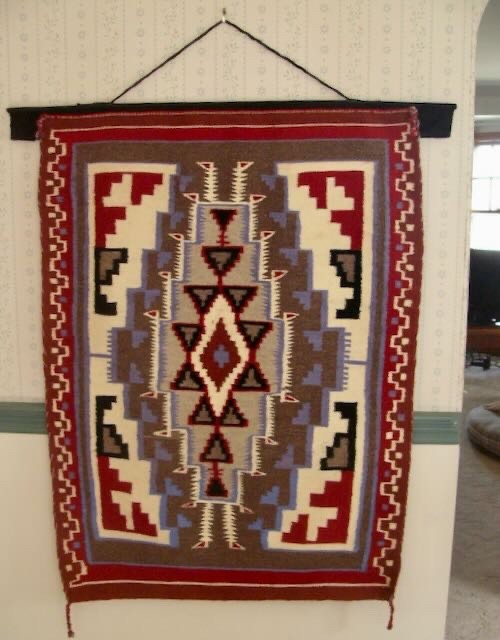
I purchased this vintage Navajo rug from the estate of a friend of my mother's, who traveled extensively while she lived and taught in Houston before retiring to Indiana.This is a Navajo regional style weaving that appears to draw inspiration from the Ganado or Klagetoh regional traditions, while featuring unique design elements like a lazy line and distinct corner treatments.Style and Design Analysis
- Regional Influence:The strong use ofGanado Redalongside a central diamond focal point, surrounded by natural greys, whites, blacks, and browns, aligns closely with theGanadoorKlagetohregional styles. However, the prominent inclusion of the light blue/lavender steps around the central diamond gives it a distinct personal variation.
- Weaving Technique (Lazy Lines):In the closer details of the central motif, diagonal lines or "breaks" in the weave can be seen. These are traditionallazy lines(diwozhí), which are a hallmark of authentic Navajo weaving. They occur when a weaver chooses to work on a specific section of the design comfort-wise without sitting across the entire width of the loom.
- Selvage and Edging:The close-up images show a dual-colored, twisted wool cords running along the sides (selvage cords) and neatly wrapped ends, which is characteristic of the traditional continuous-warp Navajo loom setup.
- Tassel Variations:It is highly common and historically typical for thetop corner tassels of a Navajo weaving to be slightly shorter, tighter, or different from the bottom tassels. When a weaver finishes a piece at the top of the loom, the remaining warp loops and selvage cords are secured very close to the final rows of weft, often leaving less excess length to create long, loose tassels compared to the bottom corners where the weaving began.
- Side Binding:The side edges feature whipped or overcast stitches looping around the side selvage. This method helps stabilize the edge tension and protect the rug when hung or used.
- Design Complexity: The inclusion of multiple colors—including carded grey, cream, black, a deep Ganado burgundy/red, and accents of blue—increases its complexity and visual appeal relative to strictly two-tone weavings.
- Weave Density & Symmetry: The lines appear sharp and symmetrical, indicating a skilled weaver.
- Condition: The edges and corner tassels (which are intact in the photo) are vital to maintaining value.
Style and Design Analysis
- Pattern Features: The design is highly typical of Navajo textile arts, featuring a prominent central diamond medallion surrounded by smaller geometric triangles, stepped terraced blocks, and serrated motifs. The alternating white and gray zig-zag borders flanking the center are classic visual hallmarks.
- Color Palette: The palette leans closely toward the Klagetoh and Ganado regional traditions, which are defined by their deep crimson/burgundy red borders, heavy use of natural sheep-gray fields, and stark accents of black and creamy white.
- Use Case: A 33"x45" size is a versatile dimension historically woven as a small floor covering or a wall-hanging tapestry, which aligns with the hanging loops affixed to the top edge in the image.
Design & Visual Characteristics
- Color Palette: It utilizes a classic, crisp palette of natural wool colors—carded grey, rich deep red, black, and cream—accented by a striking, vibrant light blue border detail. While traditional Ganado rugs typically rely heavily on a solid red background field, your piece relies predominantly on a carded gray center field accented by red, which is more emblematic of the closely related Klagetoh style.
- Construction: Excellent, tightly packed hand-spun weft threads. The presence of authentic continuous warp selvage cords along the sides, and the lack of a modern cloth backing or knotted fringe, point to a traditional upright Southwest loom construction.
- Navajo weaving is an expression ofHózhó(harmony, balance, beauty, and order).Rather than a written tale, the design tells a story of mathematical symmetry and regional tradition:
- The Center Eyedazzler/Diamond:The large, intricate central diamond structure with stacked serrated triangles radiates outward, representing the weaver’s complex internal planning and mastery over spatial geometry.
- Protection Borders:The dark outer borders and the geometric "stair-step" corner motifs frame the central energy, a visual structure meant to keep the design balanced and contained.
- Weaver's Intent:Every choice—from the carded greys and browns to the vibrant aniline reds and unique lavender-blue accents—reflects the personal artistic voice of the individual weaver working within their community's regional style.
- Serrated Geometric Layout:The complex serrated diamond styles heavily borrowed from early 1900sTeec Nos PosandGanadoregional patterns remained highly popular into the late 20th century.
- Yarn & Color Palette:The colors show sharp, bright definition. The use of a distinct lavender/light-blue shade alongside commercial-looking aniline red, deep burgundy, and naturally carded grey/brown wool is highly characteristic of yarn palettes available in the 1960s and 1970s.
- Side Selvage & Corner Tassels:Imagesshow the multi-strand, twisted corner tassels. These are the original finish points of a continuous-warp Navajo loom. The thick, purple-toned yarn used to bind the side edges (selvage) appears to be a protective whip-stitch added later or a heavy three-ply accent selvage typical of mid-century commercial wool integration.
- Weave Tightness:The close-up views show a moderately dense, uniform weave with tightly packed weft rows over the vertical warp cords, indicating a well-practiced, skilled mid-century weaver.
As far as shipping goes, I have had good luck with Fed Ex from this end. It seems quicker the USPS Ground Advantage. I have never used UPS, but wanted to present all three options.
Vintage Klagetoh Navajo Rug Handwoven Wool Native American Weaving 33.5"x43.5"
$950.00
Vintage Navajo Rug Klagetoh Style Wide Ruins Geometric Wool 28.5” x 18.5”
$299.00
Antique Navajo Rug Native American Indian Vintage Klagetoh 47x44 Textile Weaving
$415.00
