
1836 Vermont Innkeeper Tavern License Approbation West Haven Rutland County For Sale
When you click on links to various merchants on this site and make a purchase, this can result in this site earning a commission. Affiliate programs and affiliations include, but are not limited to, the eBay Partner Network.

1836 Vermont Innkeeper Tavern License Approbation West Haven Rutland County:
$217.55
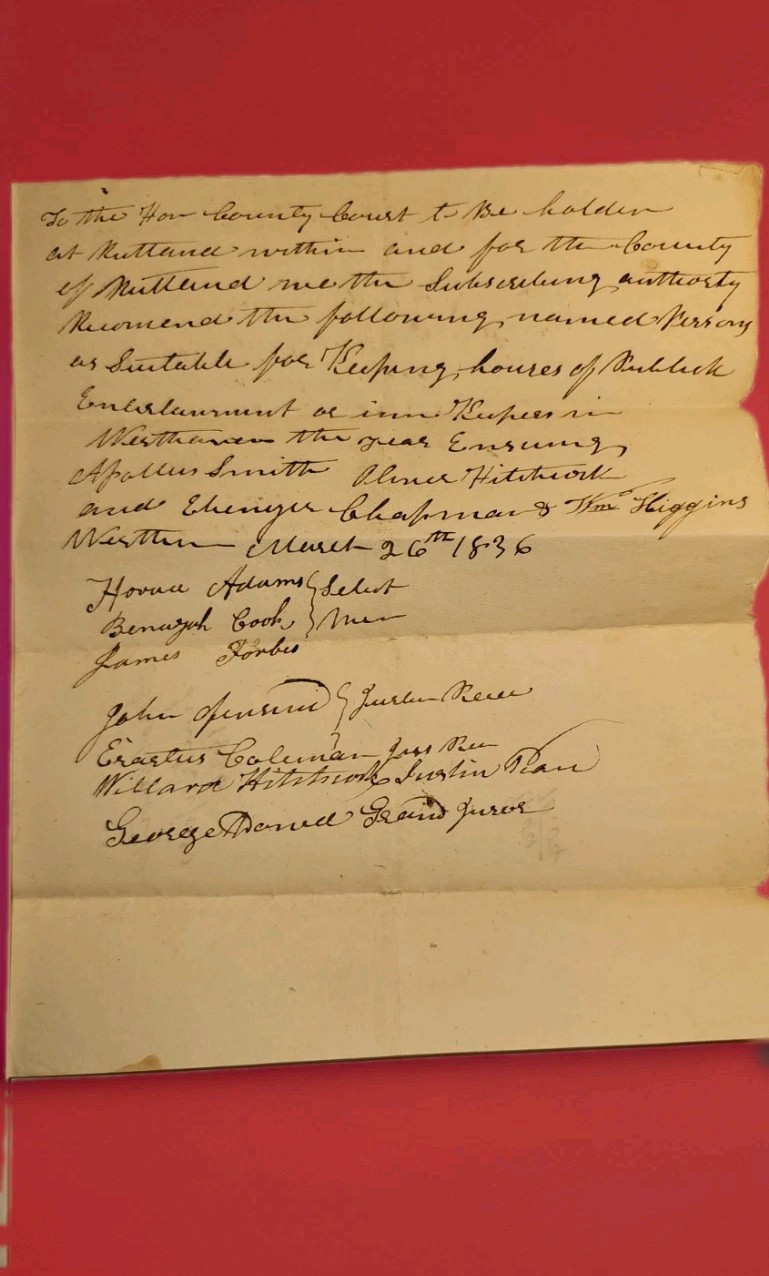
Offered here is an original manuscript Vermont tavern and innkeeper licensing approbation dated March 26, 1836, submitted by the civil authorities of West Haven, Rutland County, Vermont, to the Rutland County Court.
The document recommends Apollos Smith, Abner Hitchcock, Ebenezer Chapman, and William Higgins as suitable persons to keep “houses of Publick Entertainment or inn Keepers” in West Haven for the ensuing year.
This is an excellent example of the way early New England communities regulated taverns and inns. Operating an inn was not simply a private commercial matter: taverns functioned as important public spaces for travelers, meals, lodging, meetings, news, and local commerce. Prospective innkeepers were subject to licensing, and local authorities were expected to certify that applicants were appropriate persons to conduct such establishments.
The document carries the signatures of a particularly interesting group of West Haven civic leaders, including several men who also represented the town in the Vermont legislature.
The folded exterior is contemporaneously docketed:
Westhaven
Approbation for
Inn Keepers
1836
To the Hon County Court to be holden
at Rutland within and for the County
of Rutland we the subscribing authority
Recomend the following named persons
as Suitable for Keeping houses of Publick
Entertainment or inn Keepers in
Westhaven the year Ensuing
Apollos Smith Abner Hitchcock
and Ebenezer Chapman & Wm Higgins
Westhaven March 26th 1836
Horace Adams } Select
Benajah Cook } Men
James Forbes
John Sanford } Justis Peace
Erastus Coleman Just Peace
Willard Hitchcock
Justin Starr
George Downes Grand Juror
Verso / Docket:
Westhaven
Approbation for
Inn Keepers
1836
At the bottom are contemporary or later numerical notations:
9.04
10.04
Spelling and capitalization have been retained as written.
The Recommended InnkeepersApollos Smith
Smith was one of the four men approved to operate an inn or house of public entertainment in West Haven. He is particularly interesting because federal records establish an Apollos Smith as postmaster at West Haven, Vermont, well before the date of this document. The official federal register for 1816 lists “Apollos Smith” as West Haven’s deputy postmaster and identifies his birthplace as Connecticut.
The unusual name and exact West Haven association make this a strong candidate for the same man, although the document itself does not state his postal occupation. If the identification is correct, Smith represents the kind of individual commonly found at the center of early American village life: a man involved both in communications and in public hospitality.
Importantly, this is not Apollos “Paul” Smith of later Adirondack resort fame. Paul Smith was born in 1825 and would have been only ten years old when this document was executed.
Abner Hitchcock
Hitchcock was another of the four West Haven residents recommended for an innkeeper’s license. The Hitchcock family was firmly established in the community, and the document also bears the signature of Willard Hitchcock, then a Justice of the Peace and an important town officeholder. The precise family relationship between Abner and Willard should not be asserted without additional genealogical documentation, but their simultaneous appearance illustrates the prominence of the Hitchcock name in early West Haven.
Ebenezer Chapman
Chapman appears as the third recommended innkeeper. While readily identifying him beyond the document requires further genealogical work, the Chapman name occurs in the historical record of West Haven and Rutland County. His inclusion here establishes that in 1836 he was considered by the town authorities sufficiently respectable to be recommended to the county court for a public-house license.
William Higgins
Listed in the manuscript as “Wm Higgins,” he was the fourth prospective innkeeper. As with Chapman, the document itself is the strongest direct evidence presently available for his activity: by March 1836 Higgins was a West Haven resident seeking or receiving town approbation to operate a licensed inn or public house.
Horace Adams (1784–1866)
Adams was a West Haven selectman when he signed this document, but his civic career extended beyond town government. Vermont’s official historical roster records Horace Adams as West Haven’s representative in the Vermont House in 1836–1837, the exact period in which this approbation was issued, and again in 1845.
His signature therefore appears here at the moment he was simultaneously serving among West Haven’s principal municipal officials and entering state-level public service.
Genealogical records also place the Adams family firmly in West Haven during this period. A published family history identifies Lucy B. Adams as a daughter of Horace and Orra Adams of West Haven, Vermont.
Benajah Cook
Cook appears as one of the town’s selectmen. Selectmen formed the principal executive board of a Vermont town, administering municipal affairs and acting on local matters such as licensing recommendations.
A genealogical source records a Benajah Cook married in 1819 to Ruth Jennison; their daughter Julia Ann later married George Jakeway of West Haven. This establishes a Cook family connection with West Haven, although the exact identity of the signer should be treated cautiously unless further town records confirm the match.
James Forbes (1803–1882)
Forbes was a selectman in 1836 and subsequently became one of West Haven’s representatives in the Vermont legislature. Vermont’s historical legislative roster records James Forbes of West Haven as representative in 1838 and 1839, giving his life dates as 1803–1882.
Additional genealogical evidence identifies James Forbes as the father of Miriam Forbes, born April 15, 1826, who married Dr. James Sanford. Thus the signer belonged to a locally established West Haven family and moved from town office into state legislative service only two years after signing this document.
John Sanford
Sanford signs in the section occupied by the Justices of the Peace. As a justice, he would have exercised local judicial and administrative responsibilities, making his participation in an innkeeper approbation particularly appropriate.
The Sanford family was well established in the Rutland County area. Published genealogical material records members of the family in Castleton, West Haven, and Fair Haven during the nineteenth century, though further research would be necessary before assigning the signer a specific birth and death date.
Erastus Coleman
Coleman is one of the most historically significant signers on the sheet. He was an important early West Haven woolen manufacturer and industrialist. A nineteenth-century biographical account identifies Erastus Coleman and his wife Cornelia Billings as natives of Litchfield, Connecticut, and states that Coleman became a woolen manufacturer before settling in West Haven, where he died at about eighty years of age.
Local historical accounts further associate Coleman with early water-powered industry in West Haven, including carding, cloth production, and woolen manufacturing.
His public career was equally notable locally. Vermont’s official legislative roster records Erastus Coleman as West Haven’s representative in the Vermont House in 1828.
By 1836 he was serving as a Justice of the Peace and signing this licensing recommendation. The document therefore links early Vermont industry, local justice, tavern regulation, and state government in a single manuscript.
Willard Hitchcock (1796–1842)
Hitchcock was another prominent West Haven civic figure. Vermont’s official legislative roster records Willard Hitchcock as the town’s representative in the Vermont House in 1833, with life dates 1796–1842.
By the date of this document he was acting as a local magistrate or justice. Burial records also identify a Willard Hitchcock who died in 1842 and was interred in Hitchcock Cemetery, West Haven.
His signature adds another identifiable former state legislator to the document.
Justin Starr
Starr appears among the town officials signing the approbation. His exact office is less clearly labeled in the manuscript than those of the selectmen and Erastus Coleman, so it is preferable not to assign him a particular title beyond describing him as one of the subscribing West Haven authorities without additional town-record confirmation.
George Downes — Grand Juror
Downes is explicitly designated “Grand Juror.” In early Vermont town government, the grand juror was a local officer involved in enforcing laws and presenting violations for prosecution. His participation is particularly relevant in a tavern-licensing document because inns and public houses were closely regulated establishments.
The presence of the grand juror alongside selectmen and justices demonstrates that this was a formal governmental certification rather than an informal neighborhood recommendation.
Historical SignificanceThis document preserves an unusually concentrated snapshot of West Haven civic life in 1836.
Among its signers are:
Erastus Coleman, West Haven woolen manufacturer and former Vermont legislator; Willard Hitchcock, former Vermont legislator; Horace Adams, then serving during his own 1836–37 legislative term; and James Forbes, who would represent West Haven in 1838–39. Vermont’s official historical roster confirms each of these legislative associations.
It consequently has interest well beyond the four tavern applicants themselves. It documents the interaction of early Vermont tavern culture, local government, county courts, licensing law, transportation, hospitality and community leadership.
The identification of Apollos Smith is also intriguing because federal records show a man of that exact name serving as West Haven postmaster, suggesting a possible connection between two of the most important institutions for travelers in an early nineteenth-century village: the post office and the public house.
ConditionOriginal manuscript document with expected age toning, original folds and handling wear. There is visible edge wear and some paper loss/irregularity along the right-hand edge and fold areas. Ink remains generally strong and the principal text, names, signatures, date, and docket are readily legible. Please inspect all photographs carefully as they form an important part of the condition description.
A scarce original 1836 Vermont tavern-licensing manuscript with multiple identifiable civic and legislative figures, excellent Rutland County content, and strong appeal for collectors of Vermont history, early American taverns and inns, local government, genealogy, and manuscript Americana.
Related Items:
1836 Vermont Innkeeper Tavern License Approbation West Haven Rutland County
$217.55
Zelah Downer vs Calvin Carpenter & Chauncey Buell 1836–40 Vermont Trespass Case
$24.97
Proceedings of the Vermont Historical Society 1938–1940 9 Issue Great Condition
$32.00
