
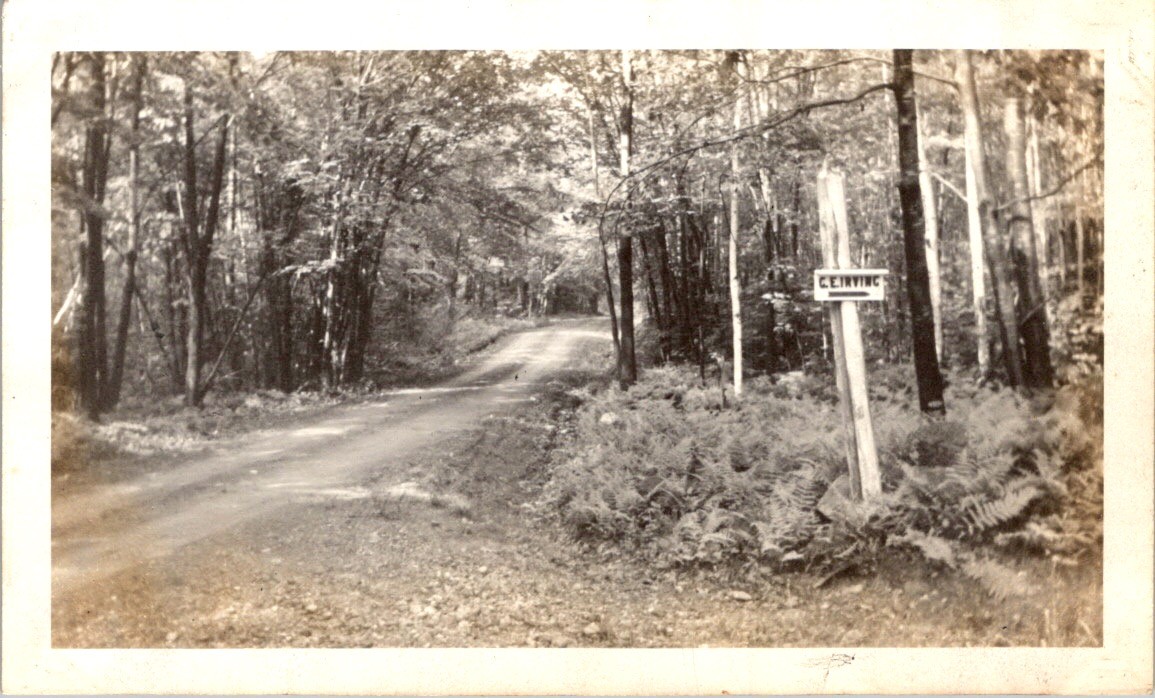
C.E. Irving Sign Forest Lane Sepia Photograph 1940s Gravel Road & Woods For Sale
When you click on links to various merchants on this site and make a purchase, this can result in this site earning a commission. Affiliate programs and affiliations include, but are not limited to, the eBay Partner Network.

C.E. Irving Sign Forest Lane Sepia Photograph 1940s Gravel Road & Woods:
$11.24
A narrow, unpaved road curves through a dense deciduous forest, its gravel surface catching the soft, diffused light of a summer or early autumn day. The track bends gently to the left before vanishing into the shadowed distance, flanked by tall trunks and a thick understory of ferns and low brush. On the right side of the road, a single wooden post supports a small, rectangular sign bearing the neatly painted or stenciled name “C.E. IRVING” above a directional arrow pointing into the woods. The sign is simple, functional, and without ornament, characteristic of mid-century rural wayfinding before standardized highway markers became ubiquitous. The forest canopy filters the sunlight, casting dappled shadows across the road and lending the scene a quiet, isolated atmosphere.The photograph is a black-and-white silver gelatin print with a warm sepia tone, likely dating from the 1930s through the 1950s based on the photographic paper’s surface quality, the white border, and the slightly rounded corners. The image carries the visual vocabulary of vernacular landscape photography, capturing a moment of regional American infrastructure where private property was marked with handcrafted signage rather than mass-produced municipal indicators. The unpaved road, the dense native vegetation, and the absence of any visible structures or vehicles place the scene in a rural or semi-wilderness setting, possibly in the northeastern United States or the upper Midwest, where such forested lanes and personalized directional markers were common on hunting camps, summer properties, or small family holdings. The name C.E. Irving suggests a landowner or resident whose property lay just beyond the turn, and the arrow implies that the road served as a semi-private access route. The print exhibits minor age-appropriate characteristics, including faint dust specks and slight surface wear, but retains a clear, legible image with good tonal range. The composition is straightforward and documentary in nature, reflecting the practical purposes of such photographs, which might have been taken to record property boundaries, document a rural route, or simply capture the approach to a family retreat. The interplay of light and shadow, the unassuming signage, and the undisturbed natural setting combine to evoke a sense of American pastoral life in the decades following the Second World War, when such quiet, tree-lined roads were still a common feature of the national landscape.
Related Items:
C.E. Irving Sign Forest Lane Sepia Photograph 1940s Gravel Road & Woods
$11.24

Monocled Captain C E Irving C B one last two surviving apprent- 1953 Old Photo
$6.26
1899-1900 Port Jervis NY Sewer Outlet Plans Delaware River Irving Righter 2 Maps
$70.16
